UPI Charges Explained: What Is MDR And Will Customers Pay For Transactions Above ₹2,000?
NPCI has announced a 0.4% MDR on eligible P2M UPI transactions above ₹2,000, capped at ₹300 per transaction, while customers will not be charged. Small P2PM merchants are exempt, while railways, telecom, insurance and fuel payments above ₹2,000 will attract a flat ₹5 MDR.

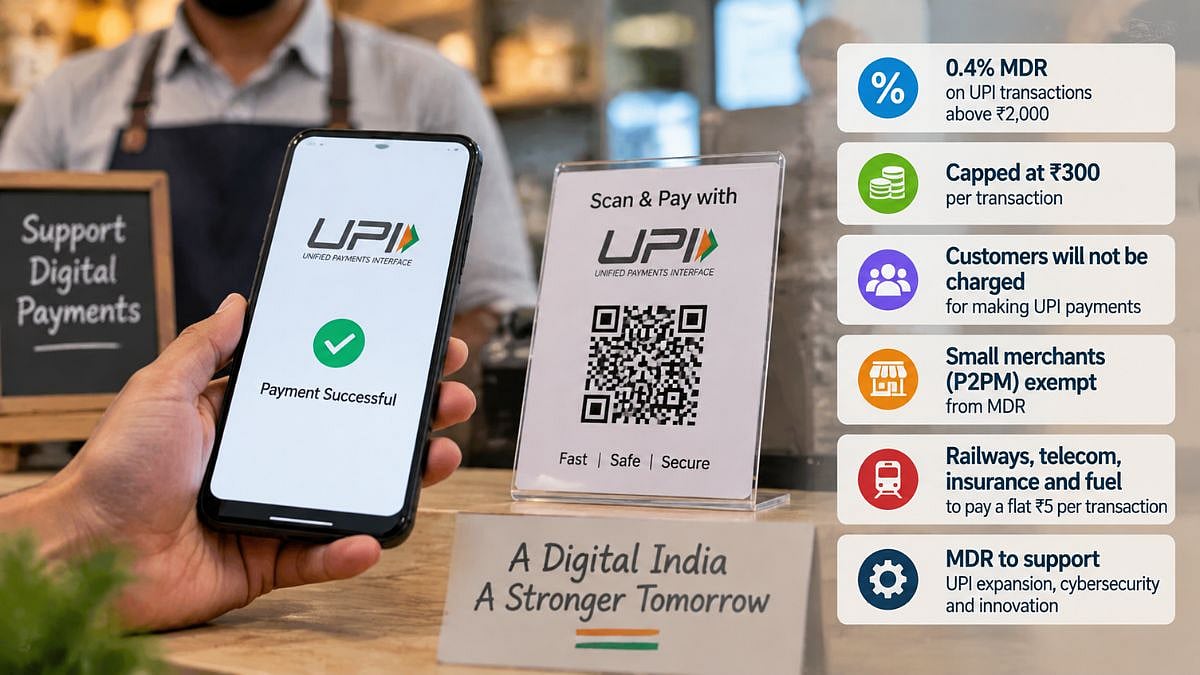
NPCI’s revised UPI framework introduces merchant charges on eligible high-value payments while keeping transactions free for customers | AI Generated Representational Image
Mumbai, September 15, 2026: The National Payments Corporation of India (NPCI) on Tuesday announced a 0.4% Merchant Discount Rate (MDR) on certain Unified Payments Interface (UPI) transactions to merchants when the payment exceeds Rs 2,000, while clarifying that customers will not be charged for making UPI payments under the revised system.
Under the new rules, Person-to-Merchant (P2M) UPI transactions above Rs 2,000 will attract an MDR of 0.4%. The charge will be capped at Rs 300 for a single transaction.
What Is Merchant Discount Rate?
MDR is a fee that banks and payment service providers charge merchants for processing digital payments. The amount can vary depending on the payment method, merchant category, transaction value and agreements between the businesses involved.
When a customer makes a digital payment to a merchant, the merchant generally pays a small processing fee to the bank or company handling the transaction.
While merchants are usually expected to bear the cost, some businesses may add it to the customer’s bill. This practice is more common for high-value card transactions, where MDR rules differ from those governing UPI payments.
Who Will Pay The MDR?
The 0.4% MDR will apply to P2M UPI payments above Rs 2,000. For transactions of Rs 75,000 or more, the fee will be capped at Rs 300.
For instance, a Rs 1,00,000 transaction would ordinarily attract an MDR of Rs 400 at the 0.4% rate. With the cap in place, however, the merchant would pay a maximum of Rs 300.
Small merchants covered by the Person-to-Person-Merchant (P2PM) framework will be exempt from MDR. NPCI introduced P2PM as a separate account category for small vendors receiving payments directly into their personal bank accounts.
According to NPCI, the small-vendor category covers merchants receiving up to Rs 1 lakh a month through UPI QR directly into their accounts. The framework is intended to encourage digital payments among small businesses and vendors in the unorganised retail sector.
Railways, Telecom, Insurance And Fuel Get Flat Fee
The percentage-based MDR will not apply to all merchant categories. Railways, telecom services, insurance and fuel are among the categories that will instead attract a fixed MDR of Rs 5 per transaction for payments above Rs 2,000.
These merchants will pay Rs 5 regardless of the total transaction value instead of the 0.4% MDR.
NPCI said the fixed fee is intended to keep costs under control for essential public services, utility payments and low-margin businesses such as fuel retailers.
Also Watch:
Where Will The MDR Collected Go?
NPCI said the MDR collected from high-value transactions will be distributed among different participants in the UPI ecosystem.
The measure is aimed at funding the expansion of UPI to more users and merchants while supporting expenditure on resilience, cybersecurity and innovation.
To get details on exclusive and budget-friendly property deals in Mumbai & surrounding regions, do visit: https://budgetproperties.in/
RECENT STORIES
-
-
-
-
-