Through The Economic Lens: Hey! Homo Sapiens, What’ve We Done?
With barely 73 years to live, why does humanity master wealth, technology and global markets, yet struggle to master itself?

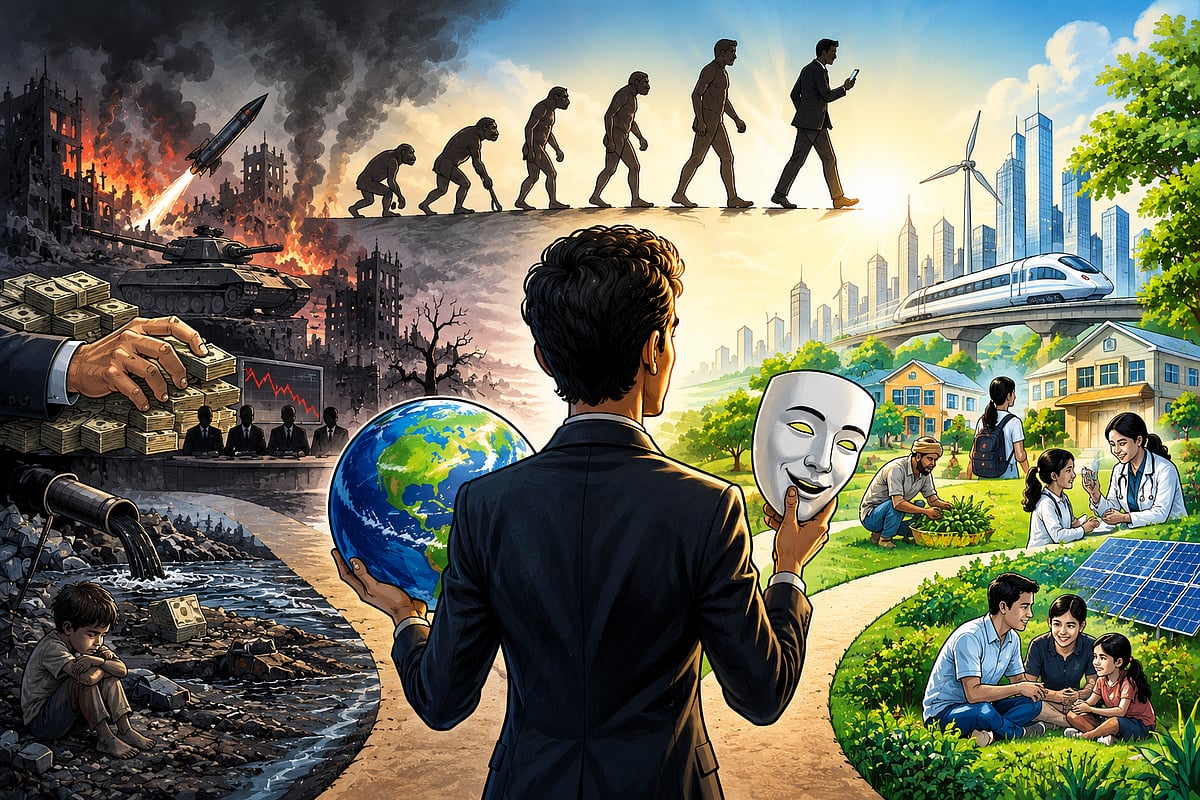
With barely 73 years to live, why does humanity master wealth, technology. |
Mumbai: AUGUST closes today, quietly withdrawing another 31 days from the one account no Homo sapiens can replenish: time. Tempted to turn the page? Another war. Another warning. I don’t care.
Bills arrive, loans demand repayment, targets follow employees home and phones refuse to sleep. Wars become notifications between breakfast and work. Sometimes “I don’t care” simply means: “I have too much to care about already.”
That is precisely why this is economics.
Global life expectancy at birth is roughly 73 years. Consider five leaders: Donald Trump is 80, Narendra Modi 75, Vladimir Putin 73, Xi Jinping 73 and Emmanuel Macron 48. Age does not determine wisdom. It reminds leaders and citizens alike of an equality no office, fortune or military power can overturn: human time is finite.
When Belief Became Wealth
Some 3.5 billion years ago, there were no currencies, corporations, governments or wars. There was chemistry.
From matter came life; from life, consciousness; then imagination. Eventually came Homo sapiens—not nature’s strongest creature, but perhaps its greatest co-operator.
We imagined nations, laws, companies and currencies—and persuaded strangers to believe together. Money works because strangers trust strangers; credit because tomorrow promises to honour today.
Civilisation converted belief into institutions. Trust became capital.
“We conquered scarcity, created wealth and taught machines to think. Yet humanity’s greatest unfinished experiment remains Homo sapiens itself.”
The Unfinished Human
Yet knowledge did not bury superstition, prosperity cure greed, or civilisation end war.
We create rules, then manipulate them: regulators breed loopholes, exchanges face price-rigging and reforms fresh bureaucracy. Manipulating institutions is among our costliest failures.
Consider war’s balance sheet. Six months of the U.S.-Israeli war on Iran have left at least 7,900 people dead. Washington puts its war cost at $37.5 billion. Hormuz traffic, above 100 ships daily before the conflict, has averaged seven. Brent crude soared from $72.48 to $120.88 a barrel, a 67 per cent surge, before easing to $88.58 on August 28—still 22 per cent higher.
Behind every number is a human cost.
Russia and Ukraine continue their arithmetic of destruction.
India’s developed-economy ambition raises a deeper question: developed for whom? RBI must defend monetary credibility, SEBI market trust, governments simpler administration—and businesses human dignity.
Profit gives enterprise oxygen. Greed suffocates its purpose.
The Next Human
AI and robotics promise abundance alongside concentrations of power. Will tomorrow’s human become wiser—or merely more powerful?
Economics teaches scarcity. Yet its rarest asset may be life itself.
No billionaire can purchase yesterday. No central bank can print another decade. No stock exchange can trade an additional hour.
After 3.5 billion years of evolution, we can split atoms, manipulate genes and teach machines to think—yet still fight over borders, beliefs, water, wealth and power.
Perhaps humanity’s greatest development deficit is no longer technological. It is wisdom.
Development and peace are economics’ ultimate balance sheet.
Before saying “I don’t care”, remember: you are already on it.
RECENT STORIES
-
-
-
-
-