India–EU Free Trade Agreement Concluded: A Strategic Breakthrough In India’s Global Trade Engagement
India and the European Union have concluded a landmark Free Trade Agreement at the India–EU Summit, unlocking major tariff cuts, services access and investment opportunities while deepening strategic economic ties between two of the world’s largest economies.

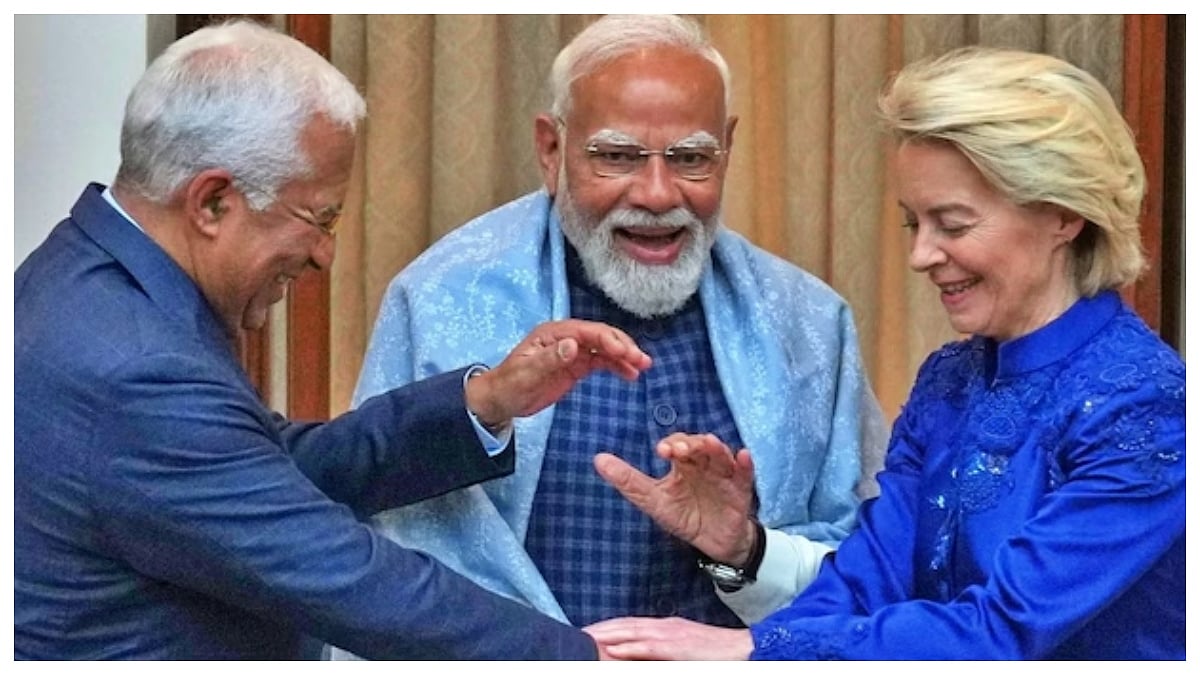
rime Minister Narendra Modi and European Commission President Ursula von der Leyen announce the conclusion of the landmark India–EU Free Trade Agreement in New Delhi | File Pic
Prime Minister Narendra Modi and European Commission President Ursula von der Leyen today jointly announced the conclusion of the India–European Union Free Trade Agreement (India–EU FTA) at the 16th India–EU Summit, held during the visit of the European leaders to India. This announcement marks a historic milestone in India–EU economic relations and trade engagement with key global partners.
The conclusion of this FTA positions India and the European Union as trusted partners committed to open markets, predictability and inclusive growth.
The FTA comes after intense negotiations since the re-launch of negotiations in 2022. The announcement of the FTA today marks the culmination of years of sustained dialogue and cooperation between India and the EU, demonstrating the political will and shared vision to deliver a balanced, modern and rules-based economic and trade partnership.
Trade figures and economic significance
The European Union is one of India’s largest trading partners, with bilateral trade in goods and services growing steadily over the years. In 2024–25, India’s bilateral trade in goods with the EU stood at INR 11.5 lakh crore (USD 136.54 billion), with exports worth INR 6.4 lakh crore (USD 75.85 billion) and imports amounting to INR 5.1 lakh crore (USD 60.68 billion). India–EU trade in services reached INR 7.2 lakh crore (USD 83.10 billion) in 2024.
India and the EU are the fourth and second largest economies, comprising 25% of global GDP and accounting for one-third of global trade. Integration of the two large, diverse and complementary economies will create unprecedented trade and investment opportunities.
Commerce Minister hails landmark agreement
Union Minister for Commerce and Industry Piyush Goyal lauded the strategic vision and steadfast leadership of Prime Minister Narendra Modi. He stated:
“The conclusion of the India–European Union Free Trade Agreement represents a defining achievement in India’s economic engagement and global outlook. This supports India’s approach to secure trusted, mutually beneficial and balanced partnerships.
Beyond a conventional trade deal, it represents a comprehensive partnership with strategic dimensions and is one of the most consequential FTAs. India has secured unprecedented market access for more than 99% of Indian exports by trade value to the EU, which also bolsters the ‘Make in India’ initiative. Beyond goods, it unlocks high-value commitments in services complemented by a comprehensive mobility framework enabling seamless movement of skilled Indian professionals.
India, powered by a young and dynamic workforce and one of the fastest-growing major economies, stands poised to leverage this FTA to create jobs, spur innovation, unlock opportunities across sectors and enhance its competitiveness on the global stage.”
Coverage across goods, services and emerging sectors
The India–EU trade pact covers conventional areas such as trade in goods, services, trade remedies, rules of origin, customs and trade facilitation, as well as emerging areas such as SMEs and digital trade, among others.
The India–EU FTA gives a decisive boost to labour-intensive sectors such as textiles, apparel, leather, footwear, marine products, gems and jewellery, handicrafts, engineering goods and automobiles, bringing down tariffs of up to 10% on almost USD 33 billion of exports to zero on entry into force of the Agreement.
Beyond enhancing competitiveness, it empowers workers, artisans, women, youth and MSMEs, while integrating Indian businesses more deeply into global value chains and reinforcing India’s role as a key player and supplier in global trade.
On automobiles, a calibrated and carefully crafted quota-based auto liberalisation package will not only allow EU automakers to introduce their models in India in higher price bands but also open possibilities for ‘Make in India’ and exports from India in the future.
Indian consumers will benefit from high-tech products and greater competition. The reciprocal market access in the EU market will also open up opportunities for India-made automobiles to access the EU market.
Boost to agriculture and safeguards for sensitive sectors
India’s agricultural and processed food sectors are poised for a transformative boost under the India–EU FTA, creating a level playing field for Indian farmers and agrarian enterprises. Key commodities such as tea, coffee, spices, fresh fruits and vegetables and processed foods will gain enhanced competitiveness, strengthening rural livelihoods, promoting inclusive growth and reinforcing India’s position as a trusted global supplier. India has prudently safeguarded sensitive sectors, including dairy, cereals, poultry, soymeal and certain fruits and vegetables, balancing export growth with domestic priorities.
Beyond tariff liberalisation, the FTA provides measures to tackle non-tariff barriers through strengthened regulatory cooperation, greater transparency and streamlined customs, Sanitary and Phytosanitary (SPS) procedures, and Technical Barriers to Trade disciplines.
Climate, CBAM and sustainability commitments
Through CBAM provisions, commitments have been secured, including a forward-looking most-favoured-nation assurance extending flexibilities if granted to third countries under the regulation, enhanced technical cooperation on recognition of carbon prices and verifiers, as well as financial assistance and targeted support to reduce greenhouse gas emissions and comply with emerging carbon requirements.
Services, mobility and professional access
Services, being the dominant and faster-growing part of both economies, will trade more in the future. Certainty of market access, non-discriminatory treatment, focus on digitally delivered services and ease of mobility will provide a boost to India’s services exports.
The FTA secures expanded and commercially significant commitments from the EU across key sectors of Indian strength, including IT and IT-enabled services, professional services, education, financial services, tourism, construction and other business sectors.
India’s predictable access to the EU’s 144 subsectors (which includes IT/ITeS, Professional Services, Other Business Services and Education Services) will provide a boost to Indian service providers and enable them to provide competitive world-class Indian services to EU consumers, while the EU’s access to 102 subsectors offered by India will bring in high-tech services and investment into India, resulting in a mutually beneficial arrangement.
On mobility, the India–EU FTA provides a facilitative and predictable framework for business mobility covering short-term, temporary and business travel in both directions. These enable professionals to travel between the two economies to provide services under different scenarios.
The EU and India are providing mobility commitments to each other for Intra-Corporate Transferees (ICTs) and Business Visitors, along with entry and working rights for dependents and family members of ICTs.
The EU has also offered commitments in 37 sectors/sub-sectors for Contractual Service Suppliers (CSS) and 17 sectors/sub-sectors for Independent Professionals (IP), many of which are sectors of interest to India, including Professional Services, Computer and Related Services, Research and Development Services and Education Services.
India also secured a framework to constructively engage on Social Security Agreements over a five-year horizon, together with a framework supporting student mobility and post-study work opportunities.
Additionally, India has secured access for practitioners of Indian Traditional Medicine to work under home title in EU member states where traditional medical practices are not regulated.
Financial services, IPR and technology cooperation
In financial services, the FTA promotes cooperation to advance innovation and secure cross-border electronic payments, while providing India with enhanced market access across several major EU member states. These provisions are expected to deepen financial integration and support the growth of financial services trade.
The FTA reinforces intellectual property protections provided under TRIPS relating to copyright, trademarks, designs, trade secrets, plant varieties and enforcement of IPRs, affirms the Doha Declaration and recognises the importance of digital libraries, specifically the Traditional Knowledge Digital Library (TKDL) project initiated by India.
The FTA is expected to facilitate cooperation in critical areas like Artificial Intelligence, clean technologies and semiconductors, supporting India's technological advancement.
A new chapter in bilateral engagement
The FTA is expected to substantially scale up trade, enhance export competitiveness and integrate Indian businesses more deeply into European and global value chains.
The India–EU FTA marks a new chapter in bilateral economic engagement, strengthening trade and strategic cooperation between India and the 27-member EU bloc. Cognisant of multifarious objectives placed on trade, the dynamic nature of trade, fast-evolving technologies and increasing regulatory complexities, the Agreement embeds multiple review, consultation and response mechanisms to deal with new, sudden challenges that may emerge in the future. The Agreement relies on strong stewardship and trust to deliver gains for both sides.
The EU becomes India’s 22nd FTA partner. Since 2014, the Government has signed trade deals with Mauritius, the UAE, the UK, EFTA, Oman and Australia, and announced a trade deal with New Zealand. In 2025, India signed trade deals with Oman and the UK and announced the conclusion of a trade deal with New Zealand.
The India–EU trade deal, along with India’s FTA with the UK and the EFTA, effectively opens up the entire European market for Indian businesses, exporters and entrepreneurs.
Also Watch:
Beyond boosting commerce, it reinforces shared values, fosters innovation and creates opportunities across sectors and stakeholders — from MSMEs, women and skilled professionals to farmers and exporters. Aligned with India’s vision of “Viksit Bharat 2047,” the FTA positions India as a dynamic, trusted and forward-looking partner on the global stage, setting the foundation for inclusive, resilient and future-ready growth for both regions.
To get details on exclusive and budget-friendly property deals in Mumbai & surrounding regions, do visit: https://budgetproperties.in/
RECENT STORIES
-
-
-
-
-