From Index To India’s Future: Ashish Chauhan On Markets, Discipline & Long-Term Wealth
In a conversation on Simple Hai!, NSE MD & CEO Ashish Chauhan discussed India’s capital market evolution with Vivek Law. He explained how indices like Nifty serve as reliable benchmarks, highlighted 30 years of market cycles, and stressed the importance of long-term discipline over short-term trading. Chauhan emphasised balanced asset allocation, professional advice.

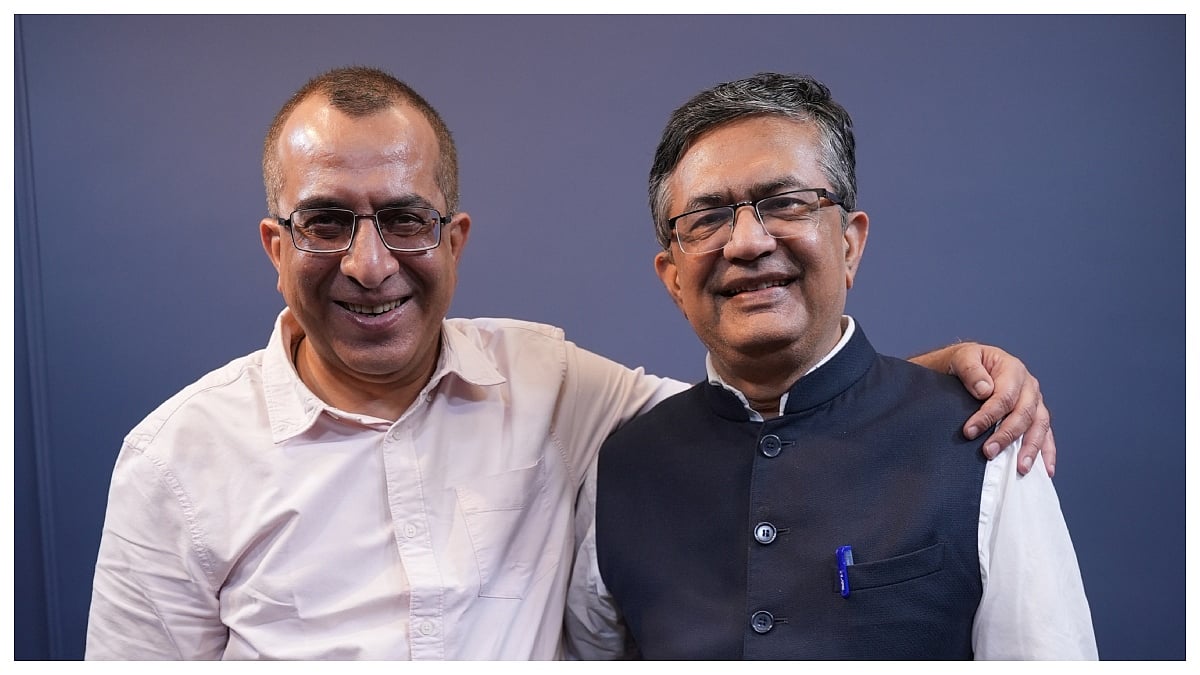
Vivek Law & Ashish Chauhan |
In a wide-ranging conversation on Simple Hai!, Co-founder & Editor-in-Chief Vivek Law spoke with Ashish Chauhan, MD and CEO of National Stock Exchange (NSE), on the evolution of India’s capital markets, the role of indices, investor behaviour, and why long-term discipline remains central to wealth creation.
Understanding Markets Beyond the Noise
The episode opened with Law introducing Chauhan as one of the key architects of India’s modern capital markets, recalling his early role in shaping market understanding for journalists and investors alike. As markets remain volatile, Law pointed to growing anxiety among investors and asked how they should view current conditions.
Chauhan responded by simplifying the idea of an index. Much like temperature reflects overall weather conditions despite individual variations, a market index reflects the broader movement of markets. It offers a reference point for investors to understand how portfolios may behave relative to overall market direction. He explained that when NSE began operations in 1994 with electronic trading, there was a need for a real-time benchmark. After extensive research and back-testing, the Nifty index was constructed with a scientific, algorithm-driven approach to avoid human bias. The aim was to create a benchmark that could broadly represent market movements and connect with diverse portfolios.
Three Decades of Cycles, Crashes, and Growth
Reflecting on 30 years of market history, Chauhan walked through multiple global and domestic disruptions, from the Asian financial crisis and the dot-com crash to the global financial crisis and the COVID-19 pandemic. These events saw markets fall sharply at different points, sometimes by as much as 40 to 60 percent. Yet over time, the trajectory remained upward. From a base of 1000 in 1995, the Nifty has grown significantly, while India’s overall market capitalisation expanded from roughly Rs 67 lakh crore to about Rs 450 lakh crore.
Investor participation has also seen a structural shift. From fewer than 2 crore investors earlier, the number has now grown to over 12 crore unique investors, with total accounts crossing 25 crore. This expansion reflects increasing trust in financial markets as a long-term wealth creation avenue.
ALSO READ
Liquidity, Trust, and the COVID Test
Law pointed to the uncertainty during COVID and asked how markets responded during such an unprecedented crisis. Chauhan highlighted that keeping markets open during the lockdown was a critical decision. Markets serve as a source of liquidity, allowing investors to access funds during emergencies. Even though markets corrected sharply, the ability to exit and access capital strengthened investor confidence. The subsequent recovery further reinforced this trust. Despite extreme pessimism at the onset of the pandemic, markets rebounded strongly, demonstrating the cyclical nature of investing.
Why Investors Struggle to Build Wealth
The discussion then shifted to investor behaviour. Law noted that despite long-term growth, many investors fail to create wealth. Chauhan attributed this to fear and impatience. Investors often exit during volatility, driven by the concern of losing hard-earned savings. This tendency pushes them toward safer instruments, even when equities offer better long-term potential. He stressed the importance of balanced asset allocation. A portfolio should include a mix of real estate, fixed deposits, gold, and equities, with equity exposure typically limited to a manageable proportion. He also cautioned against short-term trading, stating that frequent buying and selling is speculation rather than investing.
The Role of Expertise in Investing
Chauhan emphasised that most individuals lack the time and expertise to analyse markets in depth. Just as people rely on doctors for health, they should depend on financial advisors, mutual funds, or portfolio managers for investment decisions. Long-term investing, typically over three, five, or even ten years, remains essential for meaningful wealth creation. Reacting to daily market movements often leads to poor outcomes.
ALSO READ
India’s Growth Story and Market Potential
Law asked how investors should think about the future, especially in the context of India’s growth. Chauhan pointed to structural advantages that position India strongly for the coming decades. A young population, rising technology adoption, and increasing digital integration create a favourable environment for economic expansion.
He noted that India’s average age remains under 30, in contrast to ageing populations in countries such as Japan and parts of Europe. Combined with rapid adoption of digital infrastructure like UPI and high data consumption, India is emerging as a leader in technology usage. Over the past 30 years, markets have delivered returns of around 12 to 12.5 percent annually, compared to economic growth of about 6 to 7 percent. If India continues to grow at a similar or higher pace, markets are likely to reflect that expansion over time.
Derivatives: Utility Versus Misuse
Law raised concerns about derivatives trading, noting that what was originally designed as a hedging tool has increasingly been used for speculation by retail investors.
Chauhan acknowledged this shift, comparing derivatives to a tool like a knife, useful when handled correctly but dangerous when misused. While derivatives serve an important role in risk management, many retail investors engage in them without adequate understanding, often resulting in losses. He noted that regulatory concerns around protecting smaller investors are valid. Instead of relying solely on taxation measures, he suggested introducing eligibility criteria, such as income thresholds, to restrict access to complex instruments.
Market Structure, Innovation and Expansion
The conversation also explored broader developments in market infrastructure. Chauhan highlighted initiatives such as SME listings, mutual fund distribution through exchanges, and the introduction of the Social Stock Exchange. These efforts aim to deepen market participation, improve transparency, and extend the benefits of structured financial systems to a wider population. He emphasised that India has developed a robust market framework through collaboration between regulators, exchanges, and policymakers, which can now be applied to new sectors.
Personal Lessons and Financial Philosophy
Toward the end, Law asked Chauhan about lessons for young individuals entering the financial world. Chauhan reflected on the importance of building wealth while maintaining discipline and integrity. He noted that while money alone does not solve every problem, the absence of financial stability can create significant challenges. He also stressed that earning money is only one part of the journey. Managing and preserving wealth requires equal effort and understanding. Many individuals may become wealthy by chance, but sustaining wealth demands knowledge and discipline.
The Conversation Underscored A Central Idea
Markets are shaped by cycles, sentiment, and global events, but over the long term, they reflect economic growth and productivity. For investors, the path to wealth lies not in reacting to every fluctuation but in maintaining patience, discipline, and a long-term perspective. As India continues to evolve as a technology-driven, young economy, the opportunity for wealth creation remains significant for those willing to stay invested through the journey.
RECENT STORIES
-
-
-
-
-