Tome And Plume: Superstitions Associated With Pitru Paksha Have No Place In Hindu Scriptures
Pitru Paksha is traditionally observed through remembrance of ancestors, shraddha, tarpan and charity. In this bylined article, Arup Chakraborty questions popular taboos around purchases, haircuts and new clothes, and discusses Ujjain’s Siddhavat as a site of ancestral rites. His interpretations of scripture should be presented as the author’s perspective.

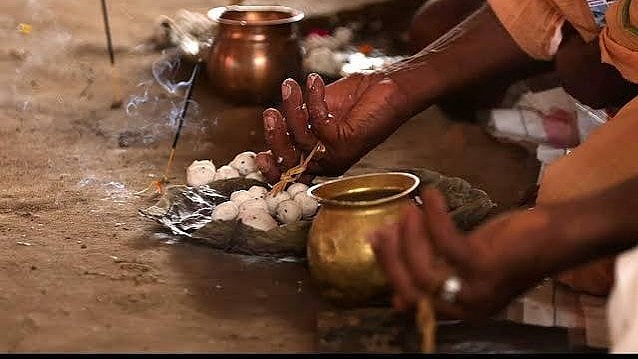
Tome And Plume: Superstitions Associated With Pitru Paksha Have No Place In Hindu Scriptures | Representative image
Bhopal (Madhya Pradesh): Karmanugo gachhati jiva ekaha – Garuda Purana (Wealth remains buried, cattle stay in the pen, wife accompanies to the doorway, friends to the crematorium, the body to funeral pyre, but on the path to eternity only your Karmas stay with you).
The 15-day Pitru Paksha before the Shardiya Navratri has remained dedicated to revering ancestors since time immemorial. Many deep-rooted superstitions, myths, and rigid taboos also stay tethered to this period across the country. But the core spiritual purpose of the period remains remembrance of our ancestors and showing gratitude to them.
Astrological anxieties, widespread social media stories, and fear-based beliefs have transformed the Pitru Paksha into a phase linked with bad luck and inauspiciousness.
Yet, neither the Vedas nor any other Hindu scriptures consider this period as inauspicious.
The Skandapurana, Matsyapurana, and Manusmriti only advise people to do good work and abstain from liquor, telling lies, and leading a luxurious life. The Garuda Purana also does not advise against buying, selling, and doing anything new.
Scholars of Indian scriptures, like Raja Bali Pandey, believed that the period remained associated with superstitions due to fear-based practices and astrological anxieties.
Some scholars feel the fear of the dead, astrological anxieties, commercial ritualism, and folklore gave birth to these superstitions.
They even say avoidance of haircuts, wearing new clothes, and buying a new vehicle have nothing to do with receiving the blessings or curses from ancestors.
According to Vedic astrology, Pitru Dosha reflects the karmic debts and family traits, and not a malicious ghost remains around trying to ruin one’s life.
Scripturally, Pitru Paksha has nothing to do with curses or evils. It is a period of austerity and simple living.
Some traditions believe our ancestors come in the form of crows. Many people feed crows to satisfy the souls of their ancestors. Likewise, a tradition of feeding cows also exists. This ritual shows universal charity and love of nature.
Ergo, superstitions associated with this period have emerged from local traditions and beliefs.
The Hindus and the Buddhists have the same tradition. Both remember their ancestors. According to the Ullambaba Sutra, Buddha’s disciple, Maudgalyayana, offered food to the Sangh to rescue his mother from the arena of hungry ghosts.
The Vedas command the remembrance and worship of ancestors (Pitrus); however, the specific calendar practice of doing so exactly during the 15 days before the Shardiya Navratri remains a tradition that emerged during the post-Vedic period.
The roots of observing the rituals during the Pritu Paksha in central India are tethered to the ancient city of Avantika (modern-day Ujjain), which has always been an integral part of the cultural heritage of the country.
The Skanda Purana, in the Avantika Khanda, talks about the Siddhavat Banyan Tree on the banks of the Shipra River, which is equal to the ancient Banyan Tree in Gaya in spiritual status.
According to the Skanda Purana, offering libations to ancestors under the tree, after taking a bath in the sacred Shipra River, frees the souls of the ancestors from the cycle of birth and death.
Sayanaarcharya, a fourteenth-century Sanskrit scholar, also speaks about the importance of remembering ancestors and offering libations to them during Pitru Paksha.
But the ancient Hindu scriptures, like the Garuda Purana, Manusmriti, Matsya Purana, and Vishnu Purana, reject any kind of superstitions associated with the 16-day period before Shardiya Navratri.
The scriptures say it is the time to smoothen the path of spirituality to get out of the cycle of birth and death. According to Hindu Samskaras by historian Rajabali Pandey, during this period, one should do charity (Dana) and spiritual duty (Shraddha). Thus, the 16-day period has nothing to do with ‘dos’ and ‘don’ts’.
Traditionally, remembering ancestors means respecting the souls that remain in the post-death and pre-birth stages. The Garuda Purana speaks clearly about these stages of life.
Tibetan Buddhism refers to the Bardo, a stage where consciousness no longer remains attached to a physical body and has yet to enter a new incarnation. The belief remains equivalent to the one rooted in the Vedas and the Upanishads. The Vedas call this state Antarbhava.
ALSO READ
RECENT STORIES
-
-
-
-
-