Tome And Plume: Scent Of Celebration Lingers Everywhere
As Navratri 2026 approaches, Bhopal prepares to welcome Goddess Durga with over 500 pandals. Beyond the festivities, Madhya Pradesh's goddess worship traditions stretch across centuries, reflected in Ashapuri's ancient temples, Udayagiri caves and archaeological discoveries in the Sone Valley. The celebrations blend seasonal beauty, devotion and cultural heritage.

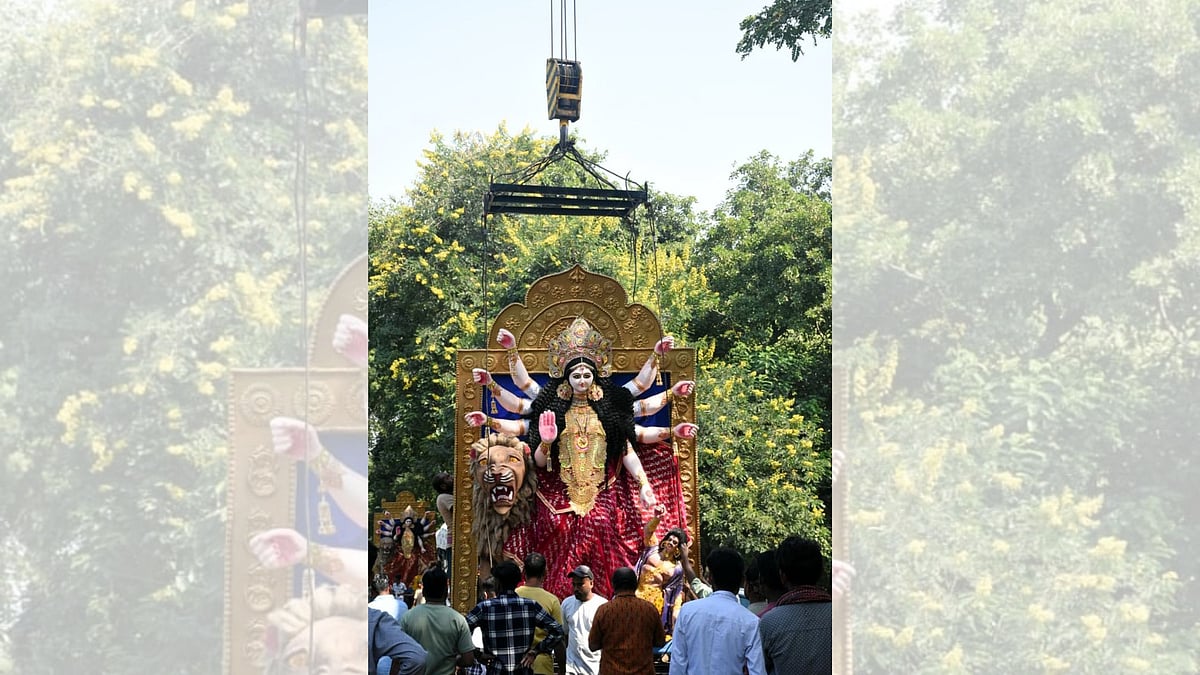
Tome And Plume: Scent Of Celebration Lingers Everywhere | FP photo
Bhopal (Madhya Pradesh): (O Divine Mother, You remove the suffering of everyone who seeks refuge in You; bless us with Your grace. O Mother of the entire universe, be pleased! O Ruler of the cosmos, protect this world. You are the supreme sovereign over all things living and non-living.)
Fall permeates the air. A light nip in the morning and in the evening rejuvenates the body and mind. The heady scent of Harshringar (coral Jasmine) and that of Saptaparni (Devil’s Flower) drift through the night.
Against this backdrop, the fragrance of the Navratri festival fills the air. Bhopal has geared up to welcome Cosmic Mother, Goddess Durga. Over 500 small and big pandals (tents) have come up at different places in the city, waiting for her idols to arrive.
The organisers of Navratri or Durga Puja festival remain busy with lighting arrangements and decorating pandals. The city’s links with the mother goddess have a hoary antiquity.
The story of that dim and distant past lies in the wellspring of Ashapuri, 36 km from the state capital. The excavations brought to light a cluster of 21 temples where archaeologists found sophisticated icons of Adishakti, Mahagauri, Maheshwari, and Vaishnavi. Thus, the state capital has stayed connected to the Divine Mother since time immemorial.
The institutionalised Shakti worship also stayed trendy during the Gupta period, nearly 1,600 years ago. The evidence found at the Udayagiri caves also indicates the city’s ancient links with the goddess.
One can visit the state archaeological museum to have a feel of its direct connections with the Cosmic Mother. The museum houses the sculptures of Goddess Durga and other feminine deities, belonging to the Kalachuri and Paramara periods from the sixth to the 11th century CE.
Many people may think the worship of Durga Puja has originated from West Bengal. The modernity of the worship may have emerged from that state, but worshipping the mother goddess in Madhya Pradesh holds timeless appeal.
Archaeologists found an 11,000-year-old shrine in the Sone Valley, Sidhi district, which they celebrate as the oldest known Hindu shrine in the world. It signifies that the worship of the Mother Goddess remained in vogue in the upper Palaeolithic or Mesolithic period. Ergo, the state stays connected to the modern-day Shaktism (goddess worship) for 11,000 years.
A team of archaeologists led by GR Sharma and J Desmond Clark excavated the site in the 1980s and hit upon a triangular sandstone covered with yellow pigment. The early men would worship the unique piece of stone as an idol of the Goddess of Shakti nearly 11,870 years ago. The site in the Sone Valley remains older than those found in the Indus Valley.
Archaeologists have kept the artefact in the museum of Allahabad University as a display for the students of history.
People visiting the site in the Sone Valley, Sidhi, can experience the tradition of worshipping the goddess until today.
The local tribal communities, like the Baiga and the Kol, continue to worship the identical natural triangular stones in shrines in the area, which they call Mai, Kali, or Kerai Ki Devi. The find indicates the people of Madhya Pradesh have maintained an unbroken chain with Mother Goddesses since time immemorial.
But as times changed, Ujjain turned into an epicentre of cultural and political activities. The place slowly grew into a cradle of Shakti worship and the composition of tantric texts. The Skanda Purana and the Devi Bhagvatam refer to the Avanti Shaktipeeth on the Bhairav Parvat. People worship Mahakali and Chandika at this place.
The idols of Mahisasur Mardini, or Goddess Durga, emerged from the description of the Markandeya Purana.
The idols of the goddess in different forms suggest that worship of the symbolic Yoni, or shakti, the manifestation of female power, fertility, and prosperity, pervaded the past. Early men, or nomadic hunter-gatherers, moved from one place to another in quest of food and shelter in the peninsula after offering prayers to the deity of the goddess.
Centuries after, the symbolic Yoni worship has evolved into diverse manifestations of the cosmic power.
ALSO READ
RECENT STORIES
-
-
-
-
-