Women’s Reservation And Delimitation: Reform Or Political Recalibration?
The debate over women’s reservation in India has intensified as the government links its implementation to delimitation and census exercises. Critics warn of delays, political imbalance, and reduced representation, while women’s groups demand immediate rollout without such conditions.

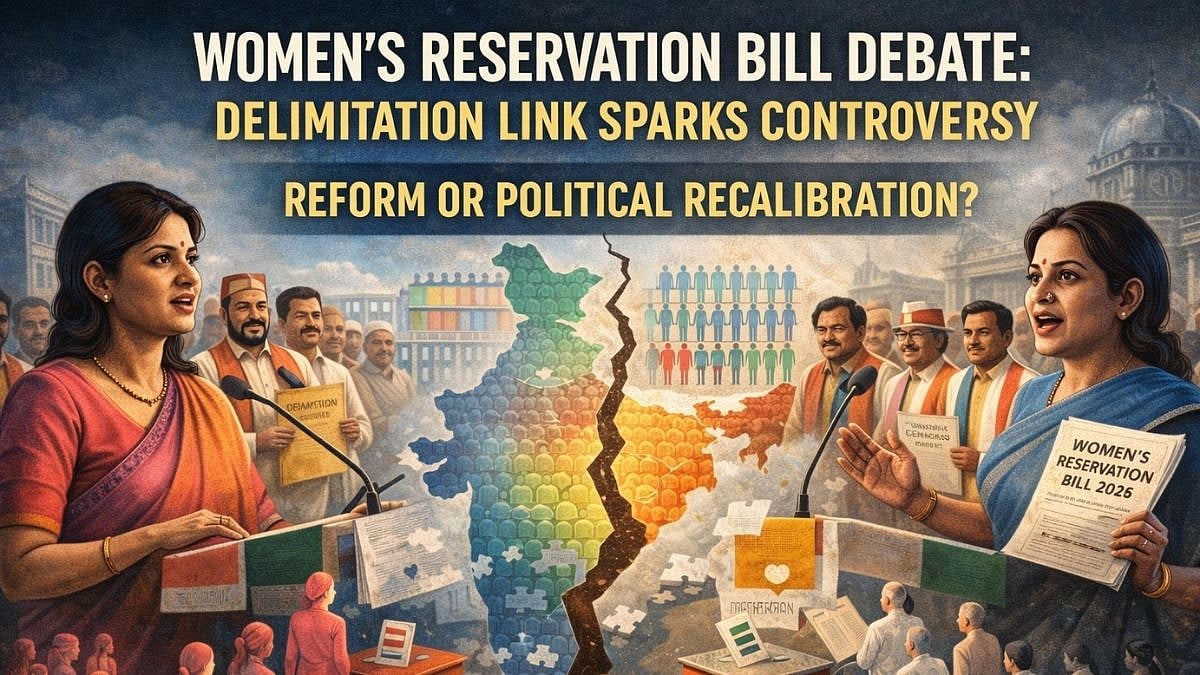
Debate intensifies over linking women’s reservation to delimitation and census in India’s political landscape | AI Generated Representational Image
Women have emerged as a formidable force in Indian politics. The numbers of women voters nearly match those of men in general and have been found to outmatch men in recent assembly elections. With 1.5 million women holding elected positions in Panchayati Raj institutions, they have proved their mettle in local governance.
Their numbers drop to 13.8 per cent in the Lok Sabha, and so the move to introduce the Women Reservation Bill in the three-day special session of Parliament is a welcome step. This constitutional amendment will raise women’s representation to almost one-third of the House, bringing it closer to global norms.
Debate over delimitation and census linkage
The Modi government has chosen to tie its rollout to the controversial delimitation exercise based on the 2011 census. The opposition parties have seen red. While some have described the delimitation exercise as a Trojan horse being brought in to stymie this 30-year-old WRB yet again, others question why a special session of Parliament has been convened just a few days before voting is set to take place in West Bengal and Tamil Nadu.
Critics also question why this delimitation exercise will be based on 2011 census data, given that a new census has been kickstarted this year. As Samajwadi Party leader Akhilesh Yadav said on the floor of the House, “If the SIR exercise could be completed in a period of two months in Bihar, why cannot the 2026 census be completed in a timely manner?”
Economists led by Prof. Santosh Mehrotra also question that, with the population crossing over 250 million from the last conducted census in 2011, why can’t the government factor in the latest census data before undertaking such a mammoth exercise?
The government has said that waiting for new census data would push delimitation—and with it women's reservation—well beyond 2029, thereby delaying a long-promised reform.
Opposition concerns and political implications
Reiterating the Congress position (which is also the position of several other parties), Congress MP Jairam Ramesh has gone public to state that when the Nari Vandan Adhiniyam (WRB), 2023, was being debated, the Congress had demanded its immediate implementation. The Modi government said it was not possible since both delimitation and the census had to be completed first. Why has the government changed its stand so abruptly on an issue that could end up deepening the faultlines between the northern and southern states?
There are concerns that the BJP wants to use the Census 2011 data because the latest census will include the OBC population data, and that could merit a re-apportioning of women’s seats. The Modi government has historically hesitated to include a detailed caste count in the census, driven by fears that it could shatter the "pan-Hindu" identity thrust that is central to the BJP politics, thereby triggering demands to increase reservation quotas for the marginalised groups.
Past delimitation exercises and their impact
There have already been two delimitation exercises undertaken by the Modi government. One is in J&K and the other is in Assam. Their findings are interesting and provide insights into how the disempowerment of Muslims seemed to be the primary objective behind both these exercises.
In Assam, the Election Commission undertook the exercise and used 2001 Census data rather than the Census 2011 data. Several constituencies were redrawn, ignoring traditional geographical boundaries, and, in the process, the influence of the Muslim community was reduced in around 15, which directly benefitted the incumbent BJP government.
In J&K, a Delimitation Commission (DC) was set up, led by Justice Ranjana Prakash Desai (retd), which used the Census 2011 data. The DC ended up altering the electoral balance in favour of the BJP by allocating six new assembly seats to Hindu-majority Jammu, even though it has a lower population than Muslim-majority Kashmir, which was given one new assembly seat.
Concerns from southern states and demand for transparency
So far, India has redrawn parliamentary seats three times based on the decennial census in 1951, 1961, and 1971. Since then, governments put a halt to this exercise, fearing an imbalance of representation due to varying fertility rates across states.
A fresh delimitation based on updated census data is expected to increase representation for states in the Hindi heartland, where population growth has been higher, potentially reducing the relative share of southern states.
Both Modi and Home Minister Amit Shah assured the House on Thursday that the current proportional share of states in Parliament will not be altered. It will be the responsibility of the Delimitation Commission to devise a formula that upholds this commitment. But the opposition-ruled states like Kerala, Telangana, Tamil Nadu, and Karnataka have expressed distrust in the government’s assurances.
Southern Chief Ministers Stalin, Siddaramaiah, Pinarayi Vijayan, and Revanth Reddy fear such an exercise will end up harming their states' political representation. They are demanding a transparent, consultative process, warning that such an exercise will effectively penalise states for their success in population control policies and for ensuring better economic progress than the states in the cow belt. These leaders also called for women's reservation to be implemented separately.
Tamil Nadu, Kerala, Karnataka, and Telangana had sought to extend the freeze on seat redistribution for 25 years. Tamil Nadu Chief Minister MK Stalin went to the extent of calling the delimitation plan “a massive, historic injustice”.
Calls for decoupling women’s reservation from delimitation
Given the tremendous impact the three pieces of legislation (WRB, 2026, and Delimitation Bills, 2026) will have on our democracy, these leaders, as well as the public at large, question why the bills have been introduced in this secretive, non-democratic manner just one day before they were introduced in the House.
Sixty women’s groups with over 500 signatories, which have been circulated to all members of Parliament, have also demanded a delinking of women’s reservation from seats’ delimitation. Their stand is that the WRB, 2026, wrongly links the census and delimitation to women’s reservation, which is a flat 33% of all legislative seats. If the government is determined to link women’s reservation to population counts, it should give women’s reservation of 48-49%, which is the demographic share.
Dr Radha Kumar, feminist, academic, and author, who is one of the signatories in the group, says, “We demand that state committees be set up whose membership will comprise a wide spectrum of political parties that can nominate suitable candidates. Their decisions cannot be overridden by the Election Commission.”
Dr S Y Quraishi, former Chief Election Commissioner, believes a way out of this conundrum would be “to have proportional representation decided according to the vote share”.
Concerns over representation and accountability
Even as this debate is going on, we cannot overlook the fact that the BJP does not have a record of being a woman-friendly party. A recent report by the Association for Democratic Reforms revealed that from the 151 sitting MPs and MLAs who have declared cases related to crimes against women in their election affidavits, the BJP tops the list with 54 MPs and MLAs. Some of these MPs have been found to be repeated offenders. Maybe it would help women gain greater confidence in the government if these accused were prosecuted.
Rashme Sehgal is an author and an independent journalist.
RECENT STORIES
-
-
-
-
-