When Constitutional Offices Become Launchpads For Political Careers
Former IAS officer Devashish Sharma’s move from Nagaon District Commissioner to BJP candidate has renewed debate over officials entering politics after holding public offices. The article examines examples involving bureaucrats, judges and Election Commissioners and proposes cooling-off periods and other institutional safeguards to address concerns over independence and public trust.

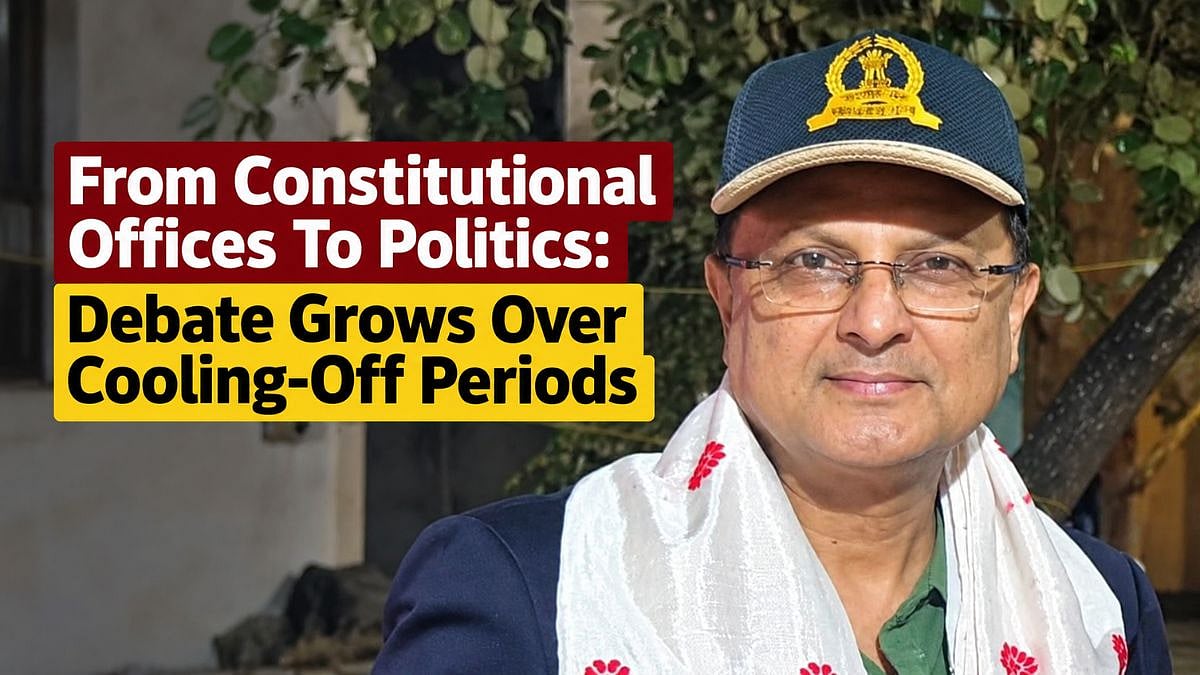
Devashish Sharma’s transition from Nagaon District Commissioner to BJP candidate has revived questions over post-retirement political roles | AI Generated Image (ANI)
The Congress party is making a big hue and cry over the BJP’s decision to nominate Devashish Sharma to contest the October 6 Lok Sabha by-election for the Nagaon seat of Assam. Sharma, an IAS officer, took voluntary retirement as Nagaon District Commissioner and was named to contest the election, indicating it was planned well ahead. He took VRS on September 3, formally joined the state’s ruling BJP on September 6 and was officially announced as the party’s nominee for the Nagaon by-election.
As District Commissioner, Sharma oversaw the recent Assam Assembly elections as District Election Officer in all eight Assembly constituencies in Nagaon district, five of which fall under the Nagaon Lok Sabha seat, from which Sharma will contest the election. Of these, Dhing was won by the Raijor Dal by a margin of 71,494 votes, Rupohihat by Congress by 69,766 votes, Samaguri by Congress by 108,310 votes, and Nagaon-Batadraba by the BJP by 61,984 votes, while the BJP’s other victory came in Raha, where it won by a comparatively smaller margin of 20,594 votes. This establishes that Sharma either did not try to influence the outcome or, if he did, he failed miserably, for which the BJP could not have rewarded him with the Lok Sabha nomination.
Bureaucrats Entering Active Politics
Sharma is not the first, and definitely not the last, bureaucrat to take VRS to plunge into active politics. The list is long and includes names like Mani Shankar Aiyar, Ajit Jogi, PL Punia, Yashwant Sinha, and several others. These bureaucrats have joined different parties at various stages.
Manohar Singh Gill, popularly known as MS Gill, was a unique case: an IAS officer who was picked as an Election Commissioner and went on to become Chief Election Commissioner in 1996. After completing his term as the CEC, he was subsequently elected to the Rajya Sabha on the Congress ticket and served as a Union minister in the Manmohan Singh government. The logical deduction then would have been that Gill must have obliged the Congress party in some manner to be rewarded with a post-retirement political assignment, though there is no such evidence in the public domain. Before him, two other Chief Election Commissioners, VS Ramadevi and TN Seshan, also went on to join the Congress party. Ramadevi became a governor, while Seshan flopped miserably in elections.
Judiciary And Post-Retirement Roles
The judiciary was not left untouched either. There is the example of Ranganath Misra, who, while serving as a Supreme Court judge, was tasked with probing the 1984 anti-Sikh riots. Misra submitted his contentious report in 1986 and was accused of concealing facts, as he did not name any Congress leader as being involved in these violent incidents. Misra retired as the Chief Justice of India in 1991, was appointed chairman of the National Human Rights Commission in 1993 and continued in the post till 1996. Subsequently, in 1998, he was elected to the Rajya Sabha on a Congress ticket.
Ranjan Gogoi was another example. He served as the Chief Justice of India for little over a year and headed a five-judge Constitution Bench that heard the controversial Ayodhya land dispute case, which had been pending for decades amidst claims that it was the birthplace of Lord Ram, while Muslims claimed the land belonged to them and that they should be allowed to reconstruct the razed Babri Masjid. The Bench heard the case for 40 days and delivered a unanimous judgement on November 9, 2019, just eight days before Gogoi’s retirement. Within four months, he was nominated by the then President Ram Nath Kovind to the Rajya Sabha in March 2020.
Questions Over Institutional Independence
Questions were raised then and will continue to be raised even in the future if political parties try to influence the Election Commission or even the Supreme Court through such appointments. Cases like that of Devashish Sharma, who theoretically at most could influence outcomes only in eight Assembly constituencies, appear very small.
There is a saying, ‘Is Hamam Mein Sab Nange Hain’, which aptly describes this malady. Every political party, in the states and at the Centre, has done something or the other to influence the executive and the judiciary, and some chosen ones have even been rewarded. Gill, Misra, Gogoi, and Sharma just represent them.
Call For Institutional Safeguards
The time has probably come to find an institutional solution to this problem that is threatening to eat into democracy like a termite. A cooling-off period can be an immediate step, but not a deterrent. Gill, for example, was made a Rajya Sabha member three years after demitting office as the CEC. While this subject needs to be debated to find a lasting solution, one step could be that, just as the President of India is debarred from contesting any election after retirement, those holding constitutional posts like judges and election commissioners should also be debarred from contesting elections. As for bureaucrats like IAS and IPS officers, a minimum three-year cooling-off period must be made mandatory, violation of which can mean losing their right to post-retirement pensions. And it must be done before the game of blame and counter-blame gets murkier, and allurements are offered by powers that be with promises of post-retirement lucrative offers. Merely finding fault with each other and having a holier-than-thou attitude might not redeem Indian democracy.
Ajay Jha is a senior journalist, author and political commentator.
RECENT STORIES
-
-
-
-
-