What Is So Vibrant About This Gujarat?
An opinion piece discusses alleged exploitation of women and girls in Vadia village, Gujarat, linking the issue to longstanding social and economic conditions. It describes how some families have faced difficult choices involving early marriage and prostitution, while social workers attempt interventions.

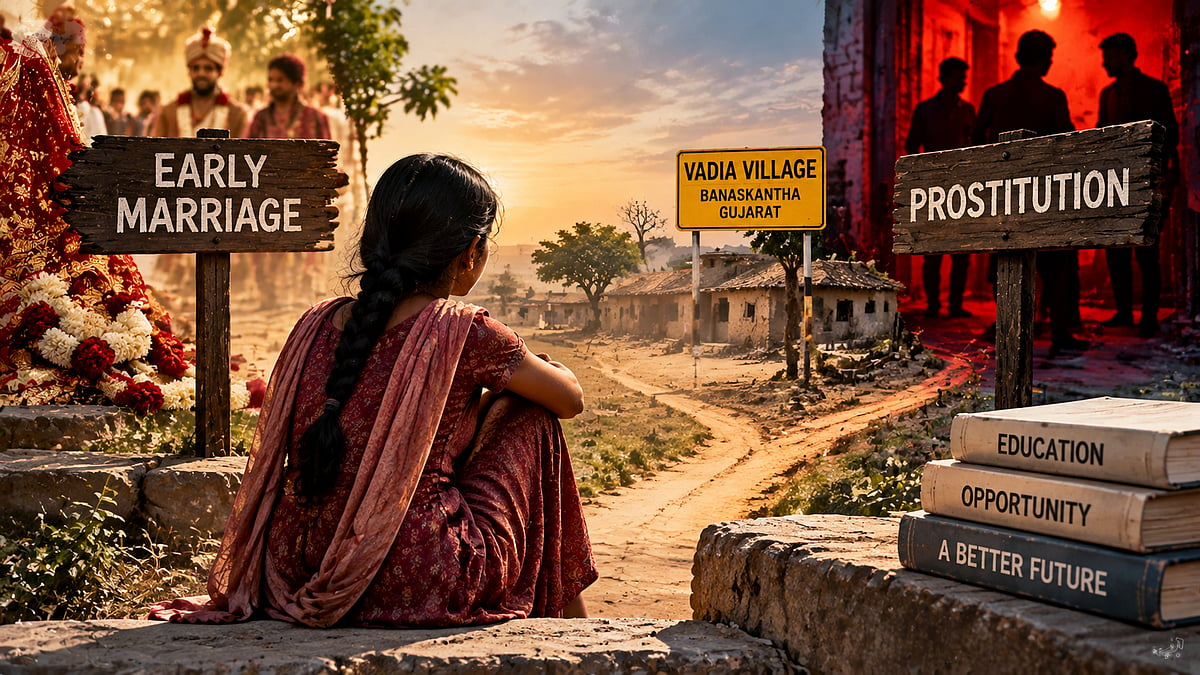
What Is So Vibrant About This Gujarat? | AI
Much has been written and talked about patriarchy and the exploitation of women in Indian media, from female infanticide and foeticide to dowry deaths, gender inequality, and sexual assault, and each time we get shocked by particular incidents and think that that is about as low as it can get, new lows are set by men in the name of societal norms. In its 79 years of freedom, India’s progress has done little to secure freedom for its women from the stranglehold of patriarchy, which continues to dictate terms as to what they should wear, how they should behave, and whom they should marry—basically a list of dos and don’ts on how they should live their lives in the country of their birth, if they are allowed to be born at all.
That minor girls in the Vadia village of the Banaskantha District of Gujarat are faced with the despicable choice between early marriage or prostitution points to not just the apathy and failure of the state but also the new low set by the men of the Saraniya nomadic tribal village. In the pre-independence era, the men worked as swordsmiths, sharpening arms for the warlords’ armies, while the women worked as “entertainers”, singing and dancing and providing sexual favours to soldiers. Freedom brought little change to women’s position in society. Out of work, post-Independence, the men took to soliciting their sisters and daughters for easy money. In cases where families were allotted agricultural land, lack of irrigation facilities in the drought-prone area forced women to take to prostitution as a source of income. The practice is widely prevalent to date.
In an attempt to break free from the age-old practice of prostitution, social workers encourage families to marry their daughters young despite knowing that child marriage is against the law. Their logic can’t be disputed: getting married at a young age is far better than being thrown into flesh trade. Marriage can open new avenues for girls, some of whom are getting educated and even considering having a career. However, isn’t it the duty of the government to ensure such practices are banned forever? Also, shouldn’t the government provide the necessary infrastructure to people so that they can earn an honest living with dignity? After close to eight decades of freedom, one would think so. However, Vadia stands as a classic example of government apathy and social indifference.
When we talk of India’s rapid transformation across the economic, technological, and infrastructure sectors, we, consciously or unconsciously, omit the social sector. And that is where the regression is most noticeable, as is reflected in the various social progress studies conducted worldwide, where India has consistently remained among the bottom few, be it the World Happiness Report or the World Gender Inequality Index. Despite Prime Minister Narendra Modi touting his vision of Beti Bachao, Beti Padhao, to protect and empower the girl child, with much fanfare, the scheme seems to have had little impact on the existing patriarchal norms. And so, 200 km from Ahmedabad, the economic hub of the state, the Vadia village stands out as the ugly underbelly of an otherwise Vibrant Gujarat.
RECENT STORIES
-
-
-
-
-