Washington’s Green Cards Or Moscow’s Cheap Oil: India’s Strategic Tightrope
India must balance discounted Russian crude oil, which supports energy security and helps contain inflation, against growing pressure from Washington over energy purchases and reported green card processing restrictions affecting major technology firms. Protecting strategic autonomy while maintaining US ties and countering China will test New Delhi’s diplomatic and economic priorities.

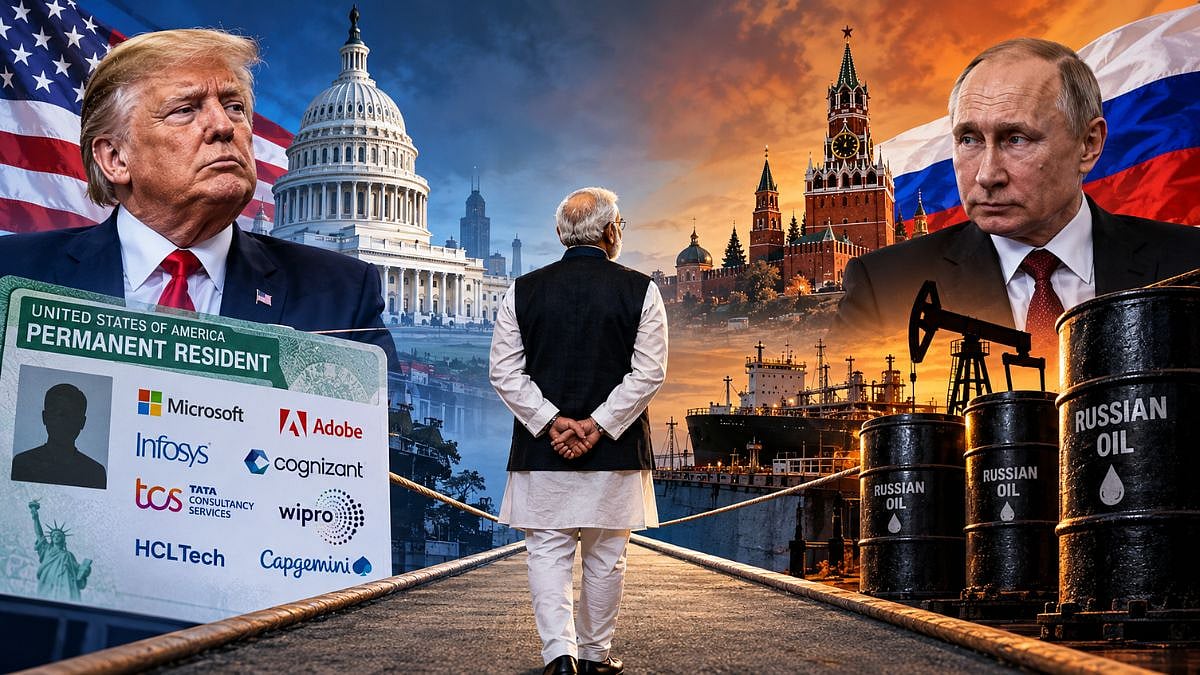
India faces mounting diplomatic and economic pressure as its reliance on discounted Russian crude intersects with Washington’s trade and immigration policies | AI Generated Representational Image
This past Sunday, October 4, External Affairs Minister Dr S. Jaishankar defended India's continued reliance on Russian crude oil and reiterated how Moscow has stood by New Delhi during some of the toughest times in India’s contemporary history. There was context to this seemingly abrupt statement of brotherhood.
On September 18, US President Donald Trump signed the ‘Sanctioning Russia and Iran Act of 2026 (SRIA)’ into law. It grants the US the authority to impose secondary tariffs of up to 100% on major global importers (the Act explicitly names India and China) that continue to buy Russian crude oil or natural gas.
Jaishankar was blunt. He said India's decisions are anchored firmly in its own national interest. Well, the EAM is right. Since Independence, India has practised strategic autonomy in its foreign policy. Now, it wants to practise strategic interdependence and involve itself in pointed interventions in a multipolar world.
As a recent example, New Delhi has moved to facilitate diplomatic channels between Russia and Ukraine on critical conflict areas, such as Black Sea shipping safety, grain exports, and energy supplies.
Washington’s Pressure On India
Thursday, October 8, presented an even bigger headache for India’s foreign policy apparatus. The Trump administration suspended major tech firms, including Microsoft, Adobe, Infosys, Cognizant, Tata Consultancy Services (TCS), Wipro, HCL Technologies, and Capgemini, from a US labour certification programme used by employers seeking permanent residency for foreign workers, blocking new applications and halting the processing of pending cases. Translation: all ‘green card’ applications are on hold.
The big question: Should India choose between cheap Russian oil or work with the US administration to build bridges with Trump over all that he and his crony capitalists are demanding?
It is not that simple. Energy is India’s single-largest import vulnerability. We are the world’s third-largest oil consumer, importing over 85% (or 5 million barrels a day) of our crude oil requirements. Last year, Indian firms spent $161 billion importing crude oil. Until 2022, Russian oil accounted for less than two per cent of India’s total oil imports. In August 2026, that figure jumped to between 35% and 40%. It is by using exactly this data point that Trump wants to arm-twist India into becoming an American subordinate.
Russian Oil As An Economic Lifeline
India faces a high-stakes diplomacy era; navigating this dilemma will be at the heart of India’s progress. Russian crude oil is an economic lifeline for India. It is cheap, it is plentiful, and the pipeline and processing infrastructure are in place. We may not realise it while buying groceries, but, were it not for Russian oil, India’s inflation would have been even higher.
New Delhi cannot kowtow to Washington; that’s a given. Besides, Russian oil is directly tied to India’s socio-economic development. Affordable energy directly lowers transportation, logistics, and fertiliser costs. A country already under severe inflationary pressure cannot afford sudden spikes in retail diesel and petrol prices that will add to the cost-of-living stress.
Discounted Russian barrels have saved India billions of dollars in foreign currency since 2022, providing Finance Minister Nirmala Sitharaman some breathing space on the fiscal deficit and allowing massive capital expenditures in public infrastructure, railways, highways, and healthcare.
There is a little-known fact: not every crude oil is the same, and each requires different technology and infrastructure to process. India’s advanced refining sector processes heavy Russian crude into products for domestic consumption and export, preserving manufacturing margins, generating employment, and keeping industrial electricity and transport costs stable.
The Venezuelan Oil Alternative
A few months ago, after Trump got Venezuelan President Nicolás Maduro arrested and extradited in a midnight raid, the US tried to push India into buying Venezuelan oil. This would have added to India’s costs. Venezuelan crude oil is extra-heavy and high in sulphur, whereas Russian crude oil ranges from medium-sour to lighter grades that flow more easily through pipelines.
These developments have stretched India’s foreign policy mandarins to their limits. India’s primary objective will be to safeguard the energy lifeline and historical defence relationship with Moscow while concurrently deepening its strategic partnership with the United States.
Balancing Washington, Moscow And Beijing
China and the US remain India’s top two trading partners, but independent of that, India is a crucial counterweight to an increasingly assertive China in the Indo-Pacific. A rupture on either front carries immense consequences because Russia and China already have what they term “a no-limits partnership”.
But how to navigate a transaction-driven approach with America? Historically, India’s “non-alignment” allowed New Delhi to sit out of Cold War rivalries, picking and choosing its partners based on issue-based alliances. In 2026, though, ideological neutrality is an expensive luxury. This means proving to the US that a strong, economically stable India is indispensable to American interests is as important as maintaining a distinct, independent channel with Moscow. The faster we shift to hard-boiled realism, the better.
The primary systemic threat to the rules-based international order lies in Asia, not Europe. Well, let’s name it: China. Jaishankar’s US counterpart, Marco Rubio, needs to be bombarded with this fact of life: India is an indispensable anchor for the success of the Quad and for maritime security in the Indian Ocean. Washington should view this broader strategic alignment as too vital to derail over cheap-energy transactions with Moscow.
Sachin Kalbag is a veteran journalist and editor. He has reported extensively from Washington, DC, and currently teaches foreign policy at St Xavier’s College, Mumbai.
RECENT STORIES
-
-
-
-
-