Uniform Civil Code: A Polarising Code Under Uniformity Cover?
The UCC debate reflects a conflict between individual equality and communities' rights to follow their own customs, the columnist argues. While supporters invoke secularism to demand equal laws, critics cite religious freedom and diversity. The writer says reforms should focus on gender justice and cites the 2018 Law Commission's call for eliminating discriminatory provisions within personal laws.

Uniform Civil Code: A Polarising Code Under Uniformity Cover? | AI
Ideological promises and proposals for a Uniform Civil Code (UCC) have been a contentious issue in India for decades, primarily because it involves the sensitive question of the relationship between religion and state. Seeking to replace religion-based personal laws governing marriage, divorce, inheritance, co-habitation, and other things like property rights with a common set of rules that apply to all citizens equally is a fair proposition. In India, personal laws governing marriage, divorce, and inheritance are rooted in religious scriptures and traditions. All major religious communities adhere to their respective personal laws.
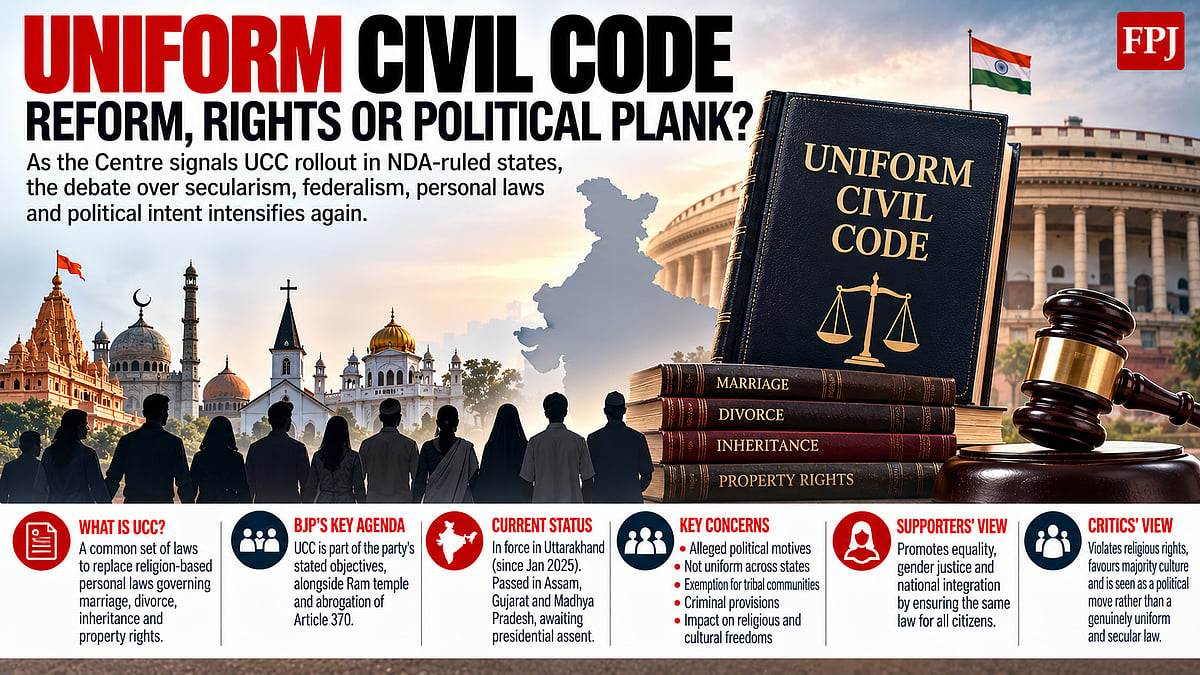
Ever since the Constitution was framed, the UCC has remained an ideal, as it envisages a uniform and secular code based on equality and social justice. However, political debates on creating a common civil code and its constitutional validity from the point of view of fundamental religious and cultural freedoms have had conflicting points of view. Implementation of the UCC has been one of the BJP’s stated objectives, along with the construction of the Ram temple in Ayodhya and abrogation of Article 370. But when political motives underscore the intent behind legislating a law that is supposed to be secular and uniform for all citizens and is given an ideological colour and majoritarian assertion masked by a broad narrative of uniformity, credible concerns and questions are bound to be raised over its roll out.
Union Home Minister Amit Shah recently indicated that the UCC would be implemented in all 21 states governed by the NDA before the 2029 Lok Sabha election. Uttarakhand was the first state to have the UCC in force since January 2025. Other states that have passed UCC bills are Assam, Gujarat, and Madhya Pradesh, which are awaiting presidential assent. The home minister's announcement of the UCC’s wider implementation has revived concerns over political motives behind the plan, given its timing and usefulness for the BJP to make the polarising issue its electoral plank in the next general election, alongside other contentious issues like the delimitation of parliamentary constituencies.
It is safe to presume that the centre has opted for state-enacted laws because it lacks the parliamentary majority to pass a central law. The point of concern with state-enacted UCC codes, according to media reports, is that they are not uniform—different states have enacted laws with different provisions, which contradicts their stated uniformity. Another feature of the UCC provision in force, and those awaiting implementation, is that it leaves out large sections of tribal populations, many of whom follow their own customs and practices. The exemption is said to be the saffron party’s way of avoiding political alienation of tribal communities whose vote is crucial for the BJP to win state and national elections.
Opposition parties and critics of the UCC have criticised the move and raised concerns over the code because it criminalises violations and, therefore, cannot be termed civil. They have raised questions about the stipulations of the code that impinge on the right to equality and the freedom of choice. In their view, a law that is neither uniform nor civil violates the constitutional rights of large sections of people, and, hence, it will not promote justice, unity, and other ideals of the UCC which are supposed to be uniform and non-discriminatory. Even some of the BJP allies in the NDA, like the JD(U) and the Telugu Desam Party, have reportedly expressed reservations about the UCC rollout in NDA-ruled states.
While the framers of the Constitution had highlighted the need for a UCC to promote national integration in a vastly diverse country like India by stressing that the state shall endeavour to provide a uniform civil code for its citizens, the UCC has remained a controversial issue for decades because it pitches group rights against individual rights. While it is seen as giving individuals the right to demand equal treatment, it is also perceived as an incursion into the rights of a group or community to set their own rules in matters such as marriage, divorce, and inheritance.
Both supporters and critics of the UCC base their arguments on secularism. The argument proffered by supporters is that secularism means the state shall treat all citizens equally, irrespective of their religious beliefs. In their view, it is wrong for a state to punish an individual for a crime for which another citizen cannot be punished mainly because the two individuals profess different faiths and beliefs—a valid argument as long as there is uniformity in law for all citizens without exemptions to certain groups or communities and there is no conflict between the UCC and one’s constitutional rights.
Critics of the UCC also use secularism to oppose the law, claiming that secularism means that all religions and beliefs must be respected equally. In their view, the UCC infringes on the rights of those who follow religions that have norms and customs that deviate from the UCC. The UCC is also opposed on the ground that it will only allow the majority Hindu community to follow its traditions and customs, while denying the same rights to people of other communities. This is a legitimate concern.
The problem with secularism that right-wing ideologues have is that they believe it is a foreign concept. The problem with uniformity is not that it cannot be achieved through dialogue, but that conflict arises when it is dubiously sought to be enforced under a cover by bypassing constitutional protections to pave the way for an all-encompassing majoritarian framework of dharma. Secularism is designed to be inclusive, regardless of the religion or non-religious worldview of all citizens. It was an integral part of ancient Indian culture, which was inclusive and diverse. It is a safeguard against bigotry and religious hegemony.
The important reason to reform civil laws is to ensure equal rights for women in matters of marriage, divorce, maintenance, and inheritance. In the Constituent Assembly, Dr BR Ambedkar advocated a UCC but suggested that it could remain voluntary. The Law Commission on Reform of Family Law (2018) opined that a UCC was neither necessary nor desirable at this stage. It advocated instead reforming discriminatory provisions across personal laws with an emphasis on achieving “equality within communities” between men and women rather than “equality between communities”. The Law Commission’s report should be thought about while legislating and implementing reforms in personal laws to ensure gender justice.
The writer is a senior independent Mumbai-based journalist. He tweets at @ali_chougule
RECENT STORIES
-
-
-
-
-