‘Times They Are A-Changin’, There’s Still Hope For India
Recent student protests over examination irregularities have expanded into a broader expression of youth frustration over unemployment, education reforms, infrastructure failures, and accountability. The piece highlights how social media-driven mobilisation and the influence of digitally connected young Indians are reshaping political debate and public engagement with governance.

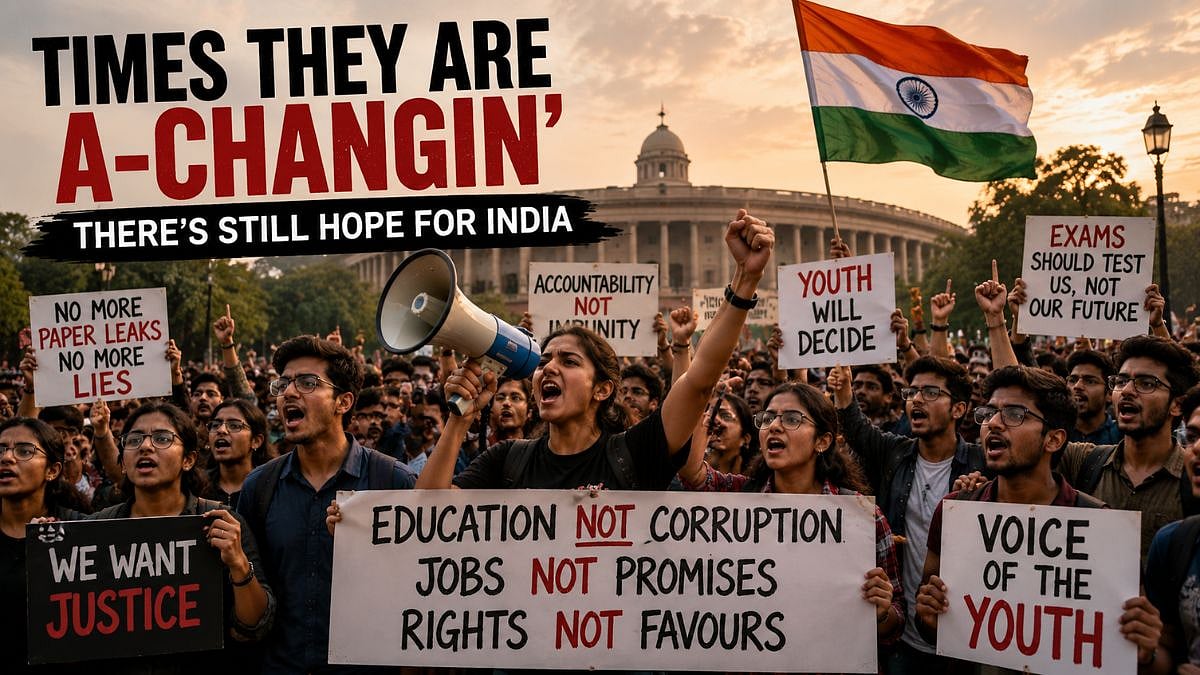
Student protests and youth-led mobilisation have reignited debate over accountability, education reforms, and the changing role of young citizens in India’s democracy | AI Generated Representational Image
A whiff of fresh air is blowing through the country. For the first time in twelve years, it seems as though the sense of fearlessness shown by Gen Z has helped galvanise the nation and renewed our faith in our democratic traditions. It reminded me of those heady days when the Emergency was lifted in 1977 and lakhs of people in Delhi spent hours walking to the Ramlila Grounds to hear leaders, including Atal Bihari Vajpayee, Jayaprakash Narayan, and Morarji Desai, speak out against the autocratic rule of Indira Gandhi.
I have often wondered how a Chief Justice could make such an off-the-cuff remark, describing young activists as ‘cockroaches’ and ‘parasites of society’. The word seems to have gained universal acceptance since we now have a Cockroach Janta Party, whose nuances and influence are being discussed across the globe.
It is obvious that the ruling elite has forgotten the fate of millions of young people who seem doomed to live under a growing spiral of unemployment. There is no other explanation for how millions of young people could come together in a matter of weeks to join a party with as weird a name as CJP. The sense of angst was so intense amongst them that they were willing to brave intense heat, tear gas, police lathis, and, as it turned out, even pellet guns to make their voices heard. Their demand: the Modi government take responsibility for all that was going wrong. Successive paper leaks were just part of the problem. The real issue was that the entire educational system was being overhauled without first putting in place proper alternatives. For example, the new system of marking that was introduced for the 12th board examinations. Students who took them reported that the ‘answer sheets’ did not match their handwriting.
Why were such massive changes being introduced at such a rapid pace when it was clear that the National Testing Agency had neither the manpower nor the skill to conduct examinations on this scale? The NEET papers were leaked in 2024 too. Even then, protesting students had sat on a dharna at Jantar Mantar and asked for the resignation of the education minister. Student protesters, then, were called ‘anti-national’ and ‘urban Naxals’, and their demand did not go through. Sadly, this is a story that has often been repeated.
During the past five years, as the National Crime Records Bureau data shows, we have witnessed over 200 major train accidents in which over 350 people have died and over 1,000 suffered serious injuries. The train accident in Balasore in Odisha killed nearly 300 people, many of them young, who were returning home from their places of work. Earlier, railway ministers, including Lal Bahadur Shastri, accepted their moral responsibilities and resigned, but the present railway minister, Ashwini Vaishnaw, refused to do so. Maybe it would be a good idea if senior members of his team began using the overburdened Mumbai locals that carry 8 million passengers daily just to understand what a ‘super-dense crush load’ feels like.
Or take the example of a small state like Uttarakhand, where an internal PWD study has highlighted how nearly 200 bridges have collapsed or are nearing collapse. The latest being a Rs 16 crore Nanda Ki Chowk bridge over the Tons River in Dehradun, where a section of the bridge was washed away on July 27, 2026, exactly two weeks after it was formally inaugurated on July 12. This complete lack of accountability has been one of the driving forces of this movement.
For the past twelve years, the BJP thought it was cool to make Congress leader Rahul Gandhi the butt of jokes on WhatsApp chats, videos, and online memes through their carefully orchestrated troll army. Petroleum Minister Hardeep Puri went to the extent of saying in the course of an interview that by demanding an enquiry into the Epstein files, “Rahul Gandhi was making an ass of himself”.
Following the NEET-UG paper leaks, when Rahul Gandhi demanded the resignation of Pradhan, the latter had sniggered at him, convinced that he was an indispensable part of Modi’s core team. Pradhan and other key BJP leaders did not expect that their long-standing dominance over the social media narrative would be disrupted so easily by the student brigade. The fact is that the CJP outmanoeuvred the government on Instagram. Within two weeks of its launch in May 2026, the CJP had amassed over 22 million Instagram followers, a following larger than even that of the BJP. The government had not expected this kind of a response.
Environmentalist Sonam Wangchuk had fasted on other occasions primarily to focus on the issue of greater autonomy for Ladakh and to highlight how this region’s fragile environment was being steadily destroyed. His earlier fasts failed to create a ripple in the corridors of power. But fasting in the heart of the capital was another story altogether. Not only did Wangchuk highlight the seriousness of the situation on the education front, but his fast also became a catalyst for a movement joined in by youth from other cities as well.
The biggest blow of this agitation has been to the Prime Minister himself; he has been forced to retreat under public pressure and ask for Pradhan’s resignation. Worse, the carefully constructed image of invincibility of the top leadership has been dented. This is not to say that so far we have witnessed any major changes in the education policy, apart from the government announcing fast-track courts and a high-powered task force to oversee examination reforms.
But the fact is that today 370 million young people are connected via smartphones and social media. They represent a quarter of the country’s population, and it is obvious that they are set to reshape our politics and, hopefully, economics as well.
Sadly, the government miscalculated because it was dealing with a spontaneous group of people who seemed to be following their own individual inner compasses. As Bob Dylan said in one of his songs, ‘Times they are a-changin’. Not only is there a sense of hope amongst all of us; there is also the conviction that the authoritarianism that had come to mark this government is finally being challenged by a bunch of cockroaches.
Rashme Sehgal is an author and an independent journalist.
RECENT STORIES
-
-
-
-
-