The Bar Council Of India Is Playing Politics
An opinion piece criticised the Bar Council of India’s response to a NALSAR student protest over a CJI’s invitation, while discussing Supreme Court observations. It said the BCI’s authority does not extend to law students before they become advocates. The article argued professional bodies must protect legal independence and allow peaceful dissent without undue pressure or disciplinary action.

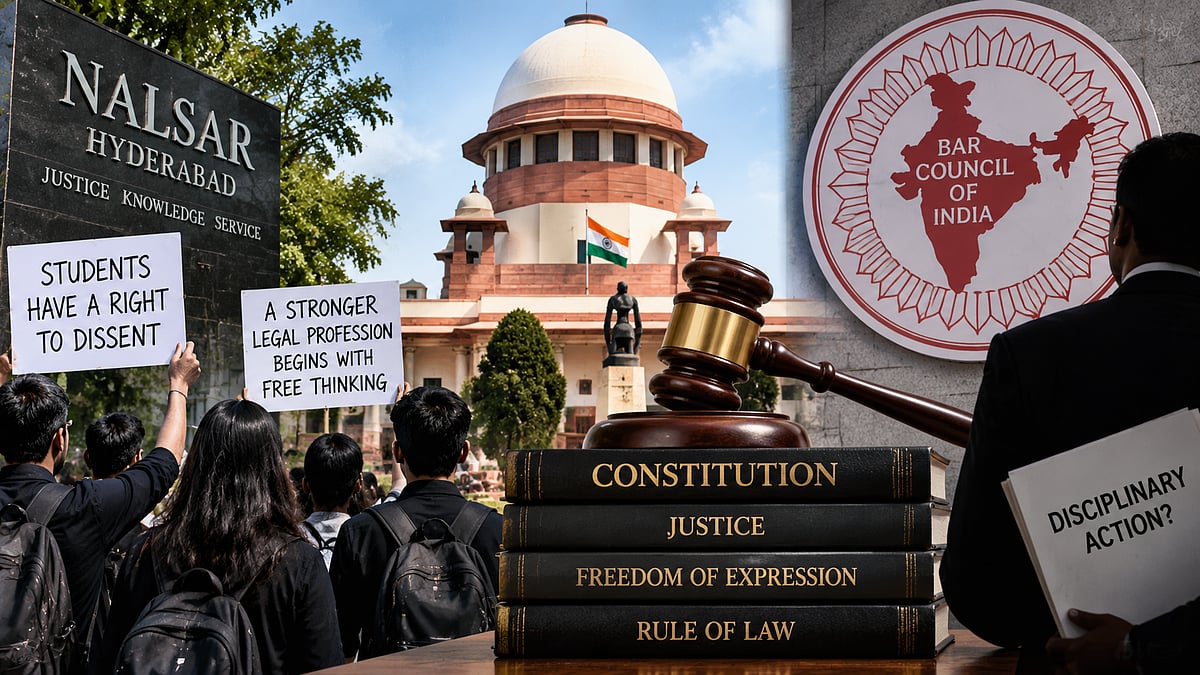
The Bar Council Of India Is Playing Politics | AI
The Supreme Court has had to rap the Bar Council of India (BCI) on the knuckles on two consecutive days. The Council and its office-bearers have only themselves to blame. What is particularly disturbing is the impression that, in its eagerness to please those in power, the BCI has forgotten the limits of its own authority. An institution meant to safeguard the independence and dignity of the legal profession should be the last to behave as though its principal duty is to demonstrate that it is more loyal than the king. Consider the case of the National Academy of Legal Studies and Research (NALSAR), Hyderabad. Its students objected to Chief Justice of India Surya Kant being invited to deliver the convocation address. Ordinarily, there could hardly be a more appropriate choice for a law school. But the students were upset by his controversial observation about “cockroaches and parasites”. Their protest may have been misguided or disagreeable, but that does not make it illegitimate. Students are entitled to disagree, and peaceful protest is not a disciplinary offence simply because it embarrasses a powerful person.
There is nothing unusual about students refusing to play along with authority. At a recent felicitation ceremony in Kerala, a large group of meritorious students responded with deafening silence when the vice-chancellor sought their response to a slogan. They were repeatedly prodded, but they refused to oblige. It was an unmistakable expression of dissent, yet nobody suggested ruining their academic growth. The BCI, however, chose to adopt precisely such a punitive approach. It wanted the NALSAR authorities to initiate disciplinary proceedings against the students and even sought to create roadblocks to their enrolment as advocates. The Supreme Court has made it clear that the BCI’s disciplinary authority begins only when a person enters the legal profession as an advocate.
There is an added irony. The three-member Bench that heard the matter was headed by Chief Justice Surya Kant himself. There is no indication that he sought punitive action against the students. The person determined to punish them was BCI chairman Manan Kumar Mishra, who is a BJP leader. That coincidence cannot be ignored when questions are being raised about the Council’s conduct. A day earlier, the court had questioned Mishra’s authority, pointing out that he was only a pro tem chief. He and his colleagues were asked to consult the Attorney-General and the Solicitor-General before taking policy decisions. The two orders expose a larger problem. Professional institutions cannot retain their credibility if political affiliations begin to influence their functioning. Tomorrow’s law students are the ones who may have to challenge governments, defend unpopular citizens, and protect constitutional freedoms. An institution that seeks to silence them today risks weakening the very profession it is supposed to protect.
RECENT STORIES
-
-
-
-
-