Tarique Rahman’s Return Reopens Bangladesh’s Old Fault Lines In A New Power Struggle
Tarique Rahman’s return from exile has reignited Bangladesh’s deepest political divide. With the Awami League sidelined and Islamist forces rising, his homecoming marks a high-stakes battle over post-Hasina Bangladesh—one that could decide not just power, but the future of democratic rule itself.

Tarique Rahman’s Return Reopens Bangladesh’s Old Fault Lines In A New Power Struggle |
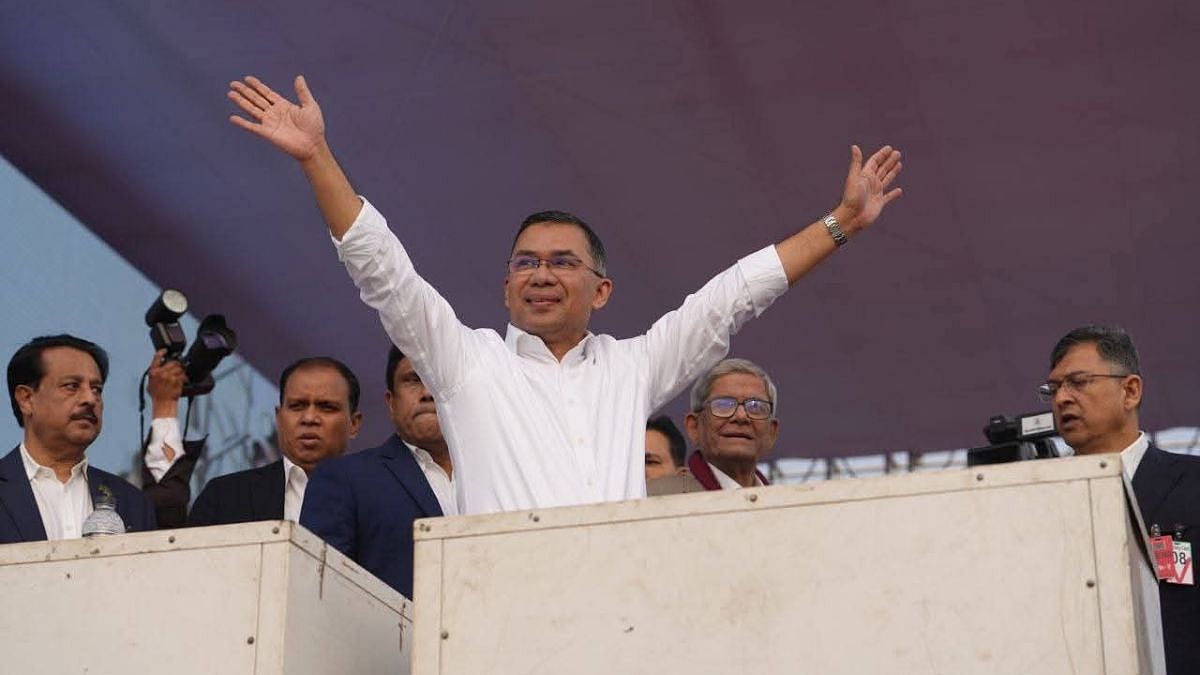
Tarique Rahman’s return to Dhaka after seventeen years in exile from far away London was not merely the prodigal’s homecoming, in more ways than one, it was the reopening of Bangladesh’s most enduring political fault line.
The controversial heir to the Zia dynasty arrived in a country profoundly altered by the collapse of Sheikh Hasina’s Awami League, the rise of Islamist and student-led forces, and the uneasy stewardship of an interim regime led by Muhammad Yunus.
The massive crowds, an elaborately secured motorcade, that greeted the “prince” was watched over by an equally hostile other half of Bangladesh, some of whom saw his homecoming as a hurdle to the “New Bangladesh” they wanted to create by muzzling the media, turning the societal foundations from liberal to Islamists as also by Awami Leaguers who see him to be an interloper who cannot be trusted to keep Bangladesh on the path to progress.
His rally, framed around “peace” and national unity, was less a victory lap than the opening move in a high-stakes contest over who will define post-Hasina Bangladesh, while leaving open the question of whether Hasina and the Awami League can be written off at all.
Rahman’s rhetoric was deliberately conciliatory. He spoke of Muslims, Hindus, Buddhists, and Christians belonging to one political community, of Gen Z revolutionaries rescuing the country in 2024, and of the need for safety and economic rights.
The repetition of the word “peace” was striking in a nation now accustomed to street battles, assassinations, and the domination of public spaces by Islamist mobs.
Yet the symbolism ran deeper than tone. By invoking 1971 and 2024, Rahman was inserting himself into Bangladesh’s historical narrative of revolt and renewal, claiming that the BNP, not the Islamists or the interim government, is the legitimate inheritor of that lineage.
The problem for Rahman is that history also weighs heavily against him. During his mother Khaleda Zia’s second premiership from 2001 to 2006, Tarique was widely seen as a parallel power centre, presiding over corruption, cronyism, and the deepening entrenchment of Islamist militant networks such as Jamaat-ul-Mujahideen Bangladesh and Harkat-ul-Jihad Islami.
He was convicted in absentia for money laundering and in connection with the 2004 grenade attack on an Awami League rally that killed 24 people, including Ivy Rahman, and permanently injured Sheikh Hasina.
While his supporters argue that he was selectively persecuted by a military-backed caretaker regime, these allegations remain central to how the army, civil society, and Bangladesh’s foreign partners view him.
Yet, politics is shaped not by reputations alone but by the vacuum created by Hasina’s downfall. The Awami League, which ruled uninterrupted from 2009 until 2024 and once commanded a vote share of up to 40 per cent, has been banned from contesting elections. Many of its leaders are jailed or in exile.
That exclusion has fundamentally distorted the political marketplace. It is this reality that makes Rahman’s return so consequential: with the largest party off the field, the BNP becomes the only nationwide, supposedly secular-nationalist force capable of contesting power.
That advantage, however, is eroding. Since the student-led uprising that toppled Hasina, Islamist forces have moved aggressively to occupy political and physical space. Jamaat-e-Islami, historically a junior partner to the BNP with a 5-12 per cent vote base, has consolidated its organisation and visibility.
Even more disruptive is the emergence of the National Citizens’ Party, a Yunus-backed ‘King’s party’ led by protest veterans whose ideological roots lie close to political Islam and who view both the BNP and Jamaat as compromised relics.
The killing of student leader Osman Hadi has injected a powerful martyrdom narrative into this Islamist-leaning camp, further fragmenting the field.
Yunus himself occupies a paradoxical role. His interim administration has gone out of its way to facilitate Tarique Rahman’s return, clearing legal obstacles and enabling a mass welcome.
In doing so, it has strengthened the BNP as a counterweight to Jamaat and the student radicals.
At the same time, Yunus relies on those very Islamist-tinged student networks as his political shield. The result is a balancing act in which Rahman is simultaneously empowered and constrained. He has been welcomed back as the heir to a nationalist legacy, yet he will continue to face distrust of sections of the army and by the new ideological gatekeepers of post-Hasina politics.
Electorally, Rahman remains the front-runner, but not the inevitable victor.
A December survey by the International Republican Institute shows the BNP leading, but the absence of the Awami League has turned what should have been a straightforward transfer of power into a volatile, three-cornered struggle.
Much will depend on how first-time voters—an unusually large cohort aged 18 to 21—and women respond to Rahman’s blend of dynastic familiarity and reformist promise.
His appeal to “peace” is clearly aimed at voters exhausted by chaos but wary of both Islamist militancy and the authoritarian habits of the old parties.
There is also the Awami League factor which cannot be wished away. Even by the BNP’s own calculations, the party still accounts for 30 per cent of the popular vote. If Sheikh Hasina calls for a vote boycott, and that works, questions will linger on the credibility of the elections. Awami Leaguers can also fight the election through proxies, making it difficult for either of the two sides to win a decisive victory.
Will such a situation work to Rahman’s advantage or will it allow Yunus to perpetuate his rule? Bangladesh’s elections have always been violent. This time round, it promises to be even more violent as two ideologies clash.
There is also the external dimension. Great powers anxious to use Bangladesh as a staging ground for a wider regional or global conflict economically may quietly bankroll their favourites and try influence the elections to retain control over the ports and military bases they require.
Provocations, violence, and disinformation are likely to define the run-up to polling.
In the most unsettling scenario, the violence itself becomes the justification for postponing the vote altogether. A sufficiently chaotic campaign would allow Yunus to claim that conditions do not permit free and fair elections, extending an interim rule that already sits uneasily with Bangladesh’s democratic traditions.
In that sense, Tarique Rahman’s return raises the stakes not only for who governs, but for whether Bangladesh is governed at all by an elected authority. For now, Rahman has momentum, a mobilised party, and the emotional power of a long-absent heir returning to reclaim his inheritance.
Whether that translates into ballots, or is overwhelmed by the centrifugal forces unleashed since Hasina’s fall, will determine if his homecoming becomes a restoration, or merely the prelude to yet another cycle of instability.
The writer is former head of PTI’s eastern region network.
RECENT STORIES
-
-
-
-
-