Should We Think Of Ourselves Like brands? Seriously?
Sanjeev Kotnala’s commentary explores the idea of treating oneself as a brand through a conversation with a marketing mentor. The discussion questions whether personal branding promotes trust and consistency or encourages image management. The article argues that unlike brands, people must live with the consequences of their actions, making authenticity different from carefully designed perception

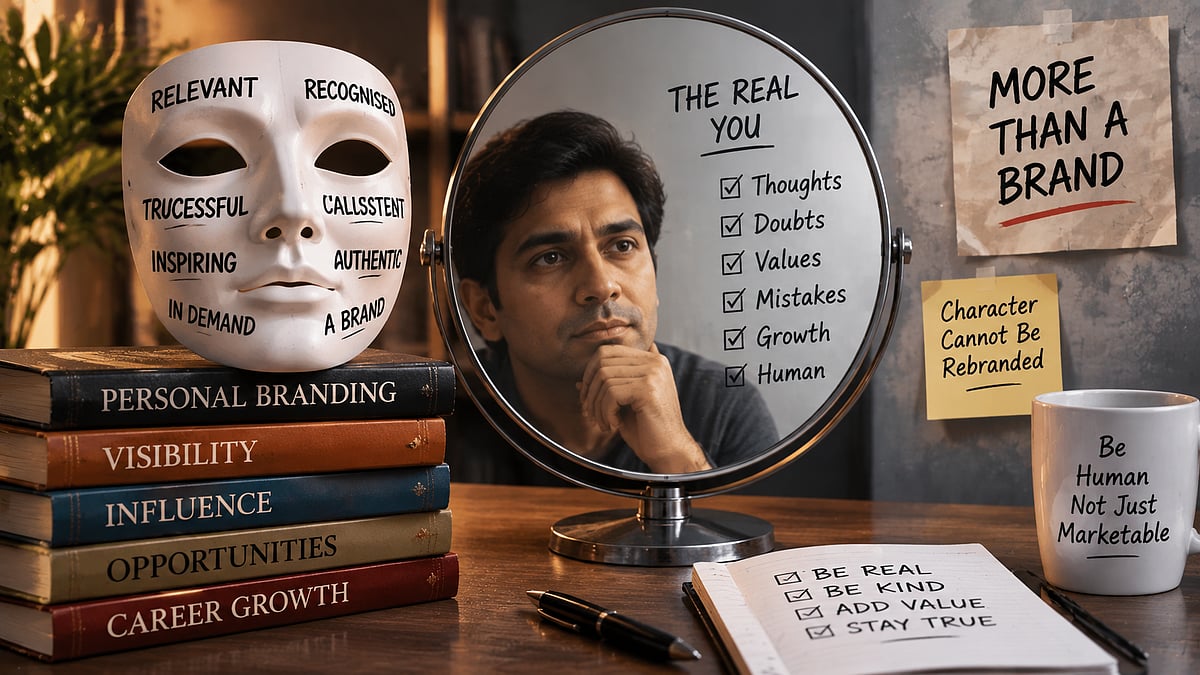
Should We Think Of Ourselves Like brands? Seriously? | AI
“Think of yourself as a brand,” Vermajee, my friend, mentor, philosopher, and marketing consultant, said, almost casually.
I looked at him. “That used to be good advice?”
“Still is.”
“I am not so sure.”
Vermajee put down his glass. “Why this sudden rebellion? You know what a good brand stands for. Relevance. Recognition. Consistency. Trust. A promise that people can rely on. What is wrong with wanting to be known that way?”
“Nothing, if that is still what brands stand for.”
He gave me the look of a marketing consultant whose favourite subject had just been insulted.
“Brands have always been about perception,” he said.
“Yes, but perception built on reality. Or at least that was the idea. You bought something because it worked, trusted the name because it had earned that trust, and came back because the experience matched the promise.”
“Mostly.”
“That ‘mostly’ is doing a lot of work.”
He smiled. “Go on.”
“Look at brands today. They tell us something is natural when it needs a chemistry lesson to explain what is actually inside. They call something healthy while carefully avoiding what it might do if consumed regularly. Risks become side effects. ‘Addictive’ becomes habit-forming. Manipulation becomes engagement. And when profits become more important than consequences, we call it shareholder value.”
Vermajee nodded slowly.
“You're saying brands have moved from creating value to managing perception.”
“Exactly. And sometimes managing perception means making sure the inconvenient truth is always kept camouflaged.”
“That would be entirely unfair,” he said. Coming from Vermajee, it was practically a confession.
“So, tell me, Vermajee, why would you still advise someone to think of themselves as a brand?”
“Because you are confusing bad brands with the idea of branding.”
“Am I? Or have brands themselves decided to teach me about the difference?”
He leaned back. “A brand is still a promise.”
“Which is precisely the problem. If the promise and reality drift apart, the brand survives on perception. A person cannot afford that forever.”
“Why not?”
“Because I have to live with myself after the campaign ends.”
That silenced him for a moment. And then he smiled, which made me laugh.
Perhaps, that is where the metaphor breaks. A brand can be repositioned. A product can be relaunched. Packaging can be redesigned. The ingredient mix can be changed, and it can be given a new name. A person, unlike a brand, has to carry the consequences of every version they have ever been.
Vermajee continued with his thought. “Don't be under the illusion. Humans have always managed perceptions, and maybe they are better than brands at it. We must behave differently with our boss, spouse, children, friends and strangers. And in the process, reveal different sides of ourselves.”
“That's being human. Not branding.”
“What's the difference?”
“Intent, perhaps. I don't want to become whatever version of me gets the best market response.”
He laughed. “There speaks the man who has never had to sell anything.”
“I have. I just don't want to sell myself.”
That, in my mind, raised a doubt about what personal branding has become. We are told to be authentic, but authenticity itself comes with instructions: package it, position it, amplify it and put it in front of the right audience. Apparently, even being yourself now needs a strategy.
“Osho would have had a field day,” I said.
Vermajee replied. “Pacca, Osho would probably ask why we are so desperate to become somebody when we could simply be.”
“And that is the uncomfortable question. We spend years building an identity, then spend more years protecting it. Now we are expected to strategise so that it can make a personal brand.”
Vermajee picked up his glass again. “But don't throw away everything branding teaches us,” he said. “Relevance matters. Trust matters. Your reputation matters. People must know what they can expect from you.”
“I agree. But perhaps the lesson should be reversed. Don't think of yourself as a brand. Think about what your behaviour makes your reputation.”
Varmajee became thoughtful, as if he were rolling the idea in his mind.
“That is almost good enough to put on LinkedIn.”
“Please don't.”
We laughed again.
Maybe “think of yourself as a brand” was good advice once because brands were expected to make a promise and keep it. Perhaps the problem is not that the advice was wrong, but that the example we were given has become increasingly difficult to defend.
And if brands today can survive on perception, while reality is hidden in the fine print, perhaps becoming a brand is not the aspiration we should be passing on.
“Still,” Vermajee said, “you need a personal brand.”
I looked at him.
“Why?”
He smiled.
“Because unfortunately, Sanjeev, the world hasn't stopped branding you just because you don't want to participate.”
Fair point.
Maybe that is what we need to think about next.
Sanjeev Kotnala is a brand and marketing consultant, writer, coach and mentor.
RECENT STORIES
-
-
-
-
-