SEBI Must Wake Up To Public Accountability In MIIs
Recent Delhi High Court rulings recognising the public functions of the NSE should prompt SEBI to strengthen accountability across market infrastructure institutions. The opinion piece calls for stronger vigilance, greater transparency, RTI compliance and governance reforms to align regulation with evolving judicial principles.

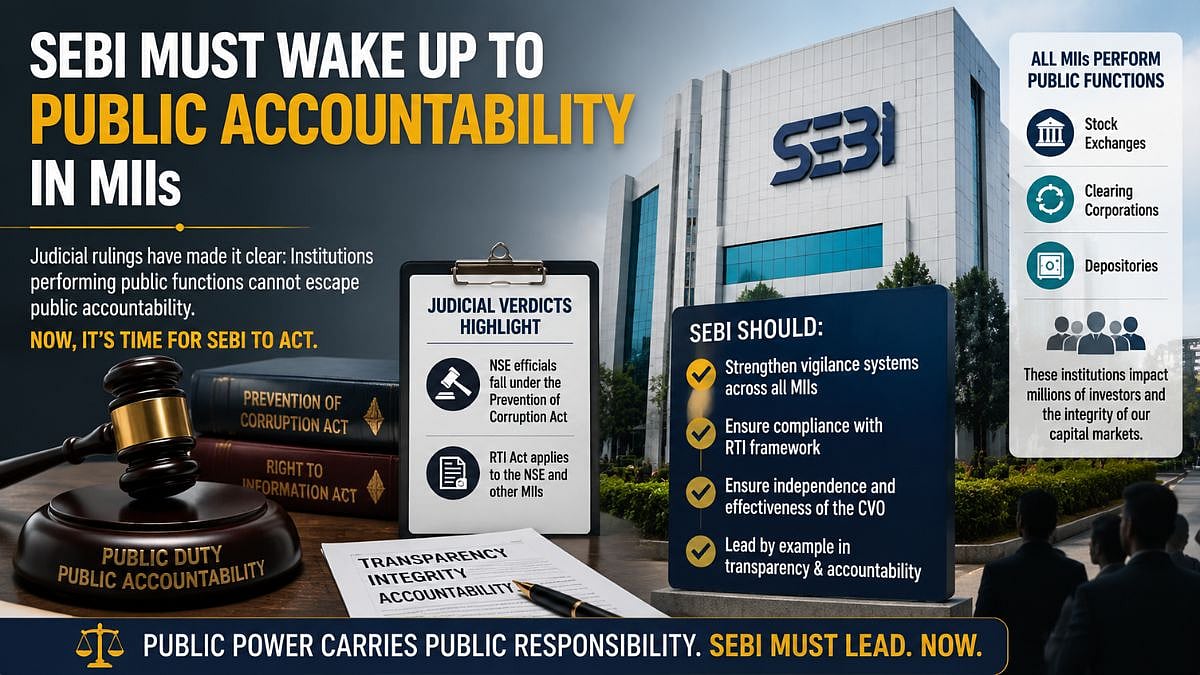
The opinion piece calls for SEBI to strengthen vigilance and transparency across India's market infrastructure institutions following recent court rulings | AI Generated Representational Image
Recent judicial pronouncements in matters involving the NSE have fundamentally altered the regulatory landscape for India's Market Infrastructure Institutions (MIIs). While delivered in different legal contexts, they establish an important principle. Institutions performing public functions cannot claim the privileges of private bodies to escape the obligations that accompany public duties.
The implications extend far beyond the NSE. They affect every exchange, clearing corporation, and depository. Unfortunately, SEBI has shown little institutional response to these landmark developments and appears to be asleep at the wheel. At a time when the government has consistently strengthened transparency, integrity, and public responsibility across institutions, SEBI increasingly appears to be a clear outlier. It also gives away the importance (or lack of it) SEBI gives to accountability when it comes to public servants.
Public Duty And Accountability
The first important development came when the Delhi High Court upheld the applicability of the Prevention of Corruption Act (PCA) to officials of the NSE. More recently, the court rejected challenges to the prosecution of former NSE MD Chitra Ramkrishna, allowing the criminal proceedings under the PCA to continue. The court held that the relevant officials were discharging public duties within the meaning of the Act.
This is not merely another order in the long-running colocation saga; it marks a significant evolution in the law.
The PCA is founded on a simple principle: Corruption is punished not because a person works for the government but because he or she performs functions that affect the public. The Act, therefore, adopts a broad definition of "public servant" by focusing on the discharge of "public duty".
Stock exchanges today are not merely private trading platforms; they enjoy statutory recognition, exercise regulatory powers, monitor trading, investigate market abuse, impose penalties, and provide the infrastructure through which capital markets function. Every one of these responsibilities is performed in the public interest.
Once we accept that these functions constitute public duty, it becomes increasingly difficult to argue that the same institution remains entirely private when questions of transparency arise. That is precisely where the recent Delhi High Court judgment holding that the RTI Act applies to the NSE assumes great significance.
Judicial Trend On Transparency
When the prosecution of NSE officials under the PCA was initiated in the colocation matter, the NSE accorded sanction for the prosecution of its former MD. Having accepted that framework, it became increasingly difficult to deny the public character of the institution when confronted with obligations of transparency.
The Delhi High Court's judgment applying the RTI Act to the NSE reflects this legal progression. The two judgments complement each other. One recognises public duty, while the other recognises the public's right to seek information from an institution discharging those duties. Together, they reinforce the principle that public responsibilities cannot exist without corresponding public accountability.
This development is not an isolated one. Indian courts have consistently expanded accountability wherever institutions perform public functions. Public sector banks have long been recognised as public authorities because of their public ownership and statutory responsibilities. More broadly, courts have repeatedly held that bodies exercising public functions cannot avoid accountability merely because they operate through a corporate structure.
The emphasis has increasingly been on the nature of the function rather than the form of the organisation. The NSE judgments fit squarely within this broader jurisprudence and are likely to influence future regulatory and judicial thinking in similar contexts.
Call For Regulatory Action
Surprisingly, SEBI has not translated these judicial developments into regulatory action. Every recognised stock exchange, clearing corporation, and depository exercises powers delegated under the securities laws. They perform regulatory functions that directly affect investors and the integrity of the securities market.
SEBI should immediately direct all MIIs to establish effective vigilance systems consistent with the principles of the CVC. They should also be required to institutionalise mechanisms for complying with the RTI framework. A proactive regulator should not wait for court judgments before strengthening governance standards. Regulatory leadership is most effective when it anticipates emerging legal principles rather than merely responding to them.
The more troubling issue lies within SEBI itself. The office of the CVO should be among the most independent positions in the regulator. There is a growing perception that SEBI vigilance has become ineffective in addressing internal accountability while being used more readily against those outside SEBI, viewed as inconvenient to the SEBI leadership. Whether justified or not, such a perception weakens confidence in the institution.
The office of the CVO should itself be treated as a highly sensitive post. Long tenures can create familiarity, reduce independence, and increase the risk of conflicts. A maximum tenure of three years would strengthen credibility. The CVC should also periodically undertake an intensive review of vigilance mechanisms within SEBI and the MIIs to ensure that they remain independent, effective, and credible.
The Way Forward
The judiciary has steadily clarified that institutions performing public functions cannot escape public accountability simply because they are incorporated as companies. The concepts of public duty, public servant, and public authority are increasingly converging around a common principle—public power carries public responsibility.
The courts have shown the direction. SEBI must now provide the regulatory leadership. It should strengthen vigilance, reinforce transparency, and ensure that every MII is governed by the standards of accountability expected of institutions performing public duties. If SEBI fails to act, the law will continue to evolve through judicial intervention rather than regulatory initiative. That would represent yet another missed opportunity for regulatory leadership and another avoidable failure of governance on the part of SEBI.
The writer is a retired IRS officer and former Chief of Surveillance at SEBI, and an advisor to corporates, market participants, and tech entrepreneurs.
RECENT STORIES
-
-
-
-
-