Saga Of Protestival, Vile Sovereignty And Rehearsal For Utopia
Gen Z-led protests at Jantar Mantar represent a new form of peaceful political dissent driven by digital activism, youth aspirations and demands for accountability. The opinion piece examines the movement's broader implications for democracy, representation and political participation in India.

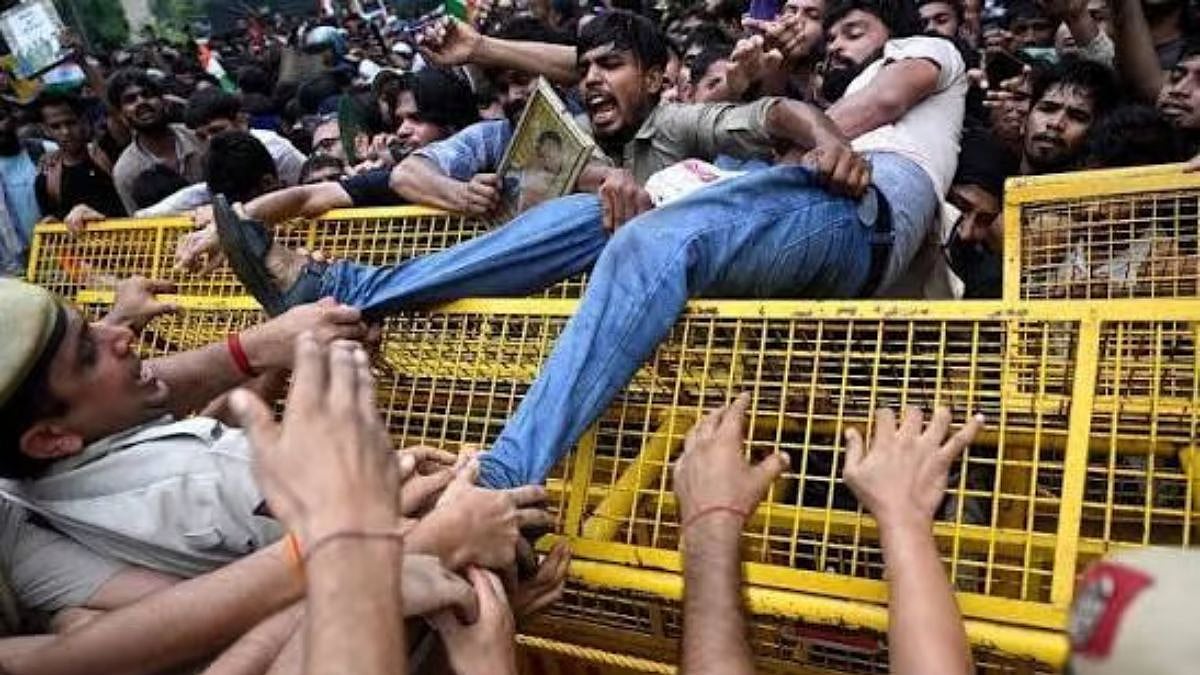
Gen Z protesters at Jantar Mantar are portrayed as redefining political dissent through peaceful mobilisation and digital activism | Representational Image
“If I can’t dance to it, it is not my revolution”. So said Emma Goldman, a potent voice of anarchism in North America and Europe. Young Indians who occupied Jantar Mantar, dancing and singing to celebrate their own revolution, intended to convey the same. Goldman said famously, “Demonstrate before the palaces of the rich; demand work. If they don’t give you work, demand bread. If they deny you both, take bread.”
She was branded by the American government as “Red Emma” and the “most dangerous woman in America”. Though protesters were vilified by many BJP leaders, the government showed restraint by not equating the young protesters with “Red Emma”.
Prime Minister Modi had to make a rare retreat by sacking Education Minister Dharmendra Pradhan. As senior commentator Nilanjan Mukhopadhyay has said, “This is not just one minister’s exit… It may be the moment Prime Minister Modi’s aura of invincibility has finally cracked.”
Politics As Celebration
Young agitators converted the protest into a fiesta and a carnival, very much like what the indigenous and women’s movements in Latin America have done in recent years.
The protesters used music, memes and reels not to dance and forget but to hurt and insult the ruling classes. Songs, dances, memes and reels gave them a view of the world. At Jantar Mantar, politics and songs became one and the same.
To this generation, politics is not for politics’ sake; it is for life’s sake. Their protest was not meant to simply charm but to seduce. Protesters used their bodies as a political act. At a time when governments across the world are taking away the rights that nations gave to their citizens, the young protesters claimed streets as belonging to people, not just cars.
In New York, you need permission from local authorities if more than 20 people gather in a park. In many other cities in the US, the street march is free only if it involves fewer than 100 people and if they occupy a single lane. In London, political protests are lumped with looters as threats to public order. The Modi government, too, has restricted protests at India Gate, Jantar Mantar and the Ramleela Maidan.
A Generation Challenges Power
Gen Z knows that they are living in what Salman Rushdie has called an “age of anything-can-happen”. Rushdie had said it about the US. He could as well have said it about India. He cautioned, “Beware America! Don’t believe it can’t happen here.” Rushdie was referring to an age where truth is lost to manipulation.
Like Emma, the Millennials and Gen Z have become a massive thorn in the side of the government.
BJP leaders, the captive media and sections of the chattering classes have all along believed that the new airports, superhighways, the big malls and the Rs 5 trillion economy dream command the new moral high ground of human civilisation. The much-trumpeted “Viksit Bharat” dream has been set as a trap in the hope that reality will be naïve enough to fall into it.
That the first Insta Revolution led by Gen Z should happen in the largest democracy in the world exposes how the practice of predatory majoritarianism has hollowed out democracy and how business has become the feast of vultures.
We have been led to believe that India is now composed of only heroes and villains. With binary storytelling sucked dry of facts, politics in India has become partisan docudrama.
Every new generation gets blamed, even blemished, by its predecessors. Weren’t boomers dismissed as too ambitious, Gen Xers cynical, and the millennials entitled? Gen Z is seen by many as unprofessional, unprepared, glued to screens and often missing the joy of being human. The Wall Street Journal has gone thus far to call them “potentially unemployable”.
However, Gen Z is having the last laugh. The Minister of Education, Dharmendra Pradhan, has been axed as demanded by the protesters at Jantar Mantar. But Defence Minister Rajnath Singh has stated that his tenure has been marked by “a steadfast commitment to transforming India into a developed nation”. Other ministers, too, have expressed solidarity with Pradhan.
Power Of Peaceful Protest
To P. B. Shelley, “poets are the unacknowledged legislators of the world”. Like poets, songs and singers, too, have a profound influence on society as they interpret future possibilities.
Carnivalesque protests are loci of resistance but also assertions of power.
Justice Ujjal Bhuyan of the Supreme Court has said, while delivering the Justice G. P. Singh Memorial Lecture in Bhopal, that the space for dissent is “shrinking”, with students who protest increasingly facing arrest and bail denials.
Shakespeare, in The Merchant of Venice, writes, “How far that little candle throws his beams!” The Jantar Mantar protests have thrown their beams far and wide.
Over the years, one has seen the ruling classes getting angrier than citizens. The young protesters at Jantar Mantar, and in other parts of the country, have directed their rage against the merchants of anger. In doing so, they have demonstrated what Italian political theorist Paolo Gerbaudo calls “citizenism”. The Gen Z movement may not overwhelm the government, but it has undermined its legitimacy.
Not all great movements begin with clearly defined goals. However, a notable feature of the Cockroach Janta Party-led movement was its peaceful nature. Harvard professor Erica Chenoweth sees it as “a pronounced shift in the global landscape of dissent”. Leaders of the Jantar Mantar movement knew that non-violent movements did not alienate anyone; they sought to bring everyone on board.
Questions For The Future
Jantar Mantar was a site of conviviality, pleasure and social cohesion. Was the protest at Jantar Mantar merely a howl of rage? Should it be seen as Gen Z in revolt or as utopia reborn? Or did we experience the Indian spring? One thing is pretty clear: Gen Z will settle for no more fairy tales from the government.
India has the world’s largest young population. But their presence in Parliament is marginal. Young voters have begun asking, “I have voted, but am I represented?” A young India and an ageing Parliament do not go together.
(The author comments on global affairs.)
RECENT STORIES
-
-
-
-
-