Rumi’s Ideal World Is Unbiased And Free From Belligerence
Rumi’s vision of a “new human” transcends rigid religious, moral and social divisions, emphasising love, equality and spiritual awareness. His famous “field” beyond wrongdoing and rightdoing is presented as a state of consciousness free from prejudice and conflict, offering a vision of a more peaceful and egalitarian humanity.

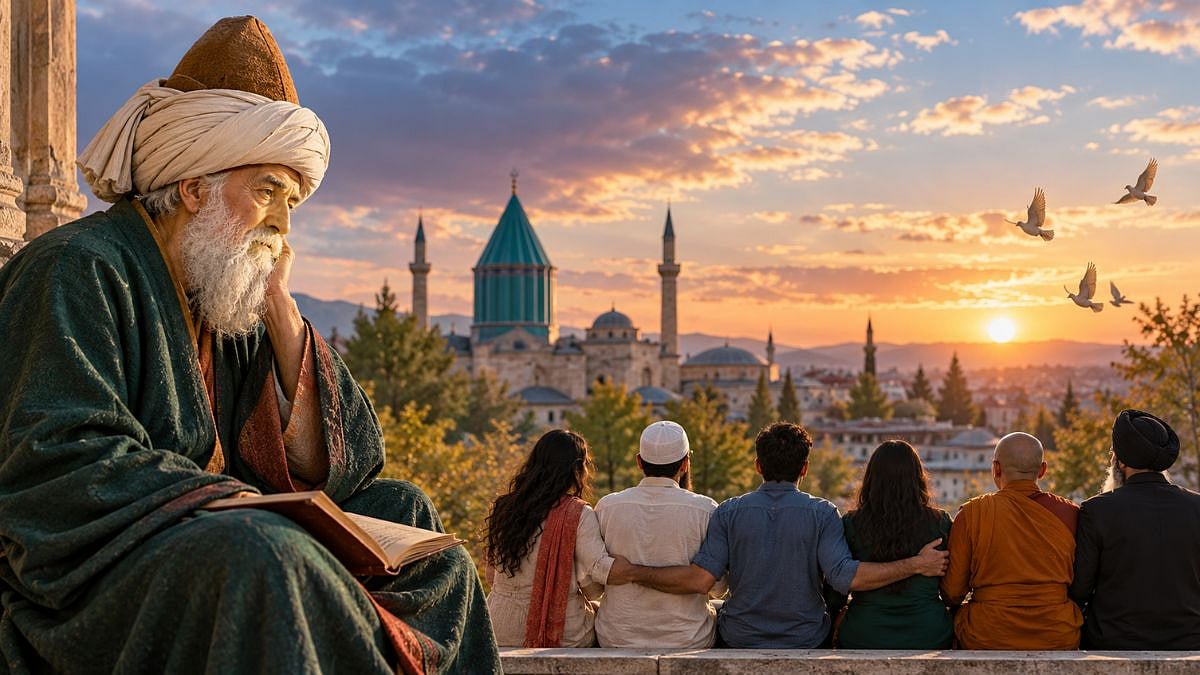
Rumi’s philosophy points towards a consciousness rooted in love, equality and freedom from rigid human divisions | AI Generated Representational Image
Az kufr-o ze Islām birun sahra-yi ast / Ma-ra be miyan-e an faza sawda-yi ast
Aref cho bedan resid sar ra benahad / Na kufr-o na Islām-o na anja ja-yi ast
(Beyond unbelief and Islam, there is a desert plain; In the midst of that expanse, we have a passion/longing. When the knowing mystic arrives there, he lays down his head [in prostration], for there is no unbelief, no Islam, and nowhere in that place.)
Many readers have come across Rumi’s oft-quoted immortal statement, “Out beyond ideas of wrongdoing and rightdoing, there is a field. I'll meet you there." But actually, it's a free, interpretive recreation by translator Coleman Barks (who cannot read and write Persian) rather than a literal translation of Rumi’s original Persian text. The original Persian quote and its translation appear in the beginning of the article. Cambridge-based orientalist, professor of Persian and arguably the greatest Western authority on Rumi, Reynold A Nicholson (1868-1945), considered this quote of Rumi as one of his most sublime thoughts that transcends itself in depth and profundity. En passant, Rumi belongs to the honoured category of wisdom teachers that would include: The Buddha, Plato, Ecclesiastes, Lao Tzu, the author of the Gospel of Thomas, Meister Eckhart, Shakespeare, Goethe, Whitman, and Emerson. He can stand with any of them in terms of his intellectual contribution and possibly beyond any of them in spiritual depth. Once, when the great German scholar Anne Marie Schimmel was asked to compare Goethe and Rumi, she responded, “The great Goethe is like an immense, majestic mountain; but Rumi, ah… Rumi is like the sky itself.” Her words capture the essence of what Rumi offers: an opening to a spiritual reality even beyond the majesty and beauty of the physical world; a transparency that allows the spiritual Sun to shine upon us. Rumi is not a self-help guru. He offers more than consolation to our neurotic anxieties. The ecstatic love he extols is not a form of mystical eroticism. He is not an iconoclast, a breaker of tradition, but an inheritor of the wisdom and revelations of the prophets.
Rumi’s Vision Of Transcendence
Coming back to his deathless quote, Rumi points to a state of consciousness that transcends rigid moral judgements, dogmatic divisions, and human conflict. In this “field” of pure love and divine presence, the analytical and dividing mind falls quiet, and souls connect through a shared, unconditioned essence rather than transactional definitions of good and bad.
Here one must understand that Rumi is not talking of an imaginary El Dorado or a metaphysical Shangri-La, where life will be idyllic and humans will be perfect. Rumi is not an afterlife daydreamer; his emphasis is on the emergence of a universal new consciousness, the advent of a new human and the arrival of a brand-new civilisation. Those who know and can read Persian and have visited Rumi's mazaar (mausoleum) in Konya, Turkey, may have seen the inscriptions on the dome. There's an inscription in Persian: Man dar just-jooye yek ensāne jadid hastam (I'm in search of a new human).
A New Human Beyond Prejudice
Rumi envisions (future) humans who'll be free of all prejudices, biases, differences, and discrimination. Those fully realised, evolved, emancipated, and enlightened humans will not seek divinity, as they'll carry divinity within themselves. To quote Shakeel Badayuni, “Pahuncha hoon wahan nahin door jahan bhagwan bhi meri nigahon se" (I've reached a point from where even god is not so far).
The whole world is passing through unprecedented turbulence and turmoil. Humans are fighting on rank silly issues like caste, class, country, creed, colour, culture, contours, and civilisations, among others. Territories are divided, and people are discriminated against. Hatred has become our civilisational spirit and love has disappeared from our lives. We're judging each other but loving none. Sectarian morality is being mistaken for collective universal morality. Religiosity is on the rise, as we're putting too much emphasis on faiths and rituals. We flip through the pages of the scriptures but don't care for flipping through the books within us. We're searching for God who's immanent.
Toward A New Morality
The new humans of the new civilisation will be totally free of all these prejudicial ills. They'll create a new morality of love and equality. That'll be the metaphor for global egalitarianism and an unquestionable recipe for transcendental love. Rumi's ideal world with its new and completely evolved denizens will be the future of mankind. To quote Nicholson, “Rumi phrased a new phase for the beleaguered mankind.”
Critics may say that Rumi envisaged the ideal world and its upright humans 800 years ago, as he was born in 1207 and shuffled off the mortal coil in 1273, but the world and its people haven't changed. Rather, all things have deteriorated drastically. But we mustn't forget that the span of 800 years or a millennium is a very short time in the endlessness of time. Efforts are afoot despite extreme despair, desperation, disparity, and decadence.
Hope Through Transformation
Inspired by Rumi's New Man, Friedrich Nietzsche dreamt of Übermensch (Overman or Superman in German). Let the world face the extreme in all spheres; a new dawn is on the anvil. Remember, “Gham jab had se zyada ho, khushi nazdeek hoti hai / Chamakte hain sitare raat jab taareek hoti hai" (When the pain is unbearable, happiness is on the cards / The stars glitter all the more brightly when the night is Cimmerian dark). Remember Rumi's words, “What hurts you, blesses you. Darkness is your candle.” Suffering and hardship are not random punishments but profound catalysts for inner transformation. Pain strips away superficial attachments and illusions, forcing the ego to humble itself. Through the "darkness" of grief or trial, a person develops inner vision, resilience, and spiritual depth that ease and comfort can never teach.
Let's hope for a non-judgemental and belligerent-free humanity envisioned by Rumi. We've had enough of blood and gore.
Sumit Paul is a regular contributor to the world’s premier publications and portals in several languages.
RECENT STORIES
-
-
-
-
-