Pokhran-II And India’s Strategic Rise: How The 1998 Nuclear Tests Redefined India’s Global Standing
The nuclear tests conducted under Atal Bihari Vajpayee transformed India from a hesitant regional power into a confident strategic state capable of resisting global pressure and reshaping South Asian security equations.

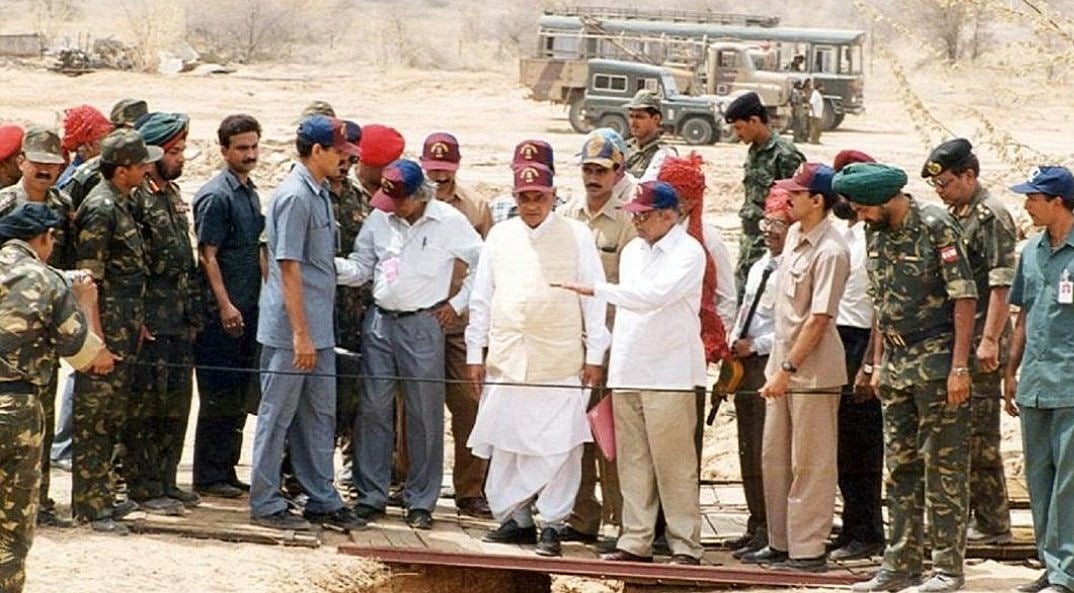
India’s Pokhran-II nuclear tests in 1998 marked a turning point in the nation’s strategic and geopolitical trajectory |
It was a defining moment in India’s modern history when a soft-spoken poet-statesman with an iron resolve chose to alter the strategic destiny of the nation.
Former Prime Minister Atal Bihari Vajpayee, known more for his moderation and eloquence than muscular posturing, stunned the world by authorising the Pokhran-II nuclear tests despite fierce opposition and sustained pressure from the United States.
In the silent and windswept deserts of Rajasthan’s Pokhran Test Range, India executed one of the most secretive and sophisticated strategic operations of the twentieth century, successfully evading the surveillance of powerful American satellites and intelligence agencies.
The tests not only marked India’s formal arrival as a nuclear weapons state but also signalled the emergence of a more self-assured and strategically autonomous India willing to defend its national interests irrespective of global pressure.
Washington reacted sharply. Then US President Bill Clinton swiftly imposed sweeping economic sanctions on India immediately after the May 1998 nuclear explosions.
The punitive measures included suspension of foreign assistance, restrictions on defence cooperation and technology transfers, and opposition to multilateral financial lending to India through international institutions.
Yet, instead of bending India’s resolve, the sanctions ultimately reinforced New Delhi’s determination to pursue an independent strategic path.
Modi recalls Pokhran as symbol of national resolve
Prime Minister Narendra Modi on Sunday invoked one of India’s most defining strategic moments — the 1998 Pokhran nuclear tests — to underline the country’s emergence as a confident and self-reliant global power under former Prime Minister Atal Bihari Vajpayee.
Modi’s remarks were not merely a tribute to India’s nuclear scientists but also a reminder of how the Pokhran-II tests fundamentally altered India’s geopolitical standing, strategic doctrine and international identity.
While representing a premier English newspaper at Amritsar during that period, this writer had the opportunity to visit the Pokhran blast site shortly after the nuclear tests and also briefly meet Atal Bihari Vajpayee.
Vajpayee appeared calm, composed and visibly confident despite mounting international criticism and the threat of economic sanctions.
That confidence reflected the political conviction behind the decision — that India was prepared to withstand global pressure in order to secure its long-term strategic interests.
How Pokhran-II shocked the world
The Pokhran-II nuclear tests, conducted on May 11 and 13, 1998, marked India’s formal entry into the league of declared nuclear weapon states.
The tests stunned the world because they were carried out in complete secrecy despite intense American satellite surveillance and global intelligence monitoring.
Within hours of the explosions in Rajasthan’s Pokhran desert, India announced itself as a nuclear weapons power capable of defending its sovereignty in a hostile regional environment.
The tests immediately triggered global outrage.
The United States, Japan and several Western countries imposed economic sanctions on India.
International financial institutions came under pressure to restrict lending and strategic cooperation with New Delhi.
Many global powers accused India of destabilising South Asia and violating the international non-proliferation framework.
From global isolation to strategic acceptance
However, history moved in a direction very different from what India’s critics had anticipated.
Instead of isolating India permanently, the nuclear tests eventually forced the world to engage more seriously with New Delhi.
Over the next decade, India’s strategic importance steadily increased.
The same Western powers that had imposed sanctions later sought deeper economic, defence and technological partnerships with India.
The transformation culminated in the India-US Civil Nuclear Agreement of 2005, which effectively recognised India as a responsible nuclear state despite its non-signatory status to the Nuclear Non-Proliferation Treaty.
Now India has positioned itself at a vantage point, and experts increasingly believe that no power on earth can make India bow down or force it to yield to pressure.
The statement carries both historical and contemporary significance.
Historically, it reflected the Vajpayee government’s decision to proceed with the tests despite knowing that severe international sanctions would follow.
Scientific achievement and political courage
On May 11, the first three nuclear tests were conducted and Indian scientists showcased the country’s capabilities before the entire world.
Pokhran-II was not merely a military event; it represented India’s technological maturity and indigenous strategic capability.
Atal Bihari Vajpayee’s government took the risk of international isolation because it believed India could no longer remain strategically ambiguous in a region dominated by two nuclear-linked security challenges — China and Pakistan.
China had tested nuclear weapons decades earlier, while Pakistan’s covert nuclear programme was advancing rapidly with external assistance.
How nuclear capability changed India’s security calculus
The tests therefore established credible deterrence.
One of the biggest advantages of nuclear capability is that it discourages adversaries from attempting large-scale military aggression.
Nuclear weapons fundamentally alter the calculations of enemy states because the costs of escalation become extremely high.
For India, the tests created a strategic shield against coercion by hostile neighbours.
The nuclear capability also strengthened India’s bargaining position internationally.
Countries across the world increasingly began treating India as a major strategic actor rather than merely a developing regional power.
India’s voice on global security, defence and geopolitical matters gained greater weight after Pokhran-II.
Another major advantage was psychological and political confidence.
The tests sent a message that India was prepared to take sovereign strategic decisions independently.
This boosted national morale domestically and reinforced India’s image internationally as a country willing to protect its long-term interests despite external opposition.
Message to adversaries and strategic stability
For India’s adversaries, Pokhran-II carried a different message.
It indicated that conventional military pressure alone would no longer be enough to intimidate India.
Nuclear deterrence created a situation where enemies had to calculate the risk of escalation before initiating major conflict.
In strategic terms, nuclear capability acts as a stabilising force because it raises the cost of war dramatically.
At the same time, India adopted a relatively restrained nuclear doctrine.
Unlike some nuclear powers, India declared a “No First Use” policy, signalling that its nuclear weapons were intended primarily for deterrence rather than aggression.
This helped India project itself as a responsible nuclear power committed to strategic stability.
Defence modernisation and economic resilience
The tests also accelerated India’s defence modernisation.
After 1998, successive governments invested more heavily in missile systems, strategic command structures, surveillance capabilities and indigenous defence technology.
India’s missile programme, including the Agni series, became a crucial component of its strategic deterrence architecture.
Economically too, the long-term impact of sanctions proved limited.
India’s economy continued expanding, and global investors eventually returned because of the country’s growing market potential.
Ironically, many countries that had criticised India later deepened defence and strategic cooperation with New Delhi as China’s rise altered global power equations.
Pokhran-II and the rise of a confident India
The Pokhran tests therefore became much more than a nuclear event.
They marked India’s transition from strategic hesitation to strategic assertion.
The tests demonstrated that India was prepared to bear economic and diplomatic costs in pursuit of national security objectives.
Today, nearly three decades later, Pokhran-II remains one of the defining moments in independent India’s strategic history.
It reshaped South Asian security equations, altered India’s global standing and laid the foundation for the country’s emergence as a major power in the 21st century.
Prime Minister Modi’s remarks were thus not merely about commemorating a historical event.
They reflected a broader political and strategic message — that India’s rise as a global power is rooted in strategic self-confidence, technological capability and the willingness to take difficult decisions in defence of national sovereignty.
(Writer is a senior political analyst and strategic affairs columnist based in Shimla)
Published on: Monday, May 11, 2026, 05:17 PM ISTRECENT STORIES
-
-
-
-
-