Paradox Of Indian Passport, Burden Of Proof
Confusion has grown after the clarification that an Indian passport is not conclusive proof of citizenship. While the legal distinction between the Passports Act and the Citizenship Act is valid, the editorial argues that the government should provide greater certainty on the documents citizens can rely on to establish their nationality.

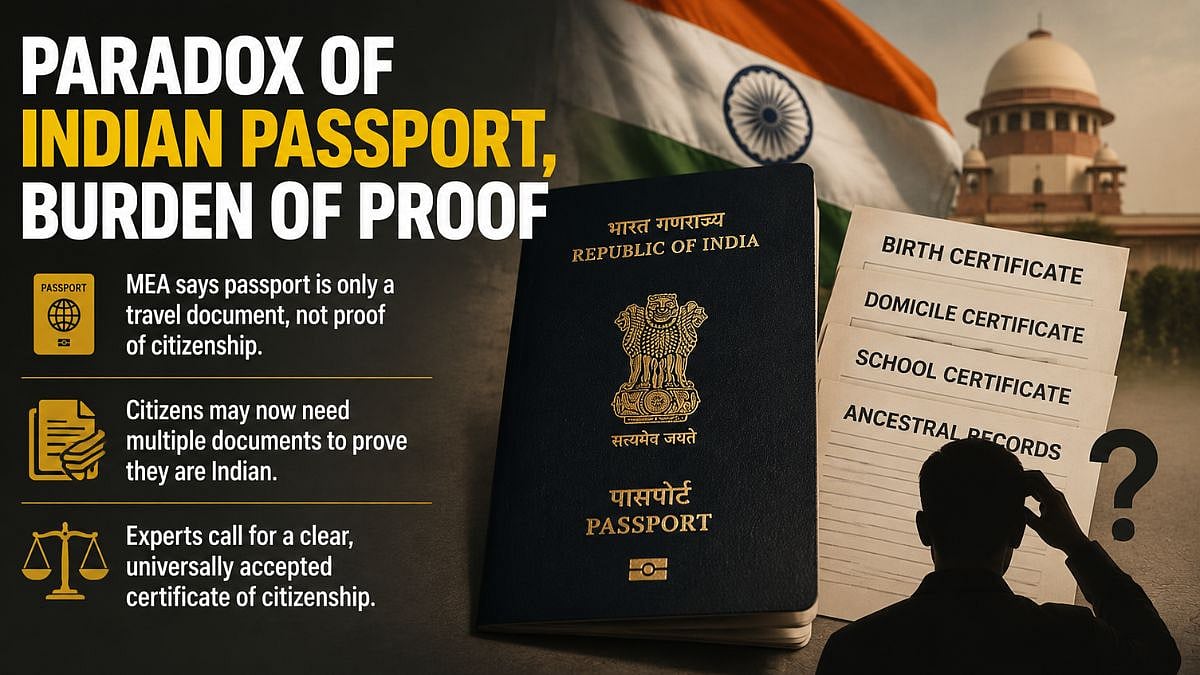
The debate over whether an Indian passport serves as proof of citizenship has reignited calls for clearer documentation norms | AI Generated Representational Image
The revelation that an Indian passport is merely a document facilitating foreign travel and not proof of citizenship has understandably shocked most Indians. For generations, citizens believed that the passport was the Republic’s highest certification of nationality. After all, it prominently records the holder’s nationality as “Indian”, bears the authority of the Government of India, and is accepted worldwide because foreign governments trust that India has verified the status of the bearer before issuing it. In a country where voter identity cards, Aadhaar, PAN cards and other documents have repeatedly been declared inadequate to establish citizenship conclusively, the passport remained the one document that inspired confidence. If even this is to be treated as insufficient, citizens are entitled to ask what exactly constitutes proof of belonging to the nation.
Need For Greater Clarity
Must an Indian now carry a bundle of birth certificates, domicile records, school certificates, ancestral documents and other papers merely to prove that he or she is Indian? In a country where illiteracy remains widespread, where official records are often incomplete and where more than half the population still depends on subsidised foodgrains for survival, such expectations appear detached from social realities.
To be fair, the Ministry of External Affairs is technically correct in pointing out that passports are issued under the Passports Act, whereas citizenship is governed by the Citizenship Act. A passport does not create citizenship, nor can it override a judicial determination in cases involving fraud, disputed parentage or illegal acquisition. Yet, legal precision cannot be divorced from public understanding. A passport is issued only after the state satisfies itself that the applicant is entitled to one. In ordinary life, and certainly abroad, it is the strongest evidence of Indian nationality that most citizens possess. As former Foreign Secretary Nirupama Rao argues, no foreign immigration officer is likely to question the nationality of a traveller carrying a valid Indian passport merely because New Delhi has offered a legal clarification. The problem lies not in the law itself but in the manner in which it has been communicated, creating needless anxiety among citizens already uncertain about the status of the documents they possess.
Need For Clear Policy
The controversy exposes a larger deficiency in India’s system of civil registration. Documentary inconsistencies have already caused hardship in places such as Assam, while special conditions relating to parentage and historical residence apply in certain other regions. If citizenship can ultimately become hostage to missing records, the government must provide certainty. It should either issue a universally accepted certificate of citizenship or declare unequivocally that a passport issued after due verification will ordinarily be treated as sufficient evidence of nationality. Citizens should not be left wondering how they would prove that they are Indians when travelling abroad or even while claiming rights at home.
RECENT STORIES
-
-
-
-
-