Nepal’s Communal Fault Lines Expose A Deeper Political Crisis
Nepal’s recent Hindu-Muslim clashes expose deeper tensions over identity, secularism and governance. The violence has raised questions over PM Balendra Shah’s crisis management, while reviving the Hindu Rashtra debate and creating concerns for Nepal’s social stability and ties with India.

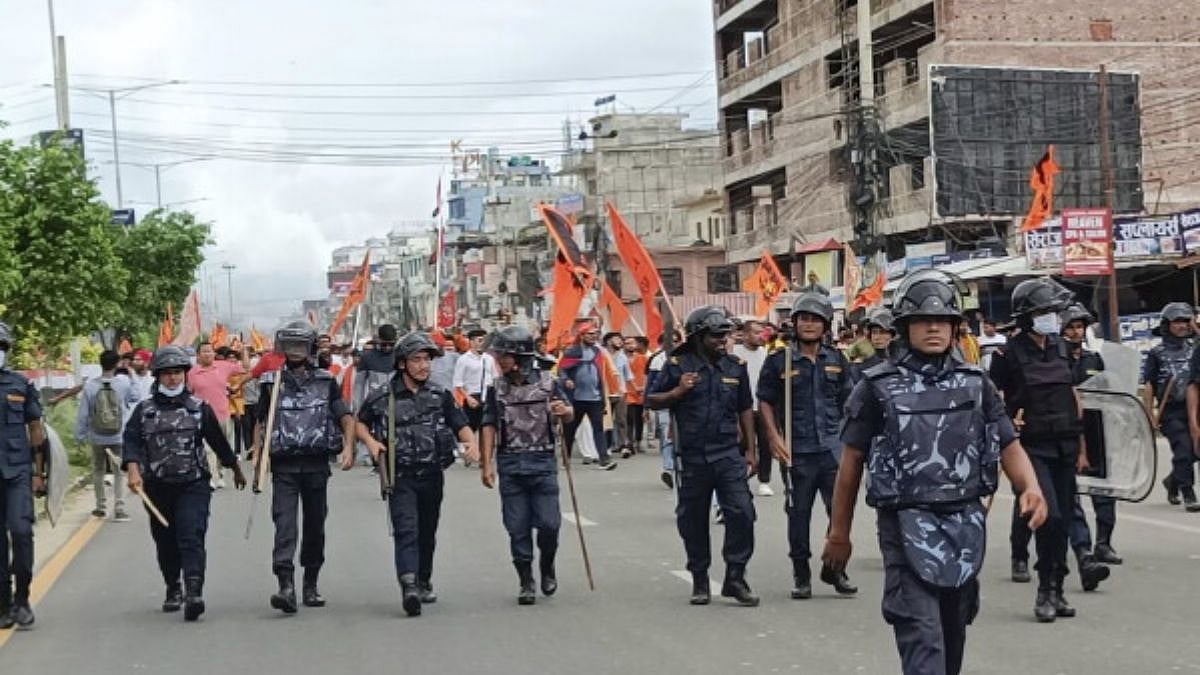
Nepal’s Communal Fault Lines Expose A Deeper Political Crisis |
Nepal’s recent communal violence is more than a local law-and-order failure. Clashes in Sunsari and Siraha in the southern plains, triggered by a dispute during a Hindu religious event and involving Hindu and Muslim groups, left at least three people dead and around 25 injured, forcing curfews and security deployment. The violence was contained, but it exposed a dangerous fault line in a country traditionally known for coexistence. More worrying is the intersection of religious tension with identity politics, institutional weakness and disappointment with Prime Minister Balendra Shah. As per reports, there were at least 17 such incidents of Hindu-Muslim tensions in the Tarai belt in the past eight years.
Why Balendra Shah Failed to Contain the Communal Outbreak
Prime Minister Balendra Shah’s failure to contain the communal violence quickly has exposed a serious weakness in his fledgling government: a delayed political response, administrative inexperience and an excessive reliance on security measures after the situation had already deteriorated. The violence began in Sunsari on July 26 but Shah remained initially largely silent , allowing a local dispute over religious flags and loud music to spread into other parts of the Madhesh region; three people were killed and scores injured before curfews and security deployment brought the situation under control . The deeper danger is that the government initially treated the episode as a conventional law-and-order problem rather than recognising its rapidly emerging communal and political dimensions. This hesitation has reinforced doubts about Shah’s ability to manage crises at the national level, particularly when his government is already facing criticism over delayed responses, executive overreach and weak institutional coordination. The danger of instability therefore extends beyond communal relations: if the government cannot reassure both communities, control inflammatory mobilisation and restore confidence in state institutions, the Hindu Rashtra-versus-secularism debate could become increasingly polarised, while the very Gen-Z constituency that brought Shah to power could turn against him. Nepal’s immediate challenge is thus not merely to restore peace on the streets, but to prevent communal mistrust from becoming a permanent political fault line.
Internal Roots of Communal Tension
The immediate trigger may have been a dispute over music, religious flags and processions, but such incidents rarely become violent without underlying mistrust. Competition over public space and religious expression can therefore acquire a communal colour quickly.
Social media has added another accelerant. Rumours, provocative videos and unverified claims travel faster than the administration can respond. A local confrontation can become a wider narrative of religious victimhood. The government’s response also raised questions: security forces eventually restored order, but treating the violence simply as a law-and-order problem misses its deeper significance. Curfew can stop a riot; it cannot repair mistrust.
Social Fabric at Risk
Nepal’s greatest casualty could ultimately be its social fabric. Communal peace in the Tarai has rested not only on institutions but on everyday interaction, shared economic interests and local accommodation. Once neighbours begin viewing one another primarily through religious identities, ordinary disputes can acquire an explosive dimension.
Hindu-versus-Muslim rhetoric could create a cycle of retaliation, encouraging segregation and hardening identities. Sustained communal polarisation would add another layer of fragility.
Hindu Rashtra versus Secular Forces
The violence has revived the unresolved debate over whether Nepal should remain a secular republic or return to its earlier identity as a Hindu state. Hindu nationalist groups increasingly demand restoration of Hindu Rashtra status, while secular and republican forces regard such a move as a threat to constitutional pluralism.
The danger is that communal violence could turn this ideological debate into a street confrontation. Hindu groups may portray clashes as evidence that the secular state cannot adequately protect majority traditions. Secular forces fear that majoritarianism could marginalised minorities.
Shah’s challenge is to prevent the state from becoming an instrument of either camp. Protecting Hindu religious freedoms must go together with equal citizenship and security for Muslims and other minorities.
From Political Rebellion to Governance Crisis
Shah’s rise represented a spectacular rejection of Nepal’s traditional establishment. The Rastriya Swatantra Party won 182 of the 275 parliamentary seats in the March 2026 election, and Shah became prime minister on 27 March. His victory embodied Gen-Z anger against corruption, unemployment and political recycling.
But the transition from rebellion to governance is proving harder. Shah entered office with enormous expectations, yet his government has faced criticism over inexperience, delays and a strained relationship with Parliament. His refusal at times to follow parliamentary conventions has raised questions about whether an anti-establishment style can be converted into institutional governance.
The communal crisis exposes this weakness. His televised appeal for calm and a transparent investigation was necessary, but the larger test is whether his government can address causes rather than merely contain consequences.
Why Shah Is Falling Short of Expectations
Shah was not elected merely to replace one party with another. He was presented as the face of generational transformation. Nepalis expected cleaner governance, economic revival, jobs, institutional reform and an end to political patronage.
Those expectations were exceptionally high, but administrative inexperience and political uncertainty have widened the gap between promise and performance. Gen-Z voters who rejected the old establishment may become equally impatient with the new one.
Impact on India
India has a direct stake in Nepal’s communal stability. The Tarai borders India, while trade, movement of people, religious links and family ties make disturbances in southern Nepal more than an internal matter. Prolonged tension could create cross-border anxieties, disrupt commerce and complicate border management.
An unstable Nepal also creates space for external influence and complicates India’s effort to maintain a stable neighbourhood. New Delhi must avoid being drawn into Nepal’s Hindu-versus-secular contest while protecting cross-border communities and bilateral stability.
Shah’s nationalism has already occasionally created friction with India, including his recent remarks on the boundary issue. India consequently needs a calibrated policy: support Nepal’s stability, strengthen institutional and people-to-people ties, and avoid appearing to favour either Hindu nationalist or secular forces.
Nepal is facing a crucial test. The communal clashes are not merely a religious dispute; they are a warning that identity mobilisation, political frustration and weak governance can combine into a volatile mixture. Shah’s historic mandate gave him an opportunity to break with Nepal’s troubled past. Unless he converts political rebellion into credible governance and protects the country’s plural social fabric, the promise of a new Nepal could become another chapter in its long search for stability.
(The writer is a senior political analyst and strategic affairs columnist based in Shimla)
RECENT STORIES
-
-
-
-
-