‘Modi Is BJP And BJP Is Modi’, Let History Judge His Tenure
An opinion piece by Ashutosh examines Narendra Modi’s leadership and compares it with Atal Bihari Vajpayee and Indira Gandhi. The writer argues Modi has built greater control over the BJP and allies than Vajpayee had, while discussing coalition politics, party authority and past challenges faced by leaders. The article also notes that history will judge Modi’s tenure.

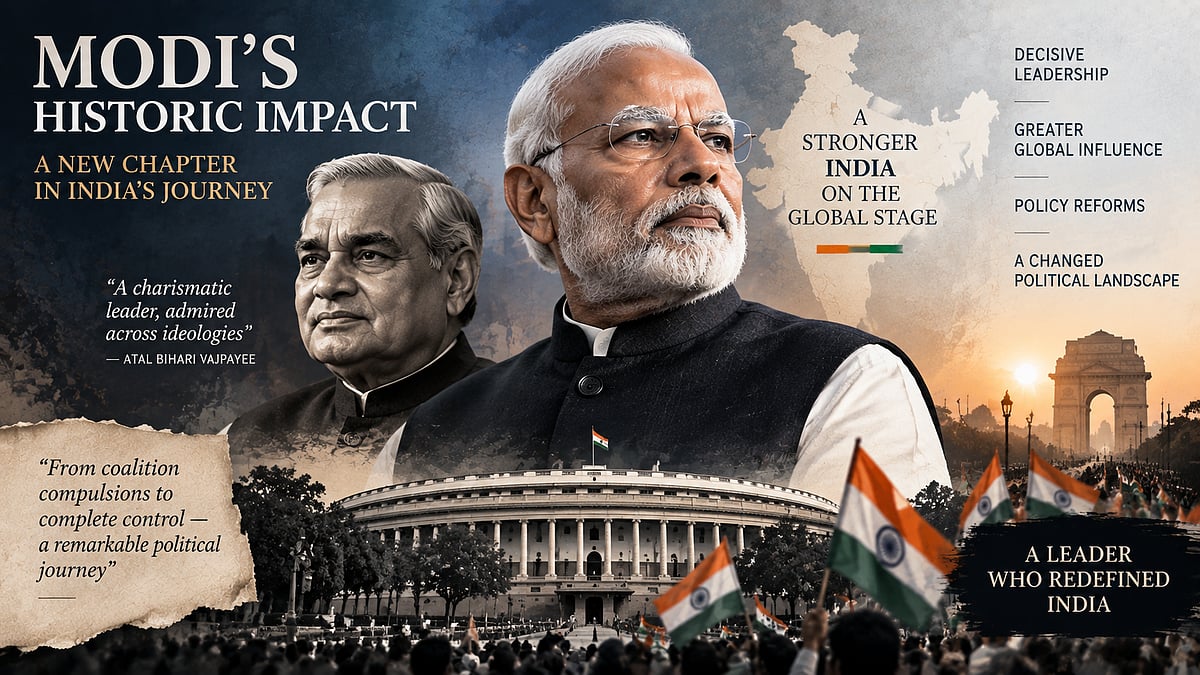
‘Modi Is BJP And BJP Is Modi’, Let History Judge His Tenure | AI
Prime Minister Modi will go down in Indian history as one of the most impactful leaders ever who changed the course of history. India before him was a different country, and it took a different turn once he became prime minister. It remains to be seen if changes that have occurred during his regime are permanent or just a blip in history. Undoubtedly, he is the greatest leader within the pantheons of the Hindutva fold. Atal Bihari Vajpayee is the only one who can come close to him.
Vajpayee was undoubtedly a charismatic leader. He was a great orator. He commanded great respect not only from his party but also from the leaders of other parties and ideologies. He was called a ‘right leader in the wrong party’. Modi is more feared than respected, but the aura around him is unmatched. Vajpayee was also a Swayam Sevak, but he was first-among-equals. A leader within the party could argue with him and survive but not with Modi.
When the BJP needed to form the government at the centre in 1998, it was because of Vajpayee that the party could attract support from secular parties. One can argue that in 2024, many secular parties like the JDU and the TDP supported Modi to form the government when the BJP did not have the majority numbers. But both situations can’t be compared. The BJP in the 1990s was not a dominant party. It was the Congress system; secularism and constitutionalism were the defining creeds; communalism was abhorred. Let’s not forget, to seek the secular parties’ support, the BJP had to keep aside its three contentious issues from the agenda of governance—Ram Mandir, Art 370, and UCC. Can secular parties dictate the same now?
In 1996, when the Congress led by Narsimha Rao lost the election and the BJP claimed the stake to form the government, it survived only for 13 days. Then Sushma Swaraj had famously said, “If Atalji was invited to form the government, allies would run after it to support the BJP government”. That did not happen. But now, Modi did not have to even ask for support. Secular leaders like Nitish Kumar and Chandra Babu Naidu felt obliged to support Modi as the prime minister. The BJP-isation of non-BJP parties in the NDA is total. They are different because they carry different names; otherwise, as a party, they are the same. But during Vajpayee’s time, allies were aggressive and, every now and then, they used to threaten the BJP with withdrawing support. George Fernandes, who was the convenor of NDA, was Vajpayee’s crisis manager, and he would shuttle from one state capital to another to massage the ego of leaders like Mamata Banerjee to keep them in the fold and not let the government fall. In April 1999, the Atal government fell, as it could not muster a single vote needed to beat the no-confidence motion. Can the same be visualised for the Modi government?
Maybe Modi was wiser after watching the fate of the Vajpayee government. He learnt that if he had to run his government smoothly, he would have to have total control, not only over his NDA partners but also over his party. Anyway, he is a strong man and extremely decisive. Like a good leader, he knows what he has to do and how. He has also learnt that morality is not the ultimate virtue of a leader if he or she has to remain in control in the government and in his or her party. That way, he is not an admirer of Vajpayee, who said on the floor of the House that “he would not break parties to remain in government”. That way, he is close to Indira Gandhi, who had no compunctions in exercising her authority to remain in command. Indira Gandhi broke the Congress Party twice, once in the late 1960s when she was challenged by the Congress syndicate and later in the late 1970s after she lost the 1977 election. Both times she emerged victorious. Modi has learnt from Indira’s experience.
Indira Gandhi was not a natural leader like her father Jawaharlal Nehru, who was popular and was phenomenally respected. Indira Gandhi had to fight and struggle to make herself acceptable within the party. She had to contest with stalwarts like Morarji Desai to become prime minister. Her leadership was openly challenged by senior leaders of the Congress.
Modi was also not the natural leader of the party. When he became the chief minister of Gujarat, he was just a general secretary of the party and had never contested elections. In 2013, when he staked his claim to be the prime ministerial candidate of the BJP, there were other leaders like Sushma Swaraj, Rajnath Singh, Nitin Gadkari, and Lal Krishna Advani who were claimants for the top job. Advani openly opposed his candidature and wrote a letter stating, “The party is surrendering the ideals of Atal Bihari Vajpayee, Deen Dayal Upadhyaya, and Shyama Prasad Mukherjee to fulfil the ambitions of one man”.
Modi is a centralising and polarising figure. He knows that he is not Vajpayee. To run the government smoothly, he not only has to control the party but also those who could threaten his dominance from the outside. Modi’s control of the party today is total. He is the party, and no one dares challenge his authority. In my opinion, he not only perfected but bettered Indira Gandhi’s playbook. Here is one difference. Modi also has to contend with the RSS’s senior leaders. He was aware of Vajpayee’s experience of how the RSS chief and other leaders used to bitterly criticise Vajpayee and discredit his government. The then RSS chief, KS Sudarshan, went to the extent of saying that “there were American agents in the prime minister’s office”. Modi ensured that none from the RSS could say the same things about him. He succeeded in neutralising the RSS to a great extent. Vajpayee was pushed to the point of resigning as prime minister and said, “Neither tire nor retire, but will be victorious under the leadership of Advani”. Now it is unthinkable. Modi is the BJP, and the BJP is Modi. Let history pass the verdict on his tenure.
The writer is Co-Founder, SatyaHindi.com, and author of Hindu Rashtra. He tweets at @ashutosh83B
RECENT STORIES
-
-
-
-
-