It Is Time We Held The BMC Accountable For Every Tree Fall And Every Pothole
Mumbai's recurring monsoon problems are the result of civic failures rather than the rains themselves. The article urges the BMC to be held accountable for preventable incidents such as tree falls and potholes, calling for responsibility to be fixed on officials whose alleged negligence puts lives at risk.

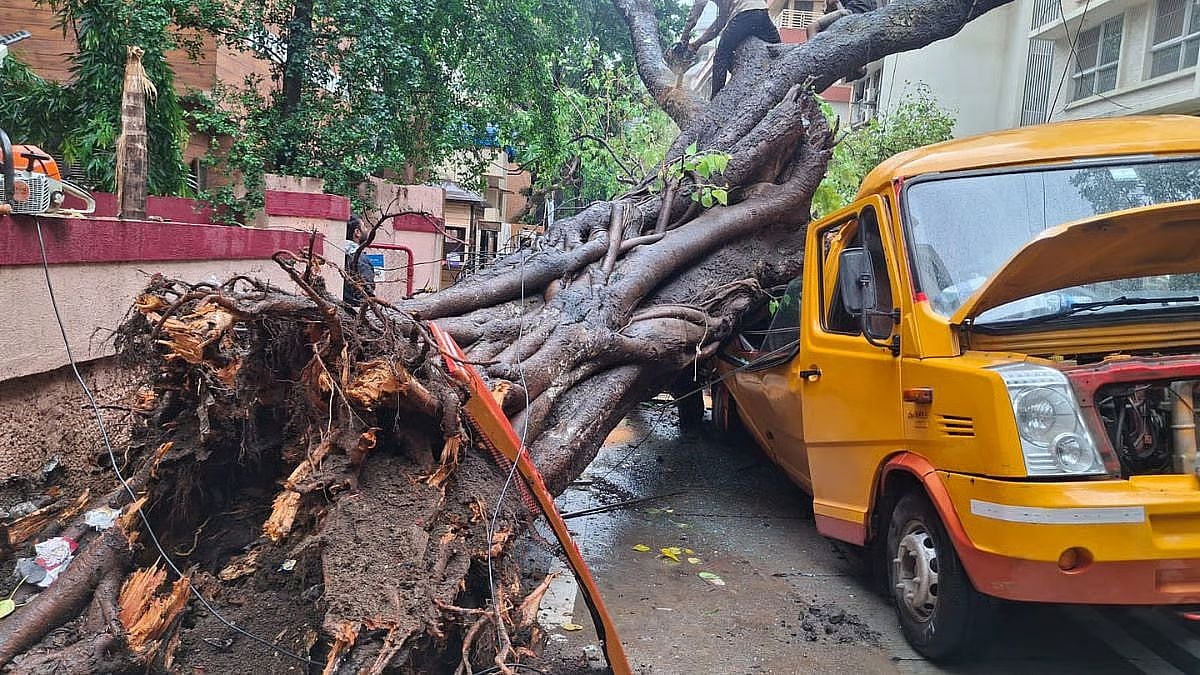
The commentary calls for greater accountability from the BMC over recurring tree falls, potholes and civic failures during Mumbai's monsoon |
It is time we held the BMC accountable for every tree fall and every pothole.
‘Monsoon misery’ is the theme Mumbai hums in frustration, with resignation, every year as the season sets in. The phrase is a favourite with news editors. Lately, it has become a hashtag on social media too. Let’s pause and reflect: is it really the monsoon that brings misery for Mumbaikars or, to call a spade a spade, all the powerful and well-financed authorities that cannot seem to get the city ready to handle the rainfall that’s expected? Of them all, the responsibility rests primarily with the Brihanmumbai Municipal Corporation (BMC), and it follows that accountability would have to start with it.
Preventable Civic Failures
Misery runs deep for the Shrivastava family, who lost their 11-year-old Vihaan when an old peepal tree fell on a moving school bus that he was in, crushing him to death at a tender age because some officials chose to take their job way too lightly. Media reports disclose that the BMC’s Garden Department had warned last April that the roots of trees in that area of Chembur were weakened because of the work undertaken by other departments for road repair or concretisation and stormwater drains. “The possibility of these trees falling during the monsoon due to damage to their roots cannot be ruled out,” the warning letter apparently stated. The inevitable happened this monsoon, snuffing out a boy’s life and injuring four children.
In the truest sense of the term, how can this be an accident? This is a human-engineered disaster. It was not only foreseen, but also nothing was done to prevent the warning from coming true. Municipal Commissioner Ashwini Bhide responded by doing what well-trained bureaucrats do—institute a committee that will probe the incident. If the committee is honest, it will not only detail the incident but, importantly, also fix the responsibility on the concerned officials. Some men and women in the BMC, with immense power in their hands, are responsible for the death of Vihaan Shrivastava. Will Mayor Ritu Tawde speak up now for Mumbaikars and hold the BMC administration accountable on our behalf?
Until officials all the way to the top are held accountable—and made to pay the price for their dereliction of duty—civic governance will be treated as a job they can take lightly, an opportunity to curry favours with the powerful, and a chance to line their nests in ways that BMC or IAS salaries alone cannot support. Who were, or are, the officials responsible in Chembur for not acting on a warning letter issued by their colleagues in the BMC? Mumbai needs to know their names and see them face the full force of the law. Theirs is not just dereliction of duty but also culpable homicide.
Demanding Accountability
Worse, these officials, perhaps even the commissioner herself, find themselves protected or immune to action when Minister Sanjay Shirsat (Shiv Sena) declares that the falling of trees and lightning strikes are not in human hands. Oh no, Minister, trees falling have everything to do with the decisions the government and the BMC have taken, such as wanton concretisation of roads and pavements, including at the roots of trees; the unscientific trimming of trees that the BMC undertakes every year; and the lackadaisical de-concretisation of tree roots done across the city.
The falling of trees, Mr Shirsat, is very much in the hands of humans who run the BMC and owe accountability to every Mumbaikar. In just one day, July 1, the BMC recorded 90 incidents of trees falling across the city and received complaints of another 45. Since the state government and the BMC are on a mission to cut as many trees as possible for various infrastructure projects, perhaps it is counted as a blessing.
The accountability is not only about trees. Take roads. Every monsoon misery is multiplied by potholes. Every year, potholes kill Mumbaikars. Which road contractor and officials have faced the law for creating conditions that led to these deaths? There’s the now-familiar pattern of potholes leading to outrage on social media and screaming headlines in news publications, episodes of online activism, some letters or petitions to the BMC Commissioner, occasionally a PIL in the Bombay High Court, alongside sympathy for those dead. But, like trees, potholes do not kill people; BMC officials who allowed such roads to be built on their watch are responsible. Do we know a single one of them? Has any of them been brought to task?
Beyond Trees And Potholes
The BMC should hold itself in shame for not even providing proper pavements in most areas of the city. By policy, the suburbs have smaller and less-endowed pavements. Most pavements are occupied by hawkers or used for parking or exist in such a disjointed, precarious state that walking becomes an adventure sport. Who in the BMC is responsible for providing pavements in each of the 24 wards, with space allotted to hawkers and pedestrians? Why are these officers not held responsible for failing at their jobs? It is the same with every aspect of urban governance.
Spirited citizens have approached the HC to hold the BMC accountable—with indifferent outcomes. That we must beseech the judiciary to hold our local government accountable for the simplest of its governance responsibilities is itself galling. Accountability begins at the very top and is enforced down the line. Let Commissioner Bhide and Mayor Tawde set the ball rolling—take Mumbaikars into confidence about the lapses in governance that have turned life-threatening and have Mumbaikars keep tabs on their ward officers. There are systems to do this. Of course, their accountability does not stop with trees and potholes but encompasses a wide canvas of land use, including gifting away open spaces (Neville D'Souza Ground is an example) and slum clusters to powerful builders, ecology, and the planning of Mumbai itself. But, at least, start with the trees and potholes.
Smruti Koppikar, an award-winning senior journalist and urban chronicler, writes extensively on cities, development, gender and the media. She is the Founder Editor of the award-winning online journal ‘Question of Cities’ and can be reached at smruti@questionofcities.org.
RECENT STORIES
-
-
-
-
-