India’s Rising WPI Exposes Dangerous Dependence On Imported Crude Oil
India’s wholesale inflation surged to 8.30% in April, exposing the country’s dependence on imported crude oil amid global supply concerns linked to the Strait of Hormuz. The article warns that rising fuel costs could soon impact consumer inflation and calls for stronger strategic petroleum reserves to protect economic growth.

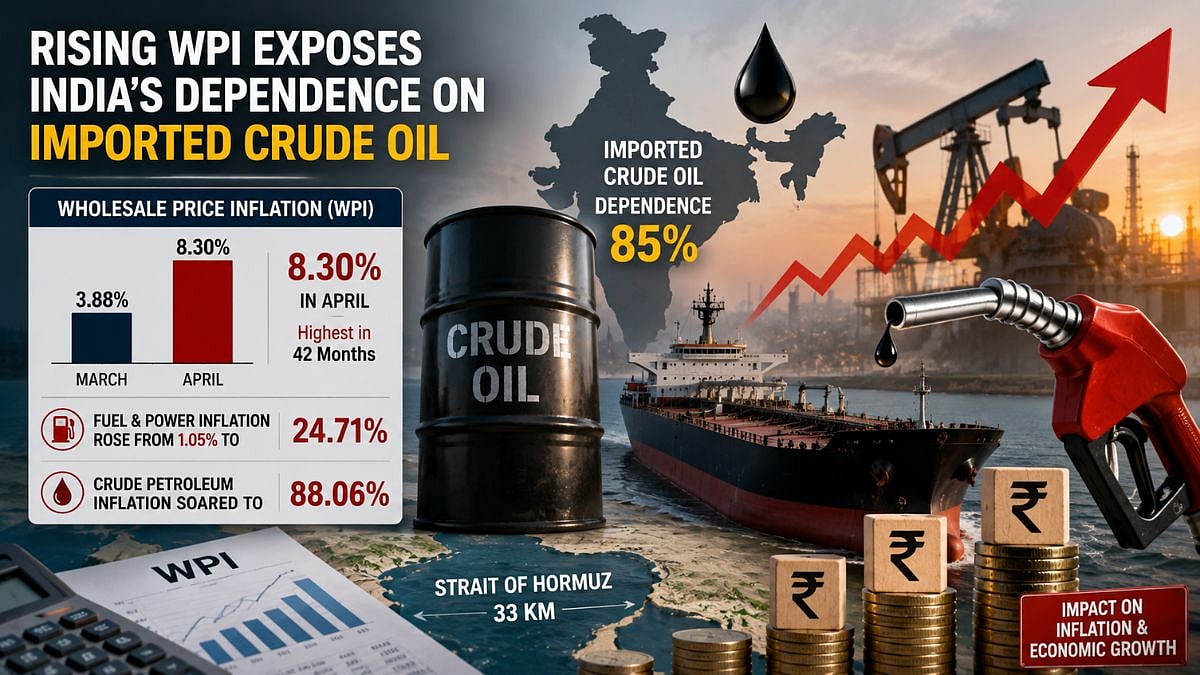
Rising crude oil prices and supply concerns are increasing inflationary pressure on India’s economy and energy security | AI Generated Representational Image
The latest data on Wholesale Price Inflation (WPI) released yesterday, for obvious reasons, underlines India’s over-dependence on imported energy.
India imports about 85 per cent of its crude oil. A large part of that flows through the Strait of Hormuz. When the Strait of Hormuz, just 33 km wide at its narrowest, tightens or closes in part, India’s economy spirals down, as seen from the WPI, which soared to 8.30 per cent in April, more than double that of March’s 3.88 per cent and the highest in 42 months.
Fuel inflation rises sharply
Fuel and power inflation rose from 1.05 per cent to 24.71 per cent in the same month. Crude petroleum inflation soared to 88.06 per cent.
The numbers tell the story that India is bleeding. But it is still not the whole picture. The WPI is upstream of everything. It is what manufacturers pay before consumers pay. By the time the WPI impacts the Consumer Price Inflation, it will be around six to eight weeks. So, the 88 per cent crude shock that India paid in April is yet to reach the petrol pump, the kitchen, and even the factory floor. That bill is still in the post.
But what should hit harder is not the fact that the WPI has doubled but that we were always aware of the problem. It is not a challenge that turned up when we were looking elsewhere.
Need for stronger energy preparedness
What we lacked was preparation, even though our strategic petroleum reserves, for times like this, can hold only about 10 days’ worth of consumption.
The 10-day buffer for nearly 1.4 billion people who rely entirely on imported energy cannot even be called a safety net. The government needs to find out why it ignored this crisis, which gave enough warning before it turned up.
The government has been quick to raise the price of petrol and diesel, which is more of a reflex action than a measured one. Expect the WPI to zoom further, followed closely by the CPI, because of the quick fix.
India had turned to Russian crude for a short while during the crisis, and this option can be exercised at any time, but why the government is not doing so needs an answer sooner rather than later.
Inflation impact on growth
We also need to realise that high wholesale inflation does not imply negative growth; rather, it means the gap between what the economy makes in nominal terms and what it makes in real terms is widening. In other words, the economy may be producing more in rupee terms but less or the same in actual goods and services.
In a sluggish world economy, India’s growth story is a bright star. To sustain growth, it is important that energy reserves be expanded to at least 30 days. Without a bigger buffer, periodic shocks, like the closure of the Strait, will continue to push us down the pecking order in GDP terms.
RECENT STORIES
-
-
-
-
-