India–EU Trade Pact Brings Relief For Farmers While Opening New Export And Services Opportunities
The long-awaited India–EU free trade agreement is expected to boost Indian farm, textile and labour-intensive exports while protecting key agricultural products from import competition. The pact also opens services markets but poses challenges through strict EU regulations on sustainability, labour and food safety.

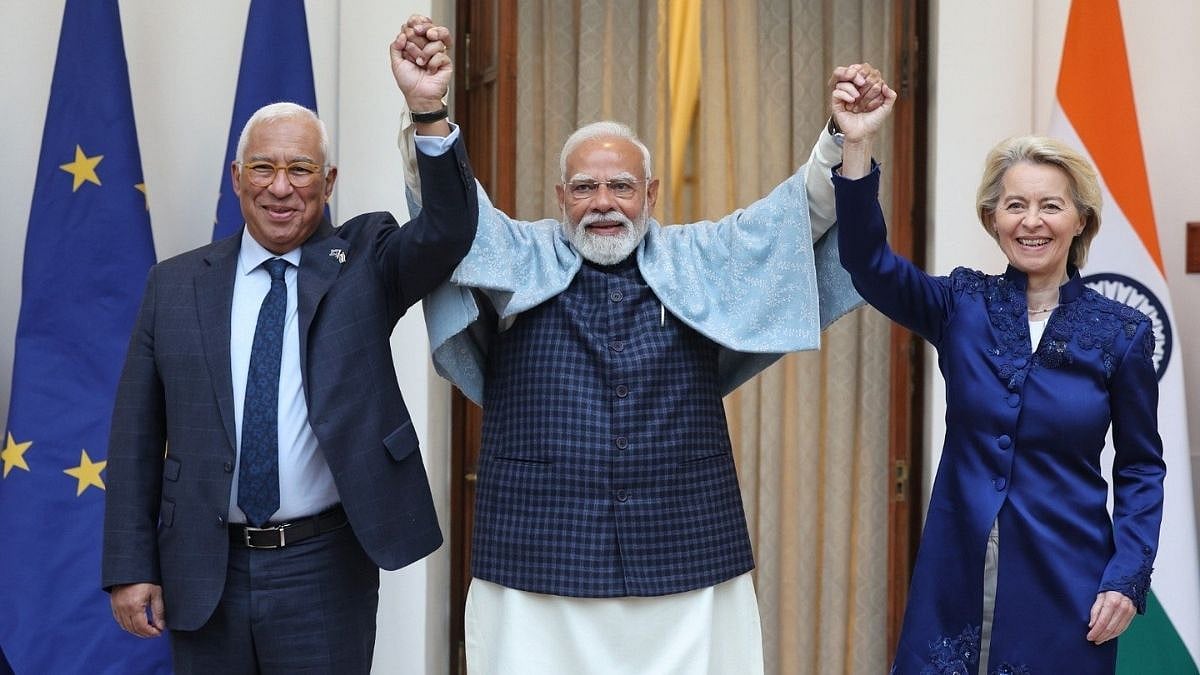
The India–EU free trade agreement promises wider market access for Indian farm and labour-intensive exports while protecting sensitive agricultural sectors | X - @narendramodi
Almost two decades after agreeing to initiate negotiations to formalise a bilateral Free Trade Agreement (FTA), India and the EU have finally announced the conclusion of the agreement. The FTA promises to benefit the two partners, coming at a time when the global economy is beset with uncertainties caused by President Donald Trump’s tariff war and the consequent dismantling of global trade rules. The escalating risk of trading with the US has forced major economies to explore ways of diversifying their export destinations. For both India and the EU, the newly minted FTA provides an opportunity to increase bilateral trade and reduce exposure to the US market.
Export boost and tariff elimination
This FTA promises to increase India’s presence in the market of one of its largest trade partners, which accounted for over 17% of the country’s exports in 2024–25. India could benefit from the EU’s decision to eliminate import tariffs on 99% of its exports in terms of trade value. Several labour-intensive manufacturing sectors, including textiles and clothing, leather, footwear, marine products, gems and jewellery, and engineering and automobiles, could be among the major beneficiaries, as the EU has offered to remove import duties on almost $33 billion of India’s exports once the implementation of the agreement gets under way.
Relief for agriculture and farmers
According to the Government of India, agricultural and processed food sectors could also receive a “transformative boost” under the India–EU FTA, since commodities such as tea, coffee, spices, fresh fruits and vegetables, and processed foods are to gain additional market access. One of the major pluses for India is that its FTA with the EU does not require it to reduce import duties on major cereals and dairy products. India has thus been able to protect its sensitive agricultural products, preventing the farming community from facing adverse import competition.
Services sector gains
Getting enhanced access in partner countries’ markets for service sectors has been among India’s key interests in bilateral trade deals. The EU seems to have met India’s expectations, as it has opened several sectors in which India has perceived strengths, including IT and IT-enabled services, education, financial services and other business sectors. The most noticeable gain for India in this sector is the EU’s commitment to provide “seamless movement of skilled Indian professionals”, which was one of India’s key demands.
EU secures major concessions
For the EU, its two-decade wait to clinch this bilateral trade deal appears to have been worthwhile, as it has secured substantial concessions to increase its presence in the world’s fourth-largest economy. India has offered to reduce or eliminate tariffs on 97% of its imports from the EU. Included in these concessions are sharp reductions in tariffs on automobiles from 110% to 10%, though future imports would be regulated through an annual quota. This is a major gain for the EU, as India had earlier stridently refused to reduce tariffs on automobiles, preventing the deal from going through.
India has also agreed to reduce import duties on a range of products, including pharmaceuticals, processed agricultural products and machinery, though in most cases tariffs would be reduced after five to seven years. This transition period should stand Indian industry in good stead, as it needs to improve its competitive strength to face import competition.
Processed food market opened
Though India has kept major agricultural commodities out of the trade deal, it has opened its domestic market for processed agricultural products to the EU. Tariffs on processed foods such as confectionery, bread, pastry, pasta, chocolates, pet food and sheep meat would be phased out over a period of time.
Non-tariff barriers remain a challenge
The Indian government is quite upbeat about the prospects of benefiting from this deal stemming from lower tariffs offered by the new FTA partner. However, realisation of the expected benefits may not be easy, as the EU uses a plethora of regulations that act as non-tariff measures. Importantly, many of these key regulations are embedded in the FTA.
Sustainability and labour standards
The chapter on Trade and Sustainable Development of the agreement introduces two sets of regulations—one to enhance environmental protection and address climate change, and the other for effective protection of workers’ rights. The EU has always favoured significant reduction of the carbon footprint and has adopted strict domestic regulations for restricting emissions. Earlier this year, the EU imposed the Carbon Border Adjustment Mechanism (CBAM), a carbon tax at the border on imports. The CBAM would make it difficult for Indian businesses to enter the EU market due to high compliance costs, eroding their competitiveness. The only silver lining is that the EU has offered to extend to India some concessions earlier provided to the US, which may benefit MSMEs.
In all its FTAs, the EU has insisted that partner countries ratify the core conventions of the International Labour Organisation to ensure effective protection of workers’ rights. India has not ratified two key conventions—freedom of association and the right to collective bargaining—to lend flexibility to its labour market. It remains to be seen whether the EU will press India to amend its labour laws.
Food safety and intellectual property concerns
Though India expects the FTA to help increase agricultural exports, conformity with the EU’s strict food safety standards could prove a formidable challenge. The EU has explicitly stated that human, animal and plant health is not negotiable and that all products imported from India under the agreement must comply with these standards.
India has accepted one of the EU’s major demands to implement a high level of protection and enforcement of intellectual property rights. Specifically, the EU has demanded protection of new plant varieties under the UPOV Convention, which prevents farmers from saving seeds from one harvest and reusing them in the next. India currently has a law that allows farmers to save seeds while also protecting new plant varieties developed by them. The Centre must ensure that this legislation is not bartered away.
RECENT STORIES
-
-
-
-
-