Have You Wondered How Your Inbox Is Choc-A-Bloc With Loan And Credit Card Offers?
Banks and fintech firms increasingly rely on consumer data and credit profiles to push pre-approved loan and credit card offers. The article examines the risks of data-driven marketing, rising unsecured borrowing, high credit card interest rates and the need for more responsible lending and consumer awareness.

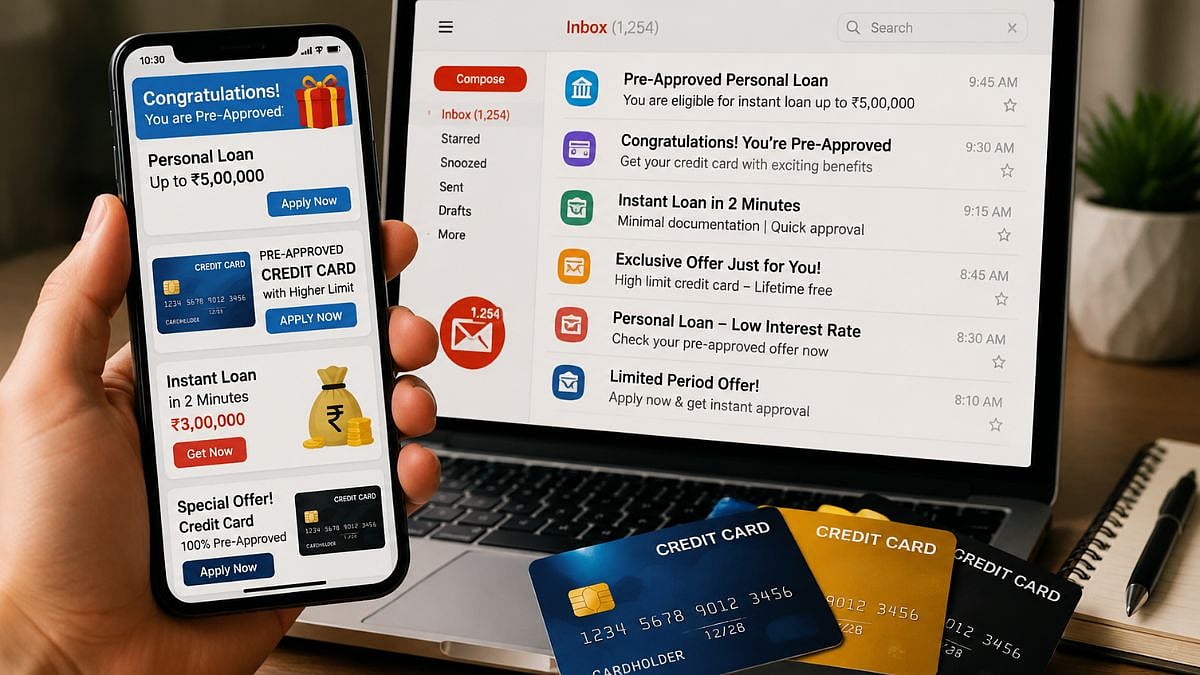
Banks and fintech firms increasingly use consumer data and credit profiles to target customers with pre-approved loan and credit card offers | AI Generated Representational Image
Each time I open my mail inbox, I am greeted with unsolicited offers of preapproved loans and credit cards. This is the unanimous experience of hundreds of my relatives and friends. It is not as if such audacious overtures are coming only from fintech firms and small banks alone. Big state-owned banks as well as the private sector biggies also throw their hats in the ring in the race for one-upmanship when it comes to granting loans, the main bread-and-butter activity of financial institutions. Your inbox is flooded with unsolicited offers because banks and digital lenders purchase consumer data profiles or run pre-screening algorithms through credit bureaus. If you have a good credit score, maintain an active banking/salary account, or have searched for financial products, you are flagged as a prime target. To be sure, some of them land in your spam folders; that hardly deters the indefatigable wooers, as it costs very little to access the email addresses of potential neo-converts to consumerism.
How Your Data Is Used
Credit bureaus frequently compile lists of consumers who meet specific credit criteria and sell this aggregated data to banks to solicit you with "firm offers". Likewise, whenever you fill out a simple web form, check your credit score, or click on a personal loan offer in a banking app, you inadvertently fall into the trap—your information is often added to targeted marketing pools. Many of these emails originate from financial aggregator platforms (like BankBazaar or Paisabazaar), where you may have previously, wittingly or unwittingly, consented to receive promotions. Such offers may seem harmless, but their sheer availability, thanks to making your financial profile available to the entire world through credit bureaus, could tempt crooks to hack your bank account. On the flip side, though, such free availability helps you buy consumer durables on credit, with dealers knowing your details through any one of your identities—PAN, Aadhaar, mobile number, etc. It is better to nip the danger in the bud by opting out or blocking such communications because, when you need a credit card or loan, you can hotfoot it to your branch or, if you are adept at net banking, apply for a card online. Be that as it may.
Why Lenders Keep Chasing You
Why are banks and fintechs so keen on onboarding you when they don’t even touch your formal loan applications with a barge pole? It is the heady prospect of interest on credit card dues, often as high as 42% per annum or more. Credit cards are unsecured loans for banks and fintechs, with credit risks running high. But for banks and fintechs, the high returns are irresistible. Banks report credit card default losses using "charge-off rates" (the percentage of total outstanding debt that is deemed uncollectable). Instead of losing the entire balance, banks typically recover a fraction of defaulted amounts through collections or debt sales to recovery agents.
As of early 2026, the annualised credit card charge-off rate for US commercial banks hovers around 3.84%. Major banks factor these default losses into their standard operating costs, which are offset by high annual interest rates (often 20% to 24%) charged to revolving balances, which in India is close to 42%, as stated earlier. Credit card defaults in India reached Rs 6,742 crore, according to recent Reserve Bank of India (RBI) data. Credit bureaus note that overall delinquency volumes hit Rs 33,886 crore, driven by a surge in unsecured borrowing and high annual interest rates. But then India is relatively new to credit cards, unlike the US, where they have been in vogue for ages, with big stores turning down debit cards and happily accepting credit cards. So, while the situation is not yet alarming, the chances of defaults reaching dangerous levels are very high.
The Risks And Rewards
When a debt is written off (charged off), banks typically sell the defaulted accounts to collection agencies at a significant discount (often for pennies on the dollar) to recoup a portion of the loss. Many wily users know this and wilfully default so as to settle with the banks on their terms. In India, the rough-and-ready methods of collection agents are too well known to bear repetition despite the RBI warning against such high-handedness. Stories of motorbike owners losing their keys at traffic signals as well as at offices and homes are legion.
But then it is not as if everything about credit cards is gloom and doom. They have their flip side. Banks enjoy substantial credit from card majors Visa and Mastercard, though lately, thanks to the RBI initiative, RuPay is doing well in the domestic segment. And they pass on the interest-free float to the cardholders. Many banks in India have a billing cycle of 45 days, which customers lap up. With quick commerce firms on the ascendant, impulsive shopping is on the rise. People find the online display of the menu irresistible and order things, thanks to the lulling effect of credit cards. First the binge, then the bill warning hardly deters them. Moreover, credit cards are there for the asking, whereas formal loan applications take months to be sanctioned with a lot of paperwork. Credit cards are issued without much fuss.
Rethinking Creditworthiness
The prudent among credit card users use them practically as debit cards—standing instructions to the bank to automatically debit their accounts with the full dues on the date they are payable, thus exposing nothing to the usurious 42% or more rates while getting to savour the 45-day free credit. Small wonder some people on the fast track preen with pride, flaunting multiple credit cards and multiple mobile phones in their pockets. Credit bureaus should also get their acts together. Why do they believe that profligacy, as manifested by higher usage of credit facilities, is an indicator of one’s creditworthiness? And why should a conservative spender, living within his means, be looked askance at?
S Murlidharan is a freelance columnist and writes on economics, business, legal and taxation issues.
RECENT STORIES
-
-
-
-
-