Global Oil Shock: Iran War Jolts Indian Markets, Weakens Rupee And Raises Costs Across Economy
The Iran war has triggered a global oil shock, impacting India’s economy with falling markets, a weaker rupee, rising bond yields, and higher household costs. Elevated crude prices and supply disruptions are expected to keep inflationary pressures high across sectors.

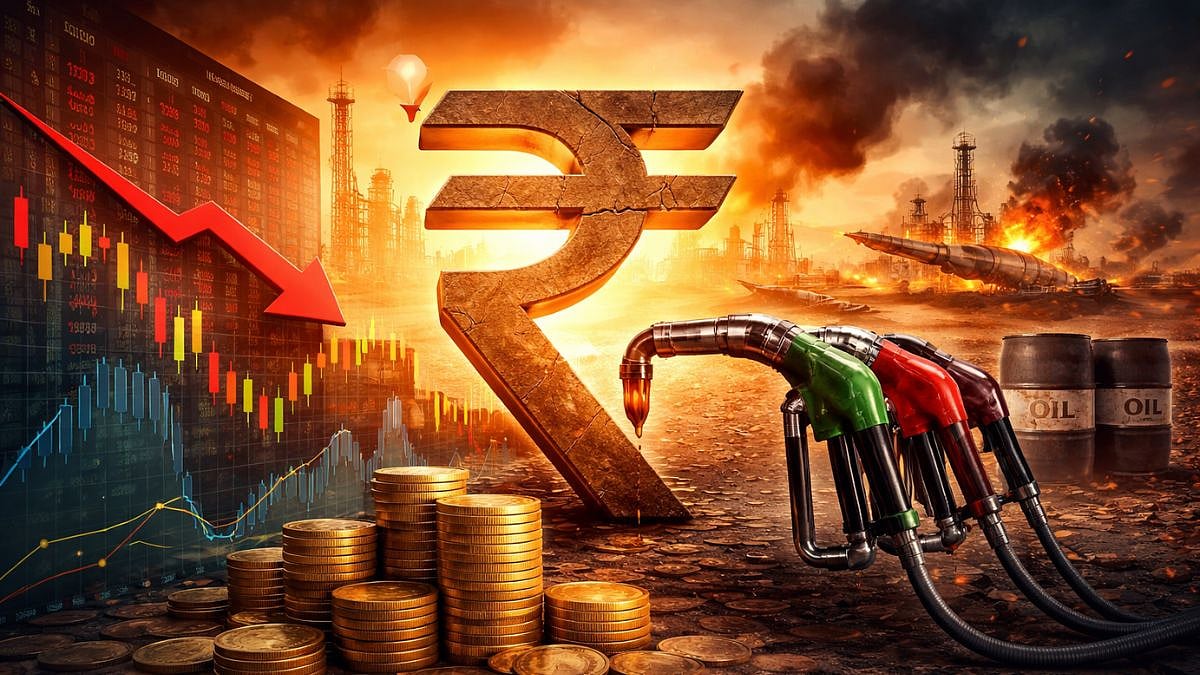
Rising crude prices and geopolitical tensions shake Indian markets, currency and household expenses | AI Generated Representational Image
From crashing equities to soaring oil, Iran war ripples through India’s markets, currency, bonds, and household costs sharply.
Madan Sabnavis
Since the Iran war began in March, there have been several ups and downs. The markets have reacted in a variable manner depending on political statements made on all sides.
Therefore, evaluating their movement becomes challenging, though admittedly everything has been turned around once too often ever since the tariff issue dominated the economic architecture.
Stock markets are down, currencies are falling, and bond yields are rising. Every time it appears that a truce could be drawn, which soothes the markets, there is contrary news that spooks them again.
Hence, when evaluating the impact on markets, the numbers must be read with some discretion, as the evaluation is at a point in time when things looked irreversible.
Stock markets and investor uncertainty
Let us look at the markets sequentially. The Sensex (free float) has lost around Rs 10 lakh crore of market capitalisation as on March 23, compared to February 27, which was before the war erupted. If the same is considered for the BSE 500, it would be Rs 20 lakh crore.
However, such numbers must be read with caution because these are notional losses and not actual, as the indices have been valued at market prices. The message, however, is clear. Stock markets have been losing rather than gaining, and this is the story across countries.
Therefore, for investors, it is a tough call. Does one invest now that the market has troughed, or can there be another new low from here? Interestingly, markets revived once there was subsequent news that there could be a solution to the war.
Rupee under pressure amid global trends
Next is the currency market. The rupee has been in a downward spiral and, while the market has been looking for guidance from the RBI in the form of intervention, it appears there may be an indifferent response.
This is logical because, as all currencies are tending to decline rather than rise, there may be little merit in selling dollars to stabilise the rupee. Selling dollars may stabilise the rupee today, but the decline would recommence once these sales stop.
The currency went down by almost Rs 3, touching Rs 94 to a dollar from Rs 90.95/$ on February 27. It crossed the 94 mark again on the 27th. This affects exporters and importers differently, with the former benefitting and the latter being disadvantaged.
Bond yields rise and borrowing costs increase
The bond market has also witnessed an increase in yields, with the 10-year yield touching 6.90–6.95% from 6.68% before the war commenced. This movement has little to do with the domestic liquidity situation but is linked to movements in US Treasuries, where yields have jumped by almost 20 basis points.
As the two remain linked in terms of maintaining differentials, domestic yields have increased sharply. The implications are that, from a banking perspective, treasury gains would face a downside, as higher yields are associated with declining bond prices.
Additionally, government borrowing would become costlier, as these bond yields serve as reference points for fresh issuances of G-Secs by the RBI. Hence, borrowing costs for the government could increase in FY27 if these yields remain elevated. A 10 basis point increase can raise the government’s interest cost by around Rs 1,700 crore.
Gold volatility amid stronger dollar
Another major price shock is seen in gold. The rally pushed prices beyond the $5,000/ounce level, suggesting the metal would thrive in this volatile environment. As on February 27, the price was $5,222/ounce. However, it fell to $4,376 on the 26th, when markets went into turmoil.
Investors who bet on gold in a supportive environment faced the impact of a stronger dollar as prices declined. Will prices recover? It is uncertain, as traditionally there is an inverse relationship between the dollar and gold prices.
The dollar is likely to remain strong, as the current environment may not support further rate cuts by the Federal Reserve, notwithstanding the appointment of a new Chairman.
Oil shock and impact on households and industries
Finally, the most important market, with far-reaching influence across sectors globally, is oil. Brent crude rose from $71 per barrel on February 28 to $105, and could move further depending on developments in the war. In contrast, the Indian basket climbed more sharply from $71 per barrel to $150 per barrel.
The concern for individuals is when this doubling will be reflected in fuel prices at the pump. Beyond crude oil, gas supplies have been disrupted due to blocked shipping routes and the shutdown of production facilities in Qatar.
At the ground level, households are already facing delays in LPG deliveries due to physical constraints. The hospitality industry is affected by limited availability of cooking gas, and alternatives are not always viable.
Transport costs will rise if fuel prices are increased. Industries such as fertilisers, pesticides, plastics, aviation, and ceramics are facing challenges due to higher petro-input costs and supply disruptions.
Widespread disruption and uncertain outlook
Overall, there has been widespread disruption, with markets bearing the brunt. The key question remains: when will this end, given the time lags involved in restoring stability to the oil economy? This shock is markedly different from the Ukraine-Russia war, which had a comparatively lesser economic impact.
The author is Chief Economist, Bank of Baroda, and author of ‘Corporate Quirks: The Darker Side of the Sun’. Views are personal.
RECENT STORIES
-
-
-
-
-