FCRA Bill 2026 Delay Reflects Political Strategy Ahead Of Elections, Raises Concerns Over Civil Society Oversight
The delay in tabling the FCRA Amendment Bill 2026 is seen as a strategic political move ahead of key elections. While the government’s stance remains unchanged, the pause highlights concerns over tightening NGO regulations and raises broader questions about balancing oversight with democratic freedoms.

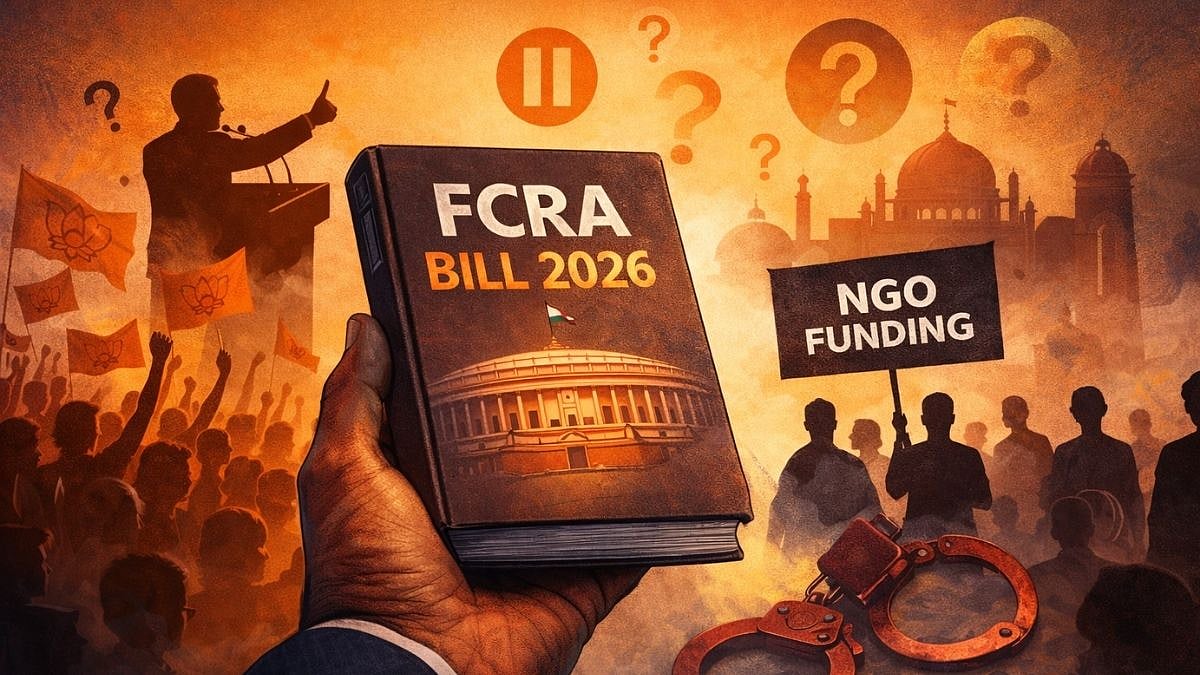
FCRA Bill delay sparks debate over political timing and its impact on civil society and democratic balance | AI Generated Representational Image
The decision not to take up the Foreign Contributions (Regulation) Bill, 2026, for discussion and voting in Parliament this week should not be mistaken for hesitation on the part of the ruling Bharatiya Janata Party. There is little evidence to suggest that the government has developed second thoughts about the substance of the legislation.
The more plausible explanation lies in electoral arithmetic. With key state elections approaching — particularly in Kerala, where minorities constitute a significant share of the electorate — the political costs of pushing through a controversial law at this juncture may have outweighed the benefits.
Legislative timing, in such cases, becomes an extension of campaign strategy rather than a reflection of reconsideration. It is, therefore, reasonable to expect that the Bill, unchanged in spirit and substance, will return to the parliamentary agenda once the electoral cycle has run its course and the immediate political sensitivities have subsided.
Pause offers scope for reflection
Yet, this pause offers an opportunity for reflection — something often lost in the rush of majoritarian lawmaking. The proposed amendments are not merely administrative adjustments but part of a longer historical continuum that traces back to the Emergency.
The original FCRA was enacted in 1976 to curb dissent and monitor organisations that challenged the government of the day. Successive amendments — in 1984, 2010, and 2020 — have only strengthened its reach and widened its scope. The current Bill represents yet another tightening of that framework, extending state oversight deeper into the functioning of civil society.
This raises an uncomfortable question: can a government that rightly condemns the excesses of the Emergency claim moral authority while simultaneously reinforcing the legal architecture that enabled those very excesses? The contradiction is not merely rhetorical; it strikes at the core of democratic credibility and institutional consistency. More troubling, however, is the disproportionate focus of regulatory zeal.
Concerns over regulatory priorities and impact
The government’s own figures suggest that the total annual inflow under FCRA — around Rs 22,000 crore distributed among roughly 16,000 organisations — is relatively modest in the larger financial landscape. In contrast, the sums involved in bank frauds and high-profile economic offences run into tens of thousands of crores, often exceeding the total annual FCRA inflow.
Yet, the state’s energies appear more directed at scrutinising NGOs, charities, and faith-based institutions rather than addressing systemic financial leakages. The result is a chilling effect on civil society, where even legitimate activities — running orphanages, old-age homes, or educational institutions — are burdened with suspicion and procedural uncertainty.
Laws that conflate oversight with control risk eroding the very social capital they ought to protect. When Parliament reconvenes and the Bill inevitably resurfaces, the question before lawmakers will not merely be one of legality, but of balance: between security and freedom, between regulation and trust, and ultimately, between power and principle.
RECENT STORIES
-
-
-
-
-