Fail Again, And Fail Better
Bihar Chief Minister Samrat Choudhary’s reported plan to replace “fail” with “eligible for skill training” for students not clearing board exams has triggered debate. The article argues that changing terminology may not address deeper problems in education. It highlights concerns over exam pressure, skill programmes and the need for schools to encourage curiosity and student wellbeing.

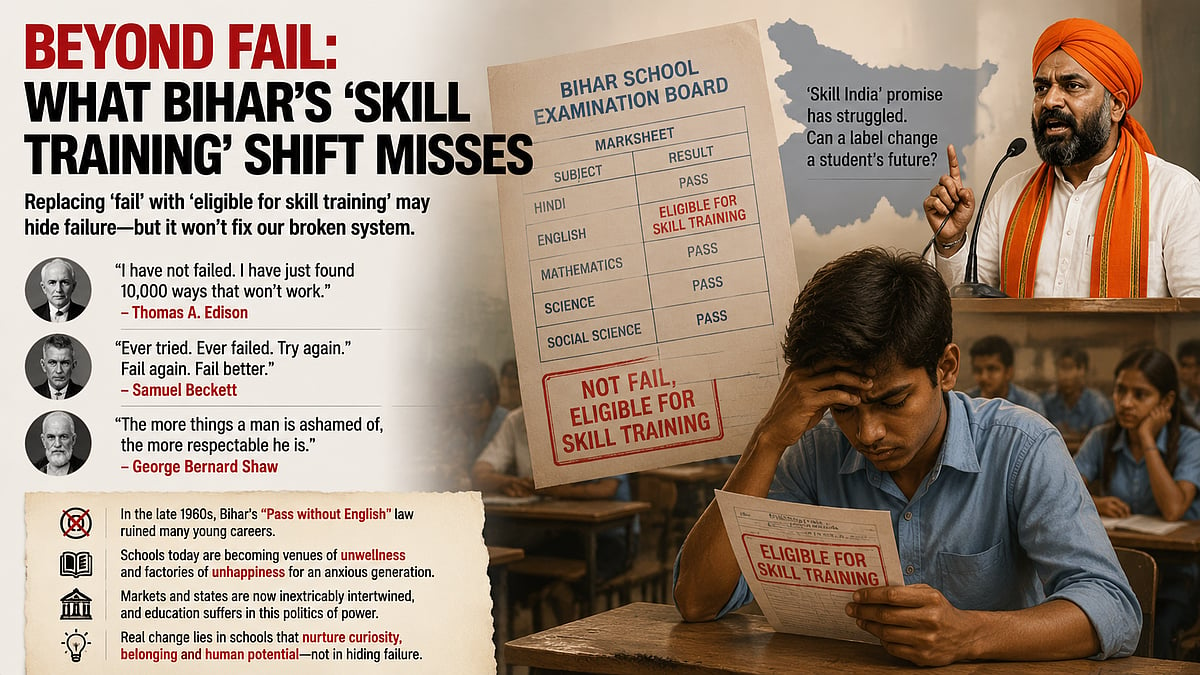
Fail Again, And Fail Better | AI
Thomas A Edison said famously, “I have not failed. I have just found 10,000 ways that won’t work.” Samrat Choudhury, Chief Minister of Bihar, expects students not clearing the Bihar School Examination Board to get philosophical. And maybe heed Irish author Samuel Beckett’s advice: “Ever tried. Ever failed. Try again. Fail again. Fail better.” Beckett’s words are unlikely to soothe the young students. He had experienced failure himself, as no one was willing to publish his first novel, “Dream of Fair to Middling Women”. Those not passing the exam will not have to suffer the ignominy of failure. The phrase “eligible for skill training” will replace “fail” in the marksheet. The government may describe it as a masterstroke, but the fate of the ‘Skill India programme’ is nothing to write home about. In the late 1960s, the Karpoori Thakur government passed a law whereby those secondary exam candidates who failed in English were declared “Pass without English”. Students with such degrees rarely found any jobs, and their careers were ruined.
Bihar is not unfamiliar with the triumph of failure, especially in the field of politics and education. One may argue, why worry when even Charles Chaplin, who once entered a look-alike competition, only came third! The Chief Minister has apparently taken to heart George Bernard Shaw’s phrase, “The more things a man is ashamed of, the more respectable he is.” This is what Laloo Yadav’s politics and governance meant. But he was by no means the only leader to fudge, feign, deny, and fake his way out of trouble to deal with the poor performance of his government in the field of education. Students with humble backgrounds belong to the anxious generation. In the present system of education, a large number of students studying in government schools are like canaries in the coal mines. Schools and colleges, to them, have increasingly become venues of unwellness and factories of unhappiness. Schools and colleges have also become incubators of unwellness.
In the prevailing system of education, it is not easy to fail. Failure means one is made to believe that it is the fault of the students and that something is wrong with them and not with the schools or the system. Schools and colleges place emphasis on academic hyper-productivity, which is another name for dehumanisation. Real change will come not from a short-sighted, half-cooked policy of not failing the students, but through a policy whereby schools encourage curiosity and a sense of belonging. Our children can’t be allowed to become the victims of epistemic injustice and unwellness in the classroom. A major challenge facing education is how markets and states are now inextricably intertwined. Education suffers, as it is linked to the politics of power.
RECENT STORIES
-
-
-
-
-