Curing India’s ‘White Line Fever’: The Urgent Need To Make Highways Safer
India’s highways continue to witness high fatalities, prompting Supreme Court directives for urgent reforms. Measures include stricter enforcement, better infrastructure, and safety systems to curb accidents and improve accountability across agencies.

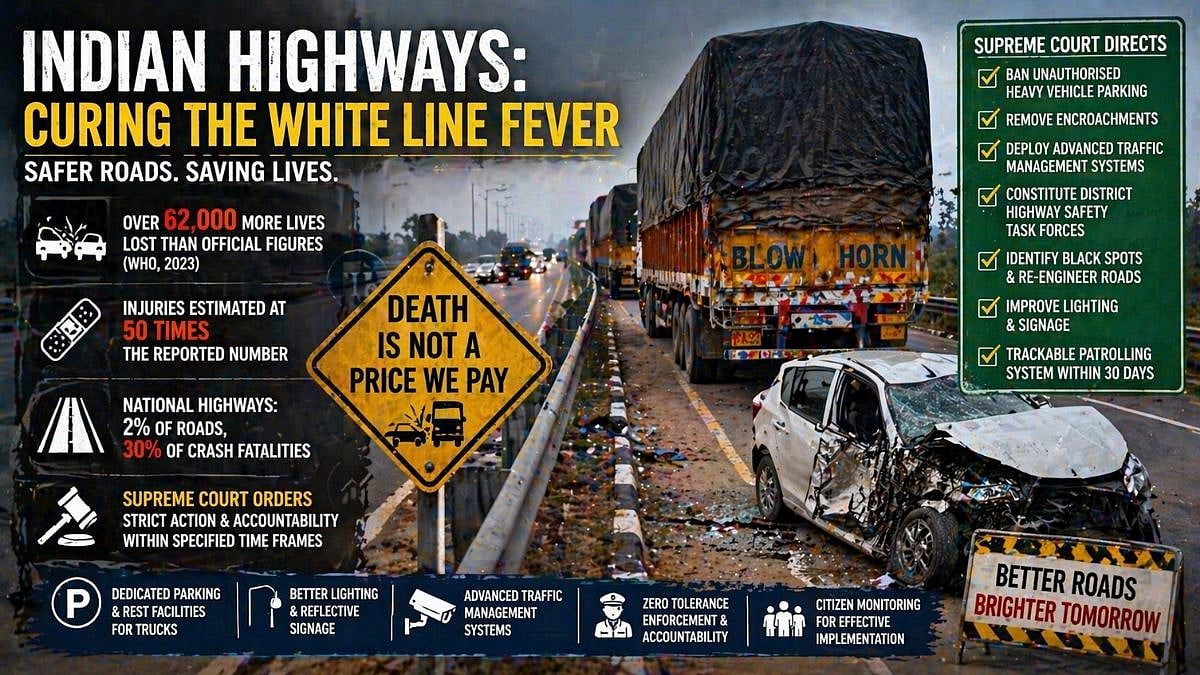
Supreme Court steps in to address rising fatalities and safety lapses on Indian highways | AI Generated Representational Image
It is a scandal that India has arguably the most unsafe highways anywhere in the world and even undercounts the number of road crash deaths. The World Health Organisation (WHO), in its last available Global Status Report on Road Safety, 2023, estimates that over 62,000 more lives were lost in the country than the officially reported 153,972. WHO’s estimates of injuries are 50 times that number. This is a colossal loss, and no measure to bring sanity to Indian roads would, therefore, appear excessive.
Supreme Court directions
The Supreme Court must be thanked for periodically nudging governments to act. The latest in such orders that advance Article 21’s guarantee of the right to life are the SC’s comprehensive directions in a suo motu case initiated in the wake of terrible accidents in Phalodi (Rajasthan) and Telangana that killed nearly 40 people.
Business as usual can no longer be the attitude at the Union Ministry of Road Transport and Highways, National Highways Authority of India, National Highways and Infrastructure Development Corporation, state PWD departments, and Border Roads Organisation, which have been ordered to prohibit unauthorised heavy vehicle parking, remove encroachments, provide advanced traffic management systems, and constitute district highway safety task forces, all within specific time frames.
These agencies must turn the badlands that the national highways are into civilised spaces. As the court notes, the NH system constitutes 2% of roads but contributes 30% of crash fatalities. The situation is not dramatically better on state highways. It is welcome that the court has ordered states to set up, within 30 days, a trackable patrolling system made up of police and transport departments.
Systemic issues and accountability
Road crashes, fatalities, and injuries are viewed in India as an acceptable cost of automobilisation to expand personal mobility and goods transport. New roads, including expanded highways built each year, and more vehicles sold through liberal financing schemes, mean more vehicle kilometres travelled, with a concomitant increase in crashes.
Accidents happen to good drivers because of bad drivers, faulty road engineering, absent road maintenance, and lack of adequate signage. The NHAI and states would do well to implement the court’s direction on identifying black spots, re-engineering roads, and installing high-quality lighting and reflective signage. Transport literature shows that only the fear of impartial and zero-tolerance enforcement reforms driver behaviour.
Virtually invisible giant trucks parked along dark roads are the equivalent of deadly weapons, and they need adequate parking lay-bys where they must be compelled to park; food and rest facilities are mandatory. Together with these and other forward-looking measures that official agencies must comply with and report to the SC, the bureaucracy and police must be held directly accountable for safety.
Call for implementation
Civil society must ensure effective implementation of the SC’s orders in the Phalodi case and earlier directions in Gyan Prakash and Rajasekaran vs. Union of India.
RECENT STORIES
-
-
-
-
-