Cousins Unite To Survive: Why Thackeray Alliance Is About Political Relevance In Mumbai
Uddhav and Raj Thackeray’s alliance for the BMC elections is driven less by sentiment and more by survival. Facing the threat of political marginalisation in Mumbai amid Mahayuti’s rise, the cousins hope unity will consolidate the Marathi vote—but the city’s complex electorate may still have the final say.

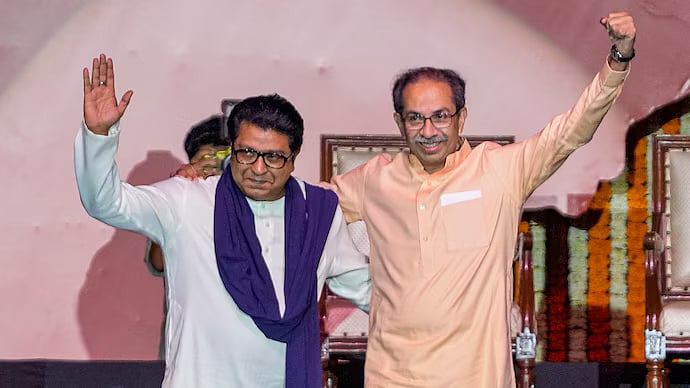
Uddhav Thackeray and Raj Thackeray join forces ahead of the BMC elections in a bid to retain political relevance in Mumbai | FPJ Image
The coming together of cousins Uddhav Thackeray and Raj Thackeray is not the result of any sudden rediscovery of brotherly affection. It is a hard-headed political calculation borne out of fear—fear of political irrelevance in the one arena that still gives them stature: Mumbai.
Their announcement that the Shiv Sena (Uddhav Balasaheb Thackeray) and the Maharashtra Navnirman Sena will jointly contest the forthcoming Brihanmumbai Municipal Corporation elections is less about sentiment and more about survival. Recent municipal elections in Maharashtra sent a clear message.
The Mahayuti—led by the BJP, Ajit Pawar’s NCP, and Eknath Shinde’s Shiv Sena—virtually swept the polls. The cousins have little doubt that if it is allowed a free run in Mumbai, the outcome would be no different. For leaders whose political relevance now rests largely on their presumed hold over the city, that prospect is alarming.
Their first show of unity came while opposing the state government’s move to make Hindi compulsory in schools from Classes 1 to 5, a move they argued would be at the cost of Marathi. That agitation underlined an uncomfortable truth: whatever political capital either cousin still commands flows from Mumbai’s Marathi-speaking population.
If the Sena vote is split between the UBT faction and the MNS, both risk being marginalised. By coming together, Uddhav and Raj Thackeray hope to consolidate the Maratha vote bank, historically the bedrock of the Shiv Sena’s power.
Marathas constitute around 35 per cent of Mumbai’s population. If they were to vote as a single bloc, they could indeed tilt the balance against the Mahayuti in many wards. History offers a cautionary parallel. In 1992, when the BJP and the Shiv Sena fought each other, it was the Congress that walked away with power.
But wishes are not always horses. The BJP-led alliance has formidable partners with a real presence in Mumbai. Eknath Shinde has already pointed out that his faction of the Shiv Sena won more seats than the entire Maha Vikas Aghadi in the recent elections. Moreover, non-Marathas are in a majority in the city, a factor that could work to the Mahayuti’s advantage.
The Congress, which also has a footprint in Mumbai, has decided to go it alone, undermining the Opposition unity the cousins hope to project. The alliance has already had ripple effects. Chief Minister Devendra Fadnavis, who earlier said the next mayor would be a Hindu, has now said the mayor will be a Maratha.
The cousins have echoed the same claim. Yet the real issue is neither caste nor identity. What India’s richest and largest municipal corporation needs is competent, corruption-free leadership rooted in the grassroots.
Mumbai’s voters have tried every major party. They can be trusted to take their own call—on performance, credibility, and the future they want for their city.
Published on: Friday, December 26, 2025, 12:09 AM ISTRECENT STORIES
-
-
-
-
-