Can NEET Anger Become The Opposition's 2027 Game Changer In Uttar Pradesh?
The NEET agitation could help the Congress and Samajwadi Party shift Uttar Pradesh's political narrative from identity politics to jobs, examinations and unemployment ahead of the 2027 Assembly election, while testing the BJP's ability to retain the support of young voters amid growing concerns over recruitment and paper leaks.

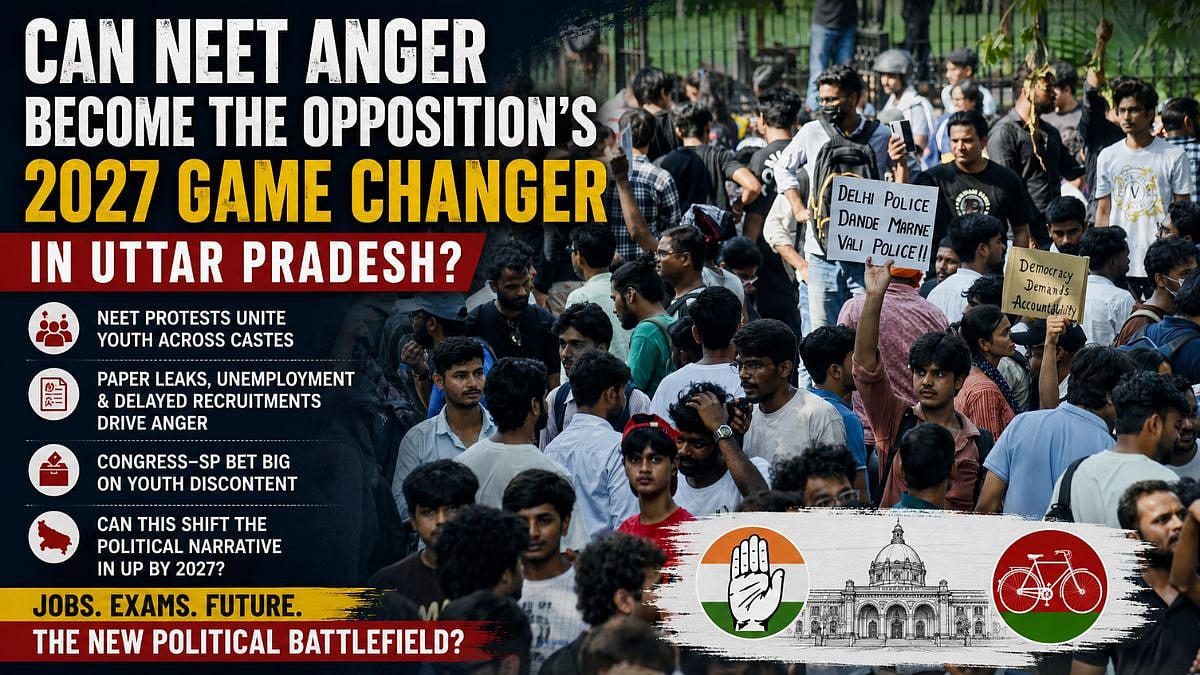
The NEET agitation has become a focal point in the Opposition's attempt to rally young voters ahead of the 2027 Uttar Pradesh Assembly election | AI Generated Image
The images from Delhi's Jantar Mantar were politically striking. Rahul Gandhi sitting among agitating students, Akhilesh Yadav joining him the next day, and Mainpuri MP Dimple Yadav comforting injured protesters after clashes with police offered something the Opposition has struggled to project in recent years: unity, empathy and a common political purpose. For the Congress and the Samajwadi Party, the NEET agitation is far more than a protest over an entrance examination; it is an attempt to redefine the political discourse ahead of the 2027 Uttar Pradesh Assembly election.
Shifting The Political Narrative
The BJP has dominated Uttar Pradesh politics for nearly a decade by setting the electoral agenda around Hindutva, welfare schemes, law and order, and Prime Minister Narendra Modi's leadership. The Opposition has repeatedly failed to force a conversation on issues that directly affect young voters. The NEET controversy has suddenly altered that equation. It has allowed the Congress and the Samajwadi Party to shift the spotlight towards paper leaks, unemployment, delayed recruitments and what they describe as institutional failure.
This is not merely another street protest; it is perhaps the first coordinated political campaign after the 2024 Lok Sabha election in which the Congress and the Samajwadi Party appear to have discovered a narrative capable of cutting across caste identities. Jobs and examinations affect every household. Unlike traditional caste mobilisation, educational insecurity creates a shared grievance among students from all communities.
The transformation of the protest into a political movement was carefully choreographed. Rahul Gandhi gave the agitation national visibility. Akhilesh Yadav ensured that the issue travelled into Uttar Pradesh. But the surprise element was Dimple Yadav. Her repeated visits to Jantar Mantar after the July 20 clashes, remaining with injured students instead of making a symbolic appearance, produced some of the most widely shared images of the protest. Videos showing her helping injured students, climbing police barricades and coordinating medical assistance created an emotional narrative that political speeches alone could never achieve.
Youth Sentiment At Centre Stage
In politics, perception often matters more than statistics. Dimple Yadav projected compassion while the government appeared defensive. Whether that perception is entirely fair is beside the point. Elections are rarely fought on administrative explanations; they are fought on public emotion.
This explains why the BJP cannot dismiss the agitation as another Opposition protest. The party has invested enormous political capital in cultivating first-time voters. Through welfare schemes, nationalism, digital outreach and promises of employment, it has built a formidable support base among young Indians. But this constituency is also the most impatient. Every paper leak, cancelled examination or delayed recruitment chips away at the government's credibility. Uttar Pradesh has witnessed repeated controversies over recruitment examinations during the past few years. The Opposition now seeks to stitch these scattered grievances into a larger political indictment.
The Congress and the Samajwadi Party understand that defeating the BJP on religious polarisation alone is nearly impossible. The Ayodhya Ram Temple, welfare delivery and Modi's popularity continue to provide the BJP with significant political advantages. Therefore, the Opposition is attempting to change the battlefield itself. If the election continues to revolve around jobs rather than identity, examinations rather than religion, and aspirations rather than symbolism, it believes the BJP's electoral dominance will become less secure.
This also explains why Rahul Gandhi and Akhilesh Yadav have chosen to repeatedly invoke unemployment alongside the NEET controversy. The examination issue by itself may fade with time, but unemployment is a permanent concern. Linking paper leaks with the larger crisis of employment allows the Opposition to sustain political pressure long after the immediate controversy subsides.
Challenges Ahead
Yet, the Opposition faces equally serious challenges.
History offers a cautionary lesson. The Congress and the Samajwadi Party fought the 2017 Assembly election together under the much-publicised "UP ke do ladke" campaign. The alliance failed spectacularly because organisational coordination never matched public messaging. Nine years later, despite the encouraging Lok Sabha performance in 2024, many of those structural weaknesses remain unresolved.
Seat-sharing continues to be a major source of friction. Congress leaders have publicly demanded parity despite the party's weak organisational presence in Uttar Pradesh. Samajwadi Party leaders privately believe the Congress is overestimating its bargaining power after the Lok Sabha election. Such disagreements have the potential to overshadow the carefully cultivated image of unity.
More importantly, converting protest into votes is far more difficult than organising demonstrations. Students protesting in Delhi do not automatically translate into electoral gains across Uttar Pradesh's 403 Assembly constituencies. The Opposition must now create district-level movements, sustain public attention for several months and convince unemployed youth that it offers a credible alternative rather than merely criticism.
Road To 2027
The BJP, meanwhile, has repeatedly demonstrated its ability to recover from setbacks. The Lok Sabha election undoubtedly exposed vulnerabilities. But the Assembly by-election results showed that the party's booth-level machinery remains highly effective. Unlike the Opposition, the BJP possesses a disciplined organisation capable of quickly changing the political narrative. It is likely to counter the NEET campaign by highlighting infrastructure development, welfare schemes, investments, law and order, and employment generation.
The BJP may also attempt to fragment the Opposition narrative by portraying the Congress and the Samajwadi Party as opportunistic supporters of every agitation. It knows that prolonged protests can lose public sympathy if they appear excessively political. The ruling party's strategy will, therefore, be to prevent the Opposition from monopolising the emotions of young voters.
Ultimately, the biggest political question is not whether the NEET protest generated headlines. It unquestionably did. The real question is whether it can evolve into a sustained youth movement capable of influencing electoral behaviour six months from now.
The Congress and the Samajwadi Party have finally found an issue that resonates beyond their traditional vote banks. They have projected unusual unity and succeeded in placing the BJP on the defensive over questions of recruitment, examinations and unemployment. But protests alone do not win elections. They must be backed by organisational cohesion, credible leadership, a realistic seat-sharing arrangement and a persuasive governance alternative.
For the BJP, the warning signs are equally clear. Welfare schemes and nationalism have delivered repeated electoral victories, but aspirations among India's youth are changing rapidly. Young voters increasingly judge governments not only by identity or ideology but also by opportunities, transparency and fairness in recruitment. Every examination controversy reinforces doubts about those promises.
The road to the 2027 Uttar Pradesh Assembly election may, therefore, witness an unusual contest. For the first time in years, the central political battle may not be over temples or caste equations; it may instead be over examination halls, recruitment lists and the future of millions of young Indians. If that happens, the NEET agitation at Jantar Mantar may eventually be remembered not merely as a student protest but also as the moment when Uttar Pradesh's electoral narrative began to shift.
The writer is a senior journalist. Views expressed are personal.
RECENT STORIES
-
-
-
-
-