An Ethical Society Does Not Apply Rules Based On Status
Selective obedience to rules, driven by status, influence and personal convenience, weakens society's ethical foundations. From traffic violations and queue-jumping to corruption and VIP culture, everyday exceptions undermine fairness. Better governance requires predictable enforcement, but citizens must also accept personal responsibility for following the rules they expect others to obey.

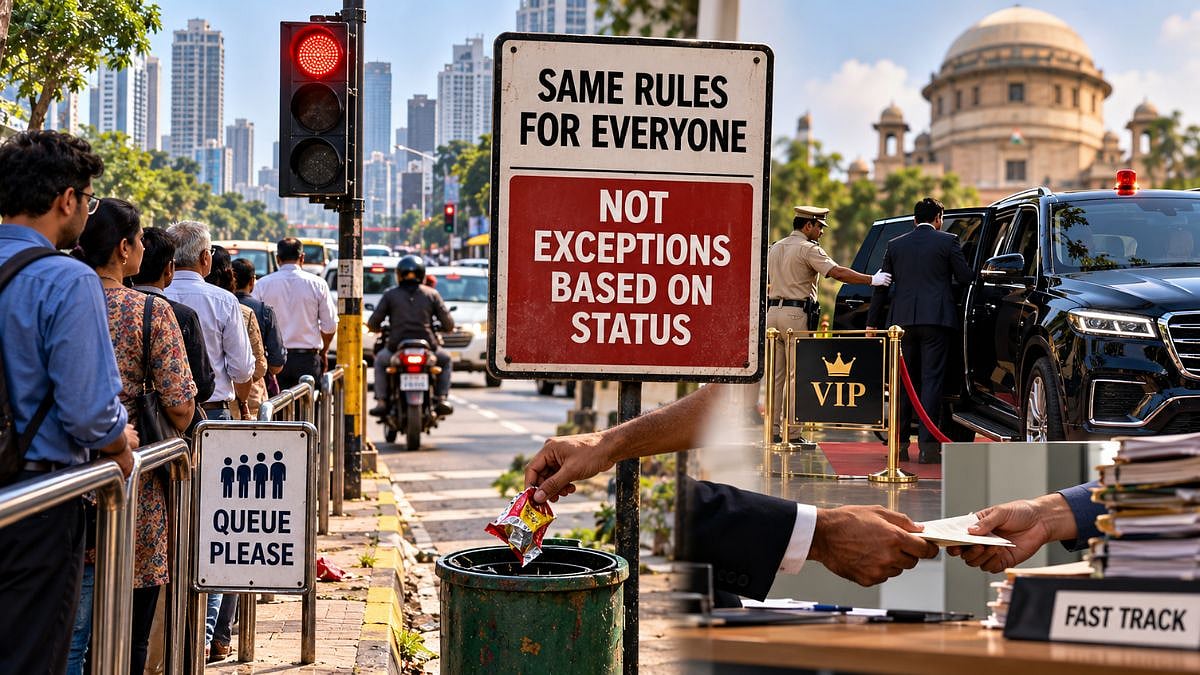
Dr Srinath Sridharan argues that equal respect for rules, regardless of wealth, influence or personal convenience, is essential to building an ethical society | AI Generated Image
There is a peculiar contradiction in the way we live with rules. We complain when institutions are arbitrary, demand that governments enforce laws, expect companies to follow regulations, and want public spaces to function with discipline. Yet, the moment a rule inconveniences us personally, we become remarkably inventive about why we should be an exception.
The traffic signal is sacrosanct when somebody else jumps it. When we are late, the red light becomes an unfortunate suggestion. We condemn encroachment until the shop, parking space or construction that benefits us occupies the footpath. We want cleaner streets but regard the wrapper in our hand as somebody else’s problem. We resent queues, then look for a familiar face, a contact or a small favour that can move us ahead.
We demand zero tolerance until tolerance is required for us. These are ordinary daily situations, almost too ordinary to notice. That is precisely why they matter. A society’s relationship with rules is formed in thousands of small negotiations between citizens and rules every day.
Our instinct is often to treat rules as restrictions imposed by somebody else. We ask whether the rule is sensible, whether enforcement is fair, whether others are obeying it and, most importantly, whether we can get around it. And when we are stopped, our first instinct is often not to ask why we broke the rule but why someone else was allowed to. Their escape becomes our defence. The last question is rarely spoken aloud. It is often the one that governs behaviour.
How Access Has Changed Our Attitudes
What has changed across generations is not merely the rules. Our idea of what deserves obedience has shifted with what we possess, what we can access, and what we believe we can get away with.
An older generation may have grown up with scarcity, where reputation travelled through a neighbourhood and social disapproval was itself a form of enforcement. There were fewer ways to bypass systems and fewer people to call. Today, wealth, technology, mobility and networks have created more exits.
The young are often accused of having lost etiquette. Sometimes they have, but every generation quietly rewrites etiquette to suit its circumstances. What one generation calls bad manners, another calls efficiency. What was once considered impolite may now be seen as assertiveness. What was once private is now content. What was once a favour is now access.
The more interesting question is not whether one generation is morally superior to another; it is whether rising access has expanded our sense of responsibility at the same speed.
When Rules Depend On Social Status
A society becomes ethically unstable when its dos and don’ts change according to status. The queue is for people who cannot buy priority. The traffic rule is for those who cannot afford a fine. Courtesy is expected from service staff but not always from those being served. Accountability is demanded from public officials, while private influence is celebrated when it solves our own problem.
This produces a strange public morality. We can be uncompromising about violations that hurt us and forgiving about violations that help us. A neighbour’s illegal parking is selfishness; our own is an unavoidable necessity. A business that evades a regulation is dishonest; the shortcut we take to get a certificate processed is merely practical. A politician who bends a procedure is abusing power; the official who bends one for us is helpful.
The language gives the game away. We call our own violations “adjustment”, “jugaad”, “understanding” or “circumstance”. Other people’s violations acquire heavier names: indiscipline, corruption, entitlement and lawlessness.
Corruption Begins With Small Exceptions
This is why corruption cannot be understood only as a transaction involving money. It begins earlier, when we become comfortable with the idea that rules are negotiable depending on who is asking, who is affected and what is at stake. The small favour and the large favour belong to the same moral continuum. One simply has a larger price.
Institutions have their responsibilities. Rules that are contradictory, excessive, opaque or selectively enforced invite evasion. The state has to make rules intelligible, enforcement predictable and penalties proportionate. Equality before the law means little if the experience of the law depends upon connections, money or influence.
But institutional failure cannot become a permanent alibi for personal conduct. We often demand better governance while reproducing, in miniature, the same behaviour we criticise the government for. We complain about VIP culture and then seek our small VIP passage.
The Digital Age And Selective Outrage
The digital age has made this contradiction more visible. We can photograph someone else’s violation, post it online and demand action within minutes. We have become excellent witnesses to misconduct when the misconduct belongs to someone else. The same platforms amplify outrage without necessarily encouraging self-examination.
There is a deeper cost. When enough people treat rules as negotiable, honest behaviour starts looking foolish. The person who waits in the queue watches someone walk ahead. The person who pays the full fee sees another obtain the same service through influence. The person who follows the traffic rule sees others save time by ignoring it. Repeated often enough, this creates a dangerous tone for the future of society.
A Republic Is Built On Everyday Conduct
A republic is sustained by laws, institutions and constitutions. But its character is revealed somewhere much smaller—at the red light, in the queue, on the footpath, in the forms we fill, in the taxes we pay, and in the favour we are tempted to ask. We want a country where rules work. The harder question is whether we still want to be the people for whom they work.
Dr Srinath Sridharan is a policy researcher and corporate adviser. X: @ssmumbai
To get details on exclusive and budget-friendly property deals in Mumbai & surrounding regions, do visit: https://budgetproperties.in/
RECENT STORIES
-
-
-
-
-