A Glass Of Water Is No Replacement For Statutory Heat-Mitigation Responsibility
Extreme heat requires government-led action rather than relying solely on individual precautions. The article calls for heat to be recognised as a disaster and advocates cooling shelters, expanded tree cover, urban forests, water-body restoration and statutory heat action plans to protect vulnerable populations from rising temperatures.

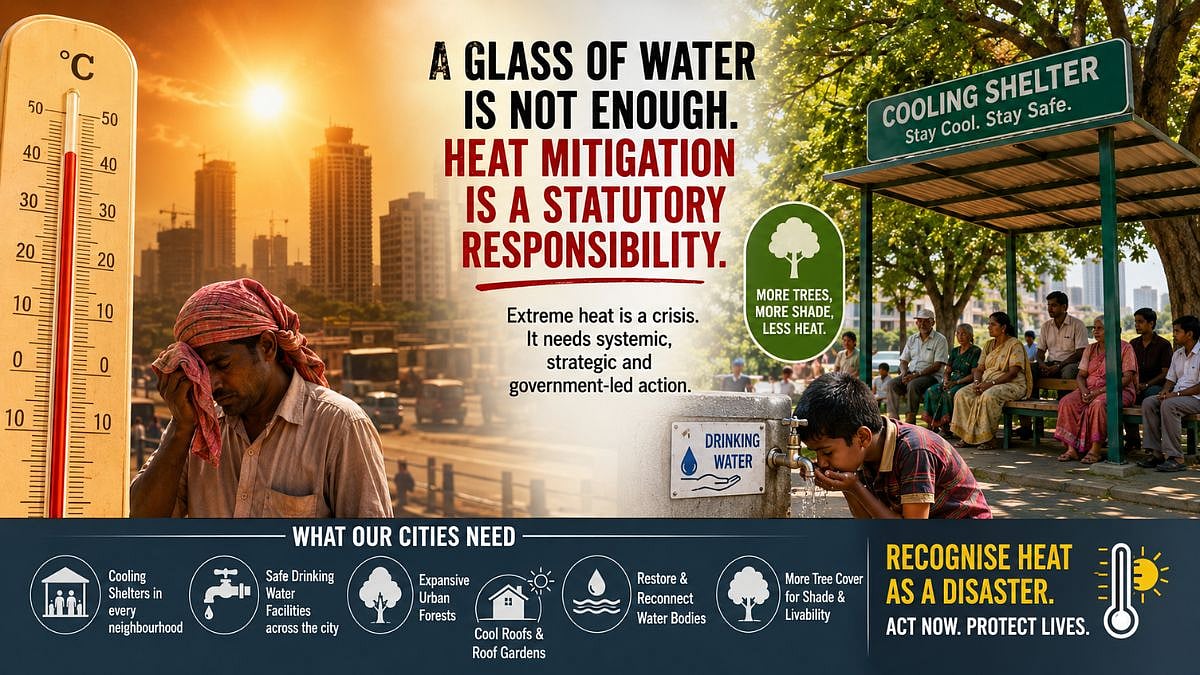
Experts are urging authorities to adopt long-term heat mitigation measures as extreme temperatures become an increasingly serious urban challenge | AI Generated Representational Image
Stay hydrated and offer a glass of water to others; if someone around you feels unusually unwell, move them to a place with shade and offer water. These are important reminders during a heatwave. It is also common sense. And, importantly, an act of basic empathy that reasonable people extend to others anyway. While appropriate and necessary, what such a reminder does is subtly shift the responsibility of combating the brutal heat on to individuals and allow the institutional mechanisms to remain unaccountable.
We are no longer in the time of the dreaded and infamous Mumbai heat. In these new normal times, readings for daytime and night temperatures threaten to go off the charts. For a decade now, daytime temperatures in March, April, and May have been in the extremely high 30 degrees Celsius range and have breached the 40 degrees Celsius barrier at least thrice for every month. This means the feels-like temperature, or the heat index, which should become the default reading, would have been closer to 45 degrees Celsius or higher.
Heat beyond individual responsibility
In such scorching temperatures over three months, as millions of people work outdoors every day and millions struggle with trapped heat in the informal settlements that they are forced to live in, a glass of water is not a solution. Ground work has repeatedly shown that many cannot afford to buy water every day of the summer months; many, especially women, make do with less hydration because public sanitation facilities either do not exist or are inaccessible; and many cannot afford to take the peak afternoon hours off because it reduces their earnings.
What do they, and all of us, need? The recognition that extreme heat can be a calamity like the floods; that such heat adversely impacts the livelihoods of millions; and that governments and authorities have a role beyond merely issuing advisories. Some advisories, such as ‘stay indoors’, are senseless. People such as gig workers cannot take off from outdoor work, or when indoor temperatures are demonstrably higher, thanks to the density of buildings and the heat-insensitive designs of the Slum Rehabilitation Authority (SRA) buildings.
Need for statutory heat action
The time is long overdue for heat to be notified as a disaster so that the state machinery becomes responsible for providing relief measures and compensation in case of heatstroke fatalities; so that heat action plans can have statutory status; so that heat mitigation measures go beyond ‘stay hydrated and offer a glass of water’ to embrace the gamut of provisions by designated authorities for the public. These include, but are not limited to, cooling shelters in every neighbourhood for vulnerable people, safe drinking water facilities at key locations across the city, cool roofs and roof gardens, expansive urban forests, enlarging tree cover to provide shade, and restoring and reconnecting the network of water bodies in the city.
Heat mitigation measures can no longer be limited to an individual; they have to be systemic, strategic, and led by authorities. This is of significance in Mumbai, a city like almost every city across India that does not even recognise shade and cooling shelters as essential public infrastructure. These are yet to come to the roundtables in the countless — sometimes pointless — seminars, workshops, and convenings on heat. It may be a long while before they are seen by governments and people as essential public infrastructure.
Shade as public infrastructure
Several studies over the past two decades have shown that areas with tree shade are 4–8 degrees Celsius cooler than areas without the canopy. Shade, as essential public infrastructure, has been well documented in international cities for well over a decade; there, greening cities has become a part of statutory plans. New York, for example, has a thorough plan of dividing the city into hundreds of zones and planting trees in every viable place within each zone to increase its canopy to 30 per cent by 2040. Paris, of course, has set the benchmark for greening vast tracts over the past decade and a half. These are but two examples where governments pivoted to make trees central to their heat mitigation strategies.
Mumbai’s authorities, curiously and frustratingly, have chosen to allow thousands of trees and mangroves to be chopped down in the pursuit of large-scale projects, as this column highlighted in its previous edition. How come no one in the state government or the BrihanMumbai Municipal Corporation, which is sitting with the Mumbai Climate Action Plan, has made the obvious connection between the loss of the natural cooling power of trees and rising heat levels in the city, between shade and heat mitigation? Perhaps they have but are blinded by other considerations, such as having their names inscribed on mega projects.
Responsibility lies with government
This rather dystopian state of affairs, including green cloth strips strung overhead at junctions to offer shade at some places in the city, reminded me of the (in)famous Nudge Theory. It was propounded by behavioural scientists and used by governments and institutions to ‘nudge’ people to climate-friendly behaviour by subtly redesigning their decisions, such as using less plastic, walking instead of driving, and so on. Recent evidence shows this to be pointless and having extremely limited impact when it comes to major global issues, such as climate-induced extreme heat or floods. Importantly, it took the focus away from the systemic changes that needed to be made by mega corporations and institutions to address systemic and self-reinforcing issues.
We can be nudged to offer a glass of water to others, but it should not take the focus away from where heat mitigation responsibility lies — the government.
Smruti Koppikar, an award-winning senior journalist and urban chronicler, writes extensively on cities, development, gender, and the media. She is the Founder Editor of the award-winning online journal ‘Question of Cities’ and can be reached at smruti@questionofcities.org.
RECENT STORIES
-
-
-
-
-