Press Questions, Cartoon Backlash: Why Norwegian Media Misses India's Rising Global Footprint Under PM Modi
While a viral clash over press freedom and a controversial cartoon dominated local headlines in Oslo, Norway’s media sidelined the major green tech and trade agreements finalised during Prime Minister Narendra Modi’s high-profile state visit

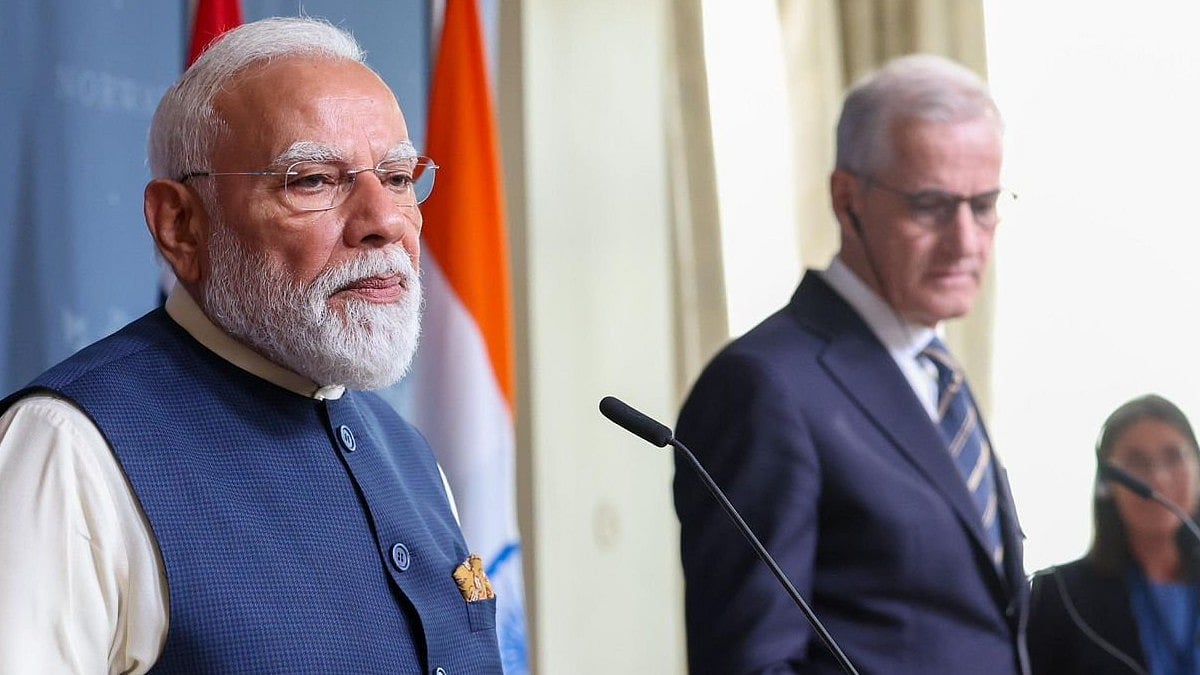
Prime MinisterNarendra Modi's visit to Norway deepened India's ties with the Nordic country | @narendramodi
During Prime Minister Narendra Modi’s official two-day visit to Oslo, Norway on May 18–19, 2026, a sharp divergence emerged between the official achievements of the trip and the media narratives surrounding it. While the bilateral talks yielded major advancements including a new Green Strategic Partnership and progress toward a multi-billion-dollar trade deal, the public conversation was largely consumed by peripheral controversies.
A confrontational exchange regarding press freedom and a controversial political cartoon in Norway's largest newspaper dominated headlines and went viral on social media. Unfortunately, this gap between tangible economic diplomacy and media optics highlights a deeper trend, why a section of the European press and commentary structure frequently struggles to align its coverage with India’s rapidly evolving global footprint.
Purpose of PM Modi's visit to Norway
The primary objective of Prime Minister Modi's trip to Oslo was twofold, holding extensive bilateral talks with Norwegian Prime Minister Jonas Gahr Store and participating in the third India-Nordic Summit alongside leaders from Denmark, Finland, Iceland, Sweden and Norway. The high-level talks focused heavily on climate action, renewable energy and economic cooperation.
According to the Press Information Bureau, the central outcomes of the visit included a commitment to elevate bilateral ties to a Green Strategic Partnership, focusing heavily on sustainability, green technology, offshore wind and carbon capture. Following the 2024 Trade and Economic Partnership Agreement (TEPA) between India and the European Free Trade Association (EFTA), the leaders also underlined an ambitious target to double bilateral trade by 2030, tapping into a projected $100 billion investment commitment over 15 years.
Furthermore, in recognition of his role in advancing ties, King Harald V conferred the Grand Cross of the Royal Norwegian Order of Merit upon PM Modi, which is Norway's highest honour for foreign heads of government.
What extraneous incident transpired during the press statement?
The strategic weight of the visit was momentarily overshadowed on May 18, 2026, during a joint press statement by the two prime ministers. As Prime Minister Modi finished his speech and began exiting the podium, Helle Lyng Svendsen, a journalist from the Oslo-based newspaper Dagsavisen, called out directly to him, asking why he would not take questions from "the freest press in the world."
Svendsen pointed out that Norway ranks number one on the Reporters Without Borders World Press Freedom Index, whereas India ranks 157th. Following diplomatic protocol for pre-arranged joint press declarations, which were not structured as an open, interactive press conference, Prime Minister Modi exited the stage without responding. Prime Minister Store remained behind to conduct independent press interviews.
A 16-second clip of the interaction went viral across social media platforms like X (formerly Twitter) and Instagram. While India's opposition leaders utilised the video to question the prime minister's accountability, supporters and the Ministry of External Affairs strongly defended the adherence to established diplomatic state protocol.
Media cartoon fuels racism controversy
Adding fuel to the media storm, Norway's largest daily newspaper, Aftenposten, drew intense backlash over a political cartoon illustrated by Marvin Halleraker, which accompanied an opinion piece by journalist Frank Rossavik. The article, headlined "A clever and slightly annoying man," was originally published on May 16 but gained massive visibility only after Prime Minister Modi's visit.
The cartoon depicted Prime Minister Modi sitting cross-legged as a traditional "snake charmer," but instead of a cobra, he was shown piping a fuel nozzle out of a basket. Social media users and political figures in both India and Norway quickly condemned the drawing, labelling it derogatory, racist and a lazy replication of colonial-era stereotypes.
Why does a section of Europe fail to see India’s larger picture?
The lens through which parts of the European media viewed the Oslo visit reveals a persistent systemic gap in understanding India’s modern geopolitical strategy. As Rossavik’s article itself noted, while Western leaders frequently prioritise ideological alignment, India operates firmly under an "India First" doctrine, engaging pragmatically with all major global powers.
Modern India practices sharp multi-alignment. India balances close strategic partnerships with the West while maintaining vital energy and defence ties with nations like Russia and championing the global interests of the Global South.
Western commentators often misinterpret this independent stance as non-cooperative or annoying rather than recognising it as the calibrated autonomy of a major global power.
There is also an analytical over-reliance on obsolete stereotypes. As seen with the Aftenposten cartoon, reducing highly technical energy diplomacy to an exoticised colonial image distracts from the core economic realities of India's massive infrastructure, technology and green transition capabilities.
Finally, a changing balance of economic power plays a decisive role. The Nordic countries possess deep technical expertise in green transition, digitisation and maritime governance. Yet, they are increasingly recognising that the commercial scalability of these technologies requires integration with India’s massive domestic market and manufacturing sector. A section of European commentary remains uncomfortable with this shifting dynamic, where small Western nations are no longer simply lecturing a developing state, but are actively competing to secure trade pacts and capital investments.
While the peripheral media events dominated social media engagement for a brief moment, the concrete outcomes of the May 2026 visit cemented by Norway's highest state honour and an upgraded Green Strategic Partnership signal that state-to-state relations are increasingly driven by hard economic realities and mutual strategic benefits, rather than the editorial slants of local newsrooms.
RECENT STORIES
-
-
-
-
-