Iran Targets Diego Garcia: How Tehran’s 4,000-km Missile Reach Redraws India’s Security Map
As missiles fly toward the remote US-UK base in the Indian Ocean, New Delhi faces a new ballistic reality where its primary backyard and energy lifelines are now within Iran’s expanded strike zone

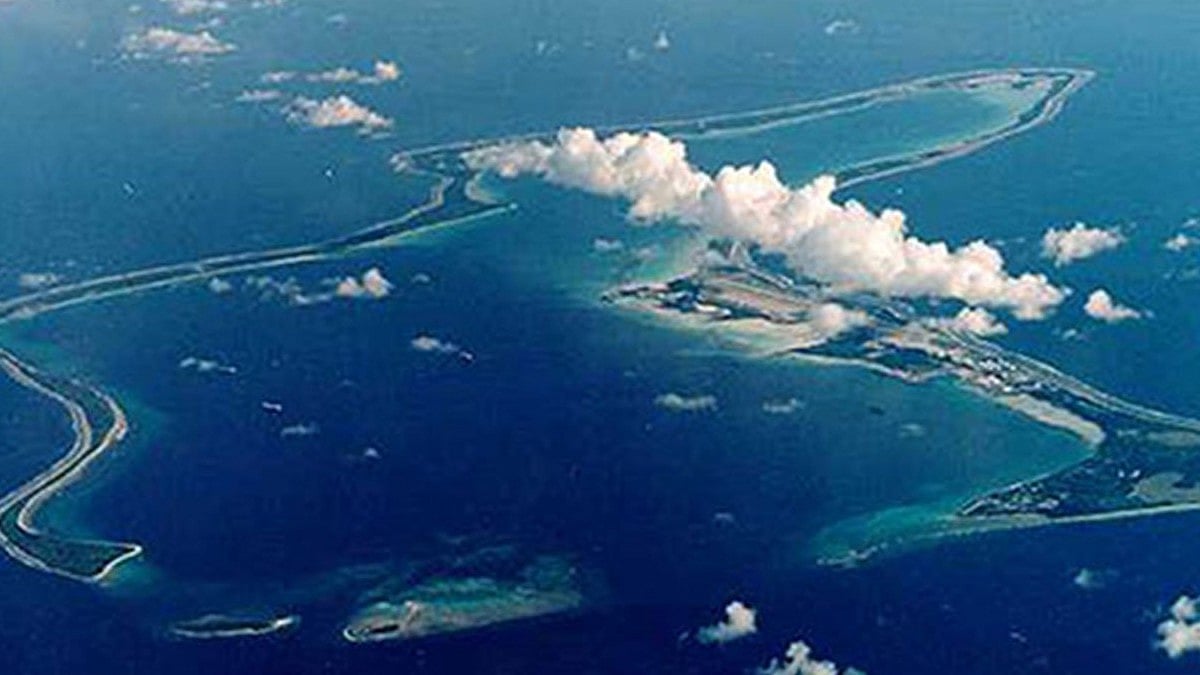
Diego Garcia | Image courtesy ANI
On Friday, March 20, 2026, a significant escalation in the West Asia conflict occurred when Iran launched two intermediate-range ballistic missiles (IRBMs) toward the joint US-UK military base at Diego Garcia. This remote atoll, located deep in the Indian Ocean, was long considered a safe haven due to its distance from the Iranian mainland. However, according to a report by The Wall Street Journal, the attempted strike has shattered that perception, signalling a dramatic leap in Tehran’s ability to project power thousands of kilometres away.
While the missiles failed to hit their target—one broke apart in flight and the other was reportedly engaged by a US Navy interceptor—the event has triggered a massive reassessment of global security.
Who was involved and what exactly happened
The incident involved the Iranian military and the combined forces of the United States and the United Kingdom. Per the WSJ report, two Iranian missiles were detected heading toward the Chagos Archipelago, where the Diego Garcia base is located. One missile suffered a mechanical failure mid-flight and disintegrated. For the second, a US warship deployed an SM-3 (Standard Missile-3) interceptor. While it remains unconfirmed if the interceptor successfully destroyed the missile or if the missile simply missed, the base suffered no casualties or damage.
The strike is believed to be a direct response to a policy shift by UK Prime Minister Keir Starmer. Just weeks prior, on March 1, 2026, London reversed its initial refusal and granted the US permission to use Diego Garcia for "defensive" strikes against Iranian launch sites. This decision was a critical turning point, as the US has been conducting an intensive air campaign following the death of Iran’s Supreme Leader, Ayatollah Khamenei, in late February.
Where is Diego Garcia and why it is so strategic
Diego Garcia is a small atoll in the central Indian Ocean, roughly 4,000 kilometres (approximately 2,500 miles) from the Iranian coastline. It is a unique military asset as a stepping stone that allows the US to launch long-range B-52 and B-2 bomber missions across Africa, the Middle East and Asia. Because of its extreme isolation and heavy fortification, it has historically been the primary hub for pre-positioning nuclear-powered submarines and massive fuel supplies.
For decades, military planners operated under the assumption that the base was outside the reach of Iran’s conventional missile arsenal. Before this week, Iran’s longest-range known missile was the Khorramshahr-4, with a publicly stated range of 2,000 to 3,000 kilometres. By targeting a site 4,000 kilometres away, Iran has effectively announced that its "threat circle" has doubled in size.
Why New Delhi should be watching
For India, the reported missile attack on Diego Garcia is a development that hits at the heart of its maritime security. While New Delhi historically advocated for a 'Zone of Peace' in the Indian Ocean, it now relies on the stability of these waters for nearly 80 per cent of its oil imports. In the 2026 security scenario, Diego Garcia acts as a necessary counterweight to rising regional threats, ensuring the safety of Sea Lines of Communication.
The revelation that Tehran possesses 4,000-kilometre-range capabilities introduces a new, unpredictable variable into India’s defence planning. If Iranian missiles can reach Diego Garcia, they could theoretically reach any target on the Indian mainland. This puts India in a precarious diplomatic position as it must balance its strategic autonomy and its partnership with Iran with the reality that its primary backyard has now become a high-stakes ballistic theatre.
How Iran achieved this range and what it implies
The "How" is the most troubling question for Western intelligence. Analysts from the Alma Research and Education Center had estimated that Iran's arsenal was shrinking—down to 2,500 missiles by February 2026—due to heavy losses in the ongoing war. However, the use of what appears to be an upgraded Khorramshahr-class missile suggests that Iran has shifted focus toward high-end, long-range technology.
By attempting to reach 4,000 kilometres, Iran has moved from a regional power to a trans-regional threat. This range doesn't just put Diego Garcia at risk. It brings major European capitals, including Athens and Rome, and even parts of Central Africa into the crosshairs of Iranian ballistic technology. It also suggests that Iran may have bypassed its self-imposed 2,000-kilometre limit by using lighter warheads or more advanced solid-fuel stages.
Why now
The timing of the launch is tied to a massive US military buildup. On the same day as the WSJ report, US officials confirmed that the USS Boxer and the 11th Marine Expeditionary Unit (roughly 2,500 Marines) were being deployed to West Asia three weeks ahead of schedule. This brings the total US troop count in the region to over 50,000.
Furthermore, reports have surfaced that the US is considering a plan to occupy Kharg Island to force the reopening of the Strait of Hormuz, which has been a primary theatre for Iranian drone and 'fast-attack' boat operations. The strike on Diego Garcia was likely intended to force the US to divert its naval assets away from the Persian Gulf to protect its 'safe' bases in the Indian Ocean.
What the immediate implications for the war are
The primary implication is the end of safe zones. If Diego Garcia is vulnerable, the US must now deploy advanced missile defence systems—like the THAAD or additional SM-3 capable destroyers—to protect assets that were previously thought to be out of harm’s way.
Additionally, the incident has complicated the UK’s legal position. While Prime Minister Starmer argued that the base would only be used for "defensive" actions, Iran’s retaliation shows that Tehran views any involvement as an act of war.
Published on: Saturday, March 21, 2026, 12:24 PM ISTRECENT STORIES
-
-
-
-
-