Once Forced To Worship Behind Closed Doors, Pakistani Hindus Receive Royal Welcome At Raja Bhaiya's Ram Katha In UP
Around 500 Pakistani Hindu refugees from Sindh travelled from Jodhpur to attend a Ram Katha in Uttar Pradesh's Kunda after an invitation from MLA Raja Bhaiya. The guests received VIP seating and accommodation, while Bageshwar Dham's Dhirendra Krishna Shastri joined them for religious rituals. Several refugees shared experiences of migration and their continuing struggle for Indian citizenship.

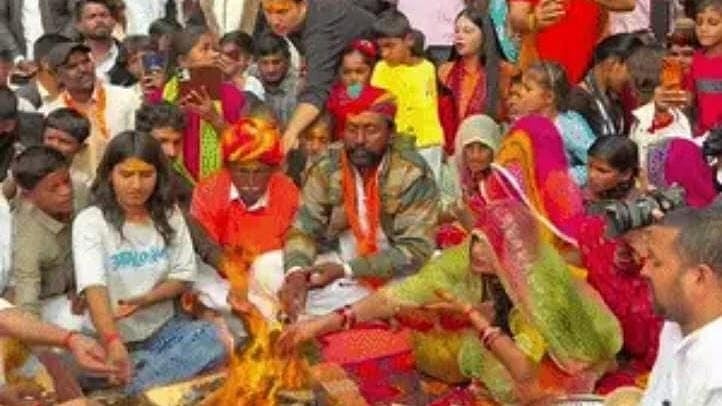
Once Forced To Worship Behind Closed Doors, Pakistani Hindus Receive Royal Welcome At Raja Bhaiya's Ram Katha In UP | File Pic
Kunda (Uttar Pradesh): They once worshipped behind closed doors in Pakistan, fearful of practising their faith openly. Now, around 500 Hindu refugees from Pakistan's Sindh province are occupying front-row seats at a grand Ram Katha in Uttar Pradesh's Kunda, where they are being treated as special guests.
Invited by Kunda MLA Raghuraj Pratap Singh, popularly known as Raja Bhaiya, the refugees travelled from Jodhpur in Rajasthan in 10 buses to attend the religious gathering being organised by Pandit Dhirendra Krishna Shastri of Bageshwar Dham. Apart from VIP seating at the pandal, three large camps have been arranged for their stay in a mango orchard behind Benti Raj Bhavan, Raja Bhaiya's residence.
The women, dressed in traditional attire with their faces covered by long veils, and men sporting sandalwood tilaks, have become a prominent feature of the gathering. For many, it is the first time they have been accorded such honour at a public religious event.
Raja Bhaiya Fulfils Promise To Refugees
The association between Raja Bhaiya and the refugees began during his visit to Jodhpur in 2024. He met families who had migrated from Pakistan and heard their accounts of leaving behind their homes, land and possessions to start afresh in India. He subsequently extended assistance to them and also reached out to Pakistani Hindu refugees living in Delhi's Majnu Ka Tila.
Raja Bhaiya had promised last year that he would invite them whenever he organised a Ram Katha. He has now fulfilled that commitment.
Religious Ceremonies Bring Emotional Moments
Before the Katha, a havan and religious rituals were organised at Benti Raj Bhavan. Dhirendra Shastri himself participated in the ceremony, sitting at the yajna altar.
Heeralaal, who migrated from Pakistan in 2018, said he had never imagined getting an opportunity to meet the Bageshwar Dham head.
"We had never thought we would get an opportunity to meet Bageshwar Baba. He performed a havan with us, and it felt as if our souls had been purified. All our needs are being taken care of here," he said.
Refugees Recall Religious Restrictions In Pakistan
Asked whether he wanted to return to Pakistan, Heeralaal said his family wanted Indian citizenship.
ALSO READ
"We left Pakistan for the sake of Sanatan Dharma. We could worship there, but only inside our homes and secretly. There is discrimination in children's education too. We send our younger daughters to school, but become apprehensive when they grow older," he said.
Sita Devi, 40, said she had watched Bageshwar Dham programmes on her mobile phone but was seeing Shastri in person for the first time.
"Nobody had ever invited us and given us front-row seats like VIP guests. I do not think we will get such an opportunity again," she said.
Young Migrants Face Citizenship Challenges
The younger generation, however, faces challenges of its own. Akash, who came to India with his family on tourist visas in 2018, said they had not returned to Pakistan since. The family is still awaiting Indian citizenship.
Also Watch:
"Teachers treat us well, but some students do not consider us one of their own. We also have to visit police stations frequently because we came from Pakistan. But we feel safe in India," he said, adding that some of his relatives still in Pakistan were keen to migrate if they could obtain visas.
Jodhpur has an estimated 17,000 to 18,000 Pakistani Hindu migrants living in 21 settlements across areas such as Sursagar, Mandore, Kaliberi and Chokhan. While some who arrived decades ago have acquired Indian citizenship, many recent migrants are still awaiting it.
Gathering Offers Freedom To Celebrate Faith
For the refugees, the gathering in Kunda is more than a religious occasion. It is an opportunity to participate openly in a celebration of their faith and experience a welcome they say they had rarely received before.
RECENT STORIES
-
-
-
-
-