What Is The Navier-Stokes Problem, & Why Is Everyone Suddenly Talking About It?
OpenAI said an internal AI model helped prove that a version of the Navier-Stokes equations can develop a finite-time singularity, a major mathematics challenge. The company said 10,000 AI agents worked on the problem and the proof was verified using Lean. However, mathematicians are debating whether it meets the original Millennium Prize criteria and concerns remain over research credit.

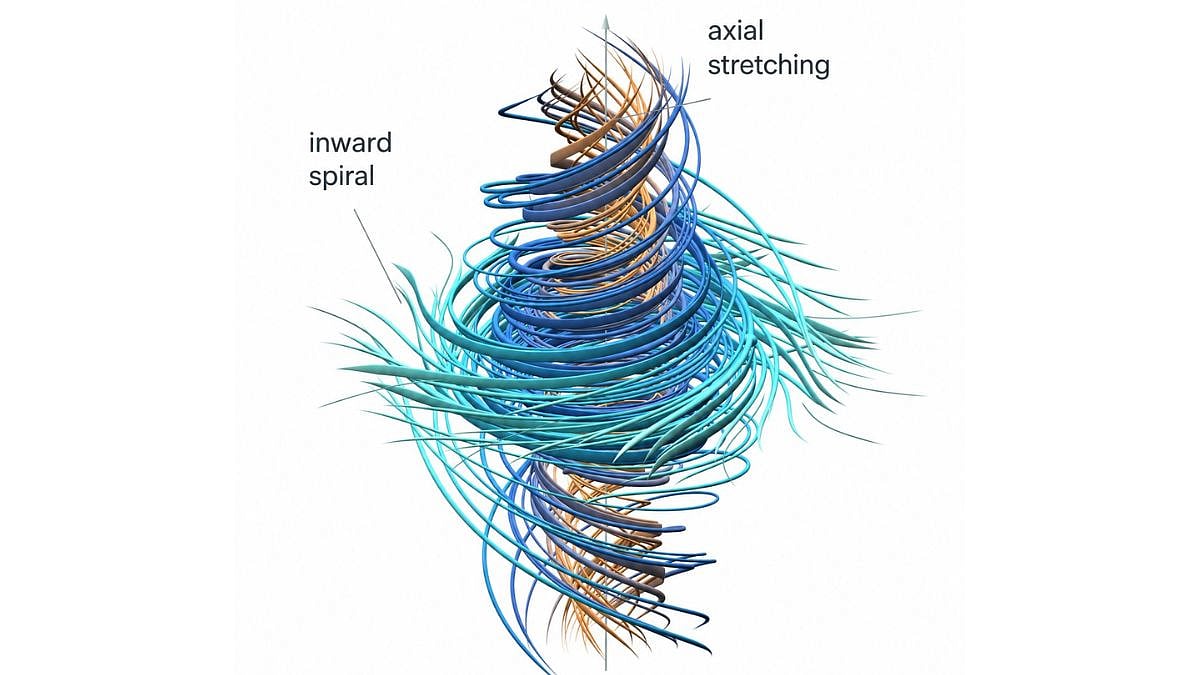
The Navier-Stokes equations describe how fluids like water, air, blood, weather systems move. They're used every day in aircraft design, ocean modelling and meteorology. But one question about them has remained unresolved for nearly a century. Can a perfectly smooth flow, described by these equations, spontaneously develop an infinite, uncontrolled spike - mathematicians call this a 'blow-up' - in a finite amount of time? Nobody has been able to prove whether this can happen, or rule it out entirely, for the three-dimensional version of the equations that actually describes the real world. But well, OpenAI has just announced that it has solved the equation, and it has triggered many mathematicians.
Why it's one of the hardest problems in mathematics?
The question was formalised in the early 2000s by the Clay Mathematics Institute as one of seven 'Millennium Prize Problems', each carrying a $1 million reward. Only one of the seven, the Poincare Conjecture, has been solved so far. Navier-Stokes has resisted every attempt for so long partly because fluid behaviour is chaotic and non-linear - small changes compound unpredictably, making it extraordinarily difficult to prove that a solution stays smooth forever, or to construct an example where it doesn't.
What OpenAI says it has done
This week, OpenAI said an unreleased internal model helped produce a proof that a version of the Navier-Stokes equations can, in fact, blow up in finite time. According to the company, roughly 10,000 AI agents worked in parallel on the problem, at a cost running into the millions of dollars, with the resulting proof formally checked using the verification language Lean. Notably, the proof applies to the 'forced' version of the equations, which include an external forcing term - not the exact 'unforced' version specified by the Clay Institute's prize. Whether this satisfies the Millennium Prize criteria hasn't yet been determined.
Why this matters beyond mathematics
If AI systems can meaningfully contribute to problems this difficult, it suggests a shift in how mathematical research itself gets done - potentially compressing years of human effort into weeks. That has real implications for fields reliant on fluid dynamics, from climate modelling to aerospace engineering, where better theoretical guarantees can translate into more reliable predictions and designs.
Why some mathematicians are uneasy
The episode has also triggered a dispute over credit, with independent researchers accusing OpenAI of building on ideas from their unpublished work. Separately, mathematician Terence Tao has warned that treating landmark open problems purely as benchmarks for AI capability risks discouraging mathematicians from sharing early-stage ideas - the kind of exploratory, often unpublished thinking that, historically, has quietly shaped how major breakthroughs eventually get made.
RECENT STORIES
-
-
-
-
-