FPJ Exclusive | Cerebral Palsy Couldn't Stop Him! Sprinter Rakesh Bhatt's Inspiring Journey From Childhood Struggles To Chasing Asian Para Games Glory
Born with cerebral palsy, Gujarat's Rakesh Bhatt overcame childhood struggles, financial hardships & difficulties with walking to become an international para sprinter. With his parents' sacrifices, coach Apurba Biswas' guidance and sponsor's support, Bhatt is preparing for the Asian Para Games 2026. Targeting medals in the 100m & 200m, he dreams of making his father & village proud.

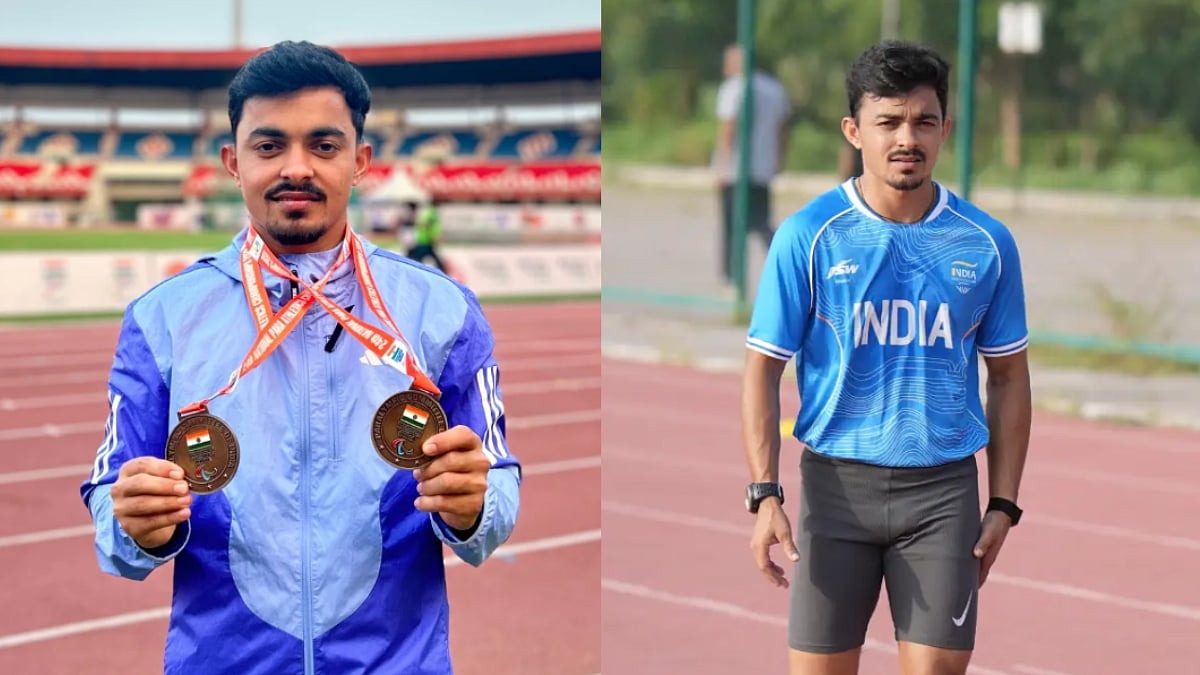
Rakesh Bhatt/Instagram
Indian para sprinter Rakesh Bhatt’s journey is a story of perseverance, family sacrifices and determination. Born with cerebral palsy in Moti Babaliyat village in Gujarat, Bhatt faced difficulties with walking and maintaining his balance from an early age. Today, he is preparing to represent India at the Asian Para Games 2026, hoping to win medals in the 100m and 200m events.
Speaking to The Free Press Journal, Bhatt opened up about his childhood, his family’s struggles, the people who shaped his sporting career and his dream of making his father proud.
Excerpts...
1• Could you tell us a little about your childhood and upbringing in Moti Babariyat village in Gujarat? What was Rakesh like as a child?
Yes, I come from Moti Babaliyat village. When I look back at my childhood, I remember the difficulties I faced while growing up. I was born with cerebral palsy. However, for the first three years of my life, neither my family nor anyone else realised that I had this condition. It was only after I turned three, when children normally begin standing and walking properly, that my parents noticed something was wrong with the right side of my body.
Normally, by the age of three or four, a child can walk comfortably. However, I struggled to walk and would often fall suddenly. Whenever someone called out to me loudly, my entire body would start trembling. That was when my parents realised that something was wrong. However, they still did not know that I had a medical condition called cerebral palsy or that I was suffering from a muscle-related disorder.
My parents were not educated. They had never attended school and only knew about farming and agricultural work. Since we lived in a village, they had very little knowledge about such medical conditions. They did not understand what the condition was or how it could affect me. When I turned five, my physical difficulties became more noticeable. My condition began causing more problems, and my parents became increasingly worried.
They started asking people around them what might be wrong with their child. Several people suggested that they should take me to a good doctor who could properly examine me and identify the problem. At that time, I was around five years old and had started attending Bal Mandir (preschool) and the first standard.
Our village is located approximately 50 kilometres from Bhavnagar, which is our district headquarters. My parents began taking me to doctors in Bhavnagar for medical examinations and treatment. That is how my childhood was. From the age of five or six, I had already started making frequent visits to hospitals.
2• You were born into a farming family and are the youngest of six siblings. What was your childhood like growing up in such a big family?
I was born into an ordinary farming family. All my brothers and sisters are older than me, and I am the youngest child in the family. As I mentioned earlier, when I was around five or six years old, my parents started taking me to hospitals for treatment. They followed the doctors' suggestions and tried their best to ensure that I received proper medical care.
At that time, our financial condition was not good. We did not even have a proper house. We lived in an old house that was in such poor condition that it could have collapsed at any moment. My elder brothers and sisters were studying, while my father and mother handled all the agricultural work themselves. They had to manage everything on their own because finding labourers was also difficult. We were facing serious financial problems.
When my parents took me to the hospital at the age of five or six, the doctors diagnosed me with cerebral palsy. They explained that one side of my body would not function properly because of the condition. However, the doctors also told my parents that if they started medication, exercises and other treatments at an early stage, I might not face as many difficulties in the future.
My parents were already struggling financially. They did not have enough money to take me to Bhavnagar, which was approximately 50 kilometres from our village, every day by bus for treatment and bring me back home. Despite these difficulties, they sought help from people around them. Sometimes my mother would accompany me to the hospital while my father stayed back to manage the farming work. On other occasions, my father would take me, and my mother would look after the farm. They supported each other and managed everything together. Whenever neither of them could accompany me, they would request someone from the neighbourhood to take me to the hospital.
From the age of five or six until I was around ten or eleven, we continued visiting hospitals for several years. We had to travel approximately 50 kilometres to Bhavnagar twice a week for treatment. Travelling by bus was not easy in those days. The buses lacked proper facilities, and the journeys were uncomfortable. There was a lot of pushing and overcrowding, making it difficult to travel comfortably.
We also did not have any relatives in Bhavnagar with whom we could stay or have meals. We had to manage our food outside, sometimes eating simple meals like roti and puri, attending the hospital appointments and returning home. Since the doctors had advised us to visit twice a week, we had no choice but to make those journeys regularly.
My parents made tremendous sacrifices throughout my childhood. From the moment they realised that something was wrong with me, they did everything possible to take care of me. They consulted doctors, arranged medicines and spent a considerable amount of money on my treatment. Even when they did not have enough money, they would borrow from people around them and somehow arrange for my medical treatment. They ensured that I received the necessary exercises, physiotherapy and other treatments recommended by the doctors.
That was how my childhood passed. My elder brothers and sisters were all studying, so they could not take leave from school to accompany me to the hospital. My parents also did not want their education to suffer because of my treatment. My parents put in tremendous effort, made countless sacrifices and worked extremely hard to ensure that I received proper treatment and care.
3• You faced difficulties with walking and balance from a very young age. How did your family support you during those early years?
When I was around three years old, my parents realised that I was having difficulty walking. Normally, by the age of three, a child learns to stand and walk properly. However, that was not the case with me. I would often fall suddenly while walking. Whenever someone called out to me from behind, my body would start trembling, and I would become frightened. These difficulties were quite frequent during my childhood.
When I was around five or six years old, my parents started taking me for medical treatment. I had difficulty controlling the right side of my body, particularly my right hand. I had to concentrate completely on moving it. Only when I focused properly could I make the right side of my body function as I wanted. During those days, we had to travel to Bhavnagar regularly to consult doctors.
The doctors advised my parents that although I was receiving exercises and treatment at the hospital twice a week, it was equally important to continue those exercises at home. They explained that regular exercise would help me recover faster and improve my muscle development. However, my parents neither had enough time nor the necessary knowledge to help me perform those exercises properly. They also found it difficult to remember all the exercises demonstrated by the doctors.
During that period, my parents came up with their own way of helping me keep my right hand straight. They would tie two or three bricks to my right hand so that it remained straight and did not bend. After tying the bricks to my hand, they would leave for their agricultural work. When they returned home, they would remove them. I was very young at that time, so I did not understand why they were doing all this.
Later, when I reached the sixth standard, a turning point came in my life. My uncle's son informed my father about a special school in Gandhinagar for children with disabilities. He told my father that they could send me to that school, where I would receive proper care and education. The school provided several facilities free of cost, including education, accommodation, food and physiotherapy.
He also explained that there were other children with similar disabilities studying there, so I would not face difficulties adjusting to the environment. Being around children with similar conditions would also help me feel comfortable and supported. That was how my family came to know about the school and the opportunities available to me.
Throughout that period, my parents, family members and people in our neighbourhood supported me tremendously. They did everything they could to help me overcome my difficulties and receive the treatment, care and education I needed.
4• What role did your parents play in helping you become independent and pursue your dreams?
Look, when it comes to becoming self-reliant, I believe that when a child starts living away from home at a young age, they naturally learn to become independent. When you stay away from your family, you begin to understand the difficulties and struggles your parents are going through. You realise how much they are sacrificing for you. In such circumstances, nobody needs to teach you how to become self-reliant. You automatically develop that quality while living away from home.
I was sent to a hostel when I was in the sixth standard. It was not because I was troubling my parents or because they did not want to look after me. That was never the reason. My parents made that decision with a positive mindset. They realised that they were unable to give me the attention and care I needed because of their circumstances.
I already had four elder brothers and one elder sister. My parents had to bear the expenses of their education, along with the additional costs of my medicines, treatment and special care. All these expenses were beyond our family's financial capacity. My parents simply did not have enough resources to manage everything. That is why they decided to send me to a hostel when I was in the sixth standard.
However, at that age, I could not understand their decision. I used to wonder why my mother and father had sent me away from home. I kept asking myself why they had put me in a hostel. For almost a year, I did not like living there at all. The hostel food was different from what I was used to eating at home. I had to live away from my family, wash my own clothes and manage everything independently. Nobody was there to do these things for me. I had to take care of myself. At that young age, it was extremely difficult for me to adjust to such a life.
However, today, when I look back at those experiences, I understand how important that decision was. I now realise that if my parents had not sent me away from home and I had never experienced hostel life, I probably would not have reached this stage in my life. I might not have been able to represent India at such a high level.
I believe my real journey began the day I left home. That was the turning point when I started learning to face challenges independently and take responsibility for myself. Before that, throughout my childhood, my parents had always been there to support me. From the time I was three years old until I was around eight or ten, they took tremendous care of me and supported me in every possible way.
They never neglected me or refused to help me because of my condition. Whatever support I needed, they provided it. My parents did everything they could for me, despite the difficulties they were facing.
5• When did athletics first enter your life?
I started pursuing athletics professionally in 2022, beginning with the National Games. Before that, when I was studying at a special school and living in a hostel, there was a sports tournament in Gujarat called Special Khel Mahakumbh, organised for children with disabilities. Students with different disabilities participated in the competition.
During my school days, I was very active and energetic. I used to run around, jump and participate enthusiastically in different activities. My physical education teacher noticed that I was good at kabaddi and kho-kho. I was quite active in both sports. Seeing my enthusiasm and performance, my teacher encouraged me to participate in the Special Khel Mahakumbh for the first time and helped me fill out the registration form.
I participated in the 100-metre race and the long jump. During my first 100-metre race, I actually fell while running. At that time, I was still undergoing physiotherapy, and I was around 13 or 14 years old. My muscles had not developed sufficiently, which made it difficult for me to maintain my balance. Sometimes, I would fall even while walking, and there were occasions when I would fall while running as well.
Despite these difficulties, I started participating in sports during my school days. However, at that time, I was not pursuing athletics professionally. I was simply participating in competitions because I enjoyed sports and wanted to take part in different activities.
After completing my schooling, I moved to Ahmedabad. In 2022, I became associated with the Gujarat athletics federation. After coming into contact with the federation, I learned that there were opportunities beyond national-level competitions. I discovered that athletes could compete at the international level, including in Asian competitions and the Paralympics, and that there was an opportunity to represent India on such prestigious platforms.
Until then, I had not been fully aware of these opportunities. Once I understood that I could potentially represent my country internationally, my perspective towards athletics changed. That was when I decided to take the sport seriously and pursue it professionally. I began focusing on my training, improving my performance and working towards bigger goals.
6• Do you remember your first experience of running competitively? What made you feel that sprinting could be your sport?
When I participated in the 100-metre race at the national level for the first time in 2022, it was a completely new experience for me. There were several athletes competing against me who were physically stronger, taller and much more experienced. They were already representing their respective states, including Haryana, Delhi and Uttar Pradesh. They were experienced sportspersons who had been competing for a long time, whereas I was completely new to that level of competition.
Looking at them, I started doubting myself. I wondered whether I would even be able to run properly or finish the race. Several negative thoughts crossed my mind. I kept thinking that I might not be able to complete the race because the other athletes were much better prepared and more experienced than me. However, despite those doubts, I participated in the race and managed to finish in third position.
At that time, my running technique and running style were not particularly good. I had not received proper professional training, and there were several areas where I needed to improve. During that competition in 2022, a coach from the Sports Authority of India (SAI), Apurba Biswas Sir, was present. He observed my performance and noticed that although my running technique was not good, I had the potential to become a strong athlete. He believed that if I received proper training and worked on my technique, I could improve significantly and become a good sprinter.
That was when he started guiding me and helping me develop my abilities. He recognised that with the right coaching and training, I could perform at a much higher level in sprinting. I always say that I did not choose the 100-metre race or athletics myself. Rather, athletics chose me. I did not initially decide that I wanted to become a sprinter or pursue sports professionally. The opportunity came into my life, and things gradually developed from there.
During that national-level competition, the SAI coach was observing my performance. After I completed my race, I met him, and he offered me some suggestions. He asked me where I lived and spoke to me about my background. Later, after completing my schooling, I moved to Ahmedabad to pursue my college education.
In 2022, I joined the academy where he was coaching. During the sprinting activities and training sessions at the academy, he closely observed my performance. He identified my potential and realised that I could become a good sprinter if I received the right guidance and training. He helped me work on my running technique, improve my sprinting skills and develop as an athlete.
7• How important has your coach and support team been in helping you reach this level?
Look, sports is something where you cannot achieve much without a coach. A coach plays an extremely important role in an athlete's life. The coach provides training, and you need to have complete faith in the training and guidance they give you. My coach and my support team have played a very important role in my journey.
In 2024, I received sponsorship from the GoSports Foundation, which provided me with financial support. My current coach is Apurba Biswas Sir, who runs an academy called Pace Academy. He took me into his academy and started training me. Initially, my family's financial condition was not good, and I could not afford to pay the academy fees. Understanding my situation, my coach did not charge me anything. He allowed me to train completely free of cost.
He continued providing me with training and guidance without asking for any fees. It was only after I received sponsorship from the GoSports Foundation that he started charging me fees. Until then, he had never asked me to pay anything. That is why I would say that my coach, my sponsors and the Gujarat federation have played a tremendous role in helping me reach this stage of my career. Their support has been extremely important throughout my journey.
My coach is not just my coach; he is also my mentor. He has guided me through every situation, whether it involved my training, competitions or other challenges. Before every competition, he would guide me, explain what I needed to do and help me prepare mentally and physically. He has always been there to support me and help me improve as an athlete.
I believe that the guidance of a good coach and the backing of sponsors are extremely important for any athlete who wants to succeed at a higher level.
8• What does your daily training routine look like, and what do you focus on the most during your preparation?
My training routine consisted of nine sessions a week. Out of these, three were strength and conditioning sessions, which involved gym workouts focused on developing basic power and strength. The remaining six sessions were conducted on the track. Of these, three sessions specifically focused on workouts for the 100-metre and 200-metre events. During the other three sessions, we worked on speed endurance, tempo running and basic running techniques.
I used to train in Ahmedabad. The training ground was approximately four to five kilometres away from the hostel where I lived. My daily routine began at 5:30 AM. I would wake up, get ready between 5:30 AM and 6:30 AM, and reach the training ground by 6:30 AM. Our morning training sessions lasted for three hours, from 6:30 AM to 9:30 AM.
After completing the training session, we would do cool-down exercises, stretching and other recovery activities. By the time we finished everything, it would usually be around 10:30 AM. I would then return to the hostel, freshen up, take a bath and have breakfast. By the time I completed these activities, it would be around 11:30 AM or noon.
Nutrition plays a very important role in sports. A proper diet is essential for an athlete's performance, recovery and overall development. Since nutrition was so important, I did not eat the food provided at the hostel. Instead, I arranged my meals from outside through a tiffin service. However, managing the tiffin service also took considerable time. I had to collect my food, bring it back and return the tiffin containers afterwards. All these activities would take approximately two hours of my day.
After completing everything, I would usually take a short afternoon nap lasting around 30 to 45 minutes. Then, at around 3 PM, I would return for my second training session, which involved weight training and gym workouts.
This was my regular daily routine. I would wake up at 5:30 AM, attend my morning training session, return to the hostel, manage my meals and other daily activities, take a short afternoon nap and then attend my evening training session.
During training, we focus mainly on one thing: trying to improve every single day. Our aim is to perform well in every training session, give our best and continuously push our limits. We also try to improve our timings with every repetition. I believe that if you perform well during training, it will eventually reflect in your overall performance during competitions. That is why we focus primarily on making every training session productive and effective. Our goal is to improve our performance day by day, work on our weaknesses and consistently push ourselves to achieve better results.
9• You are also preparing for the Asian Para Games 2026. How has your preparation been going?
Yes, we are preparing for the Asian Games, and I am confident that I will win medals in both events — the 100-metre and 200-metre races. I am determined to return from the Asian Games with medals in both events. My preparations are going well, and I am fully focused on achieving this goal. We have been preparing for the Asian Games for the past two to three months. Our training and planning have been focused on achieving our targets and ensuring that we return with medals.
10• How do you prepare yourself mentally before stepping onto the track for a major race?
Yes, when you participate in a big race or a major competition, and you step onto the track and reach the starting line, a lot of thoughts start running through your mind. However, I try to focus on just one thing: whatever I have practised during training, I need to execute exactly that during the race. I remind myself that I have trained well and that I only need to reproduce what I have done in training.
My focus is entirely on the finish line. When I stand at the starting line, I want to see only the finish line ahead of me. I do not want any unnecessary thoughts entering my mind. I do not want to think about how I should run, what technique I should use or how I should make my start. All those things have already been practised during training.
When the starter says, "On your marks," I take my position. When the command "Set" is given, I get ready. As soon as the gun goes off, I start running. At that moment, my only aim is to get off the blocks as quickly as possible, run as fast as I can and reach the finish line. I do not want to think about anything else during the race.
11• What are your expectations from yourself at the Asian Para Games?
We have high expectations for the Asian Games because we have trained really well and prepared thoroughly for the competition. In our previous major competition, the Commonwealth Games, we had a good chance of winning a medal. However, due to certain difficulties, we were unable to secure one. Despite that disappointment, we have continued working hard and improving our performance. This time, we are approaching the Asian Games with 100 per cent confidence. We have prepared ourselves thoroughly and are determined to win medals at the competition. We have worked extremely hard during training and are fully prepared to achieve our goals.
12• How important would an Asian Para Games medal be for you and your family after everything you have gone through?
Winning a medal at the Asian Games would mean a lot to me and my family. My family and I know how many difficulties we have faced and how much we have struggled to reach this stage of my life. Everyone in my family and the people around us are happy and supportive. They all want Rakesh to win a medal at the Asian Games.
Since I started pursuing sports in 2022, my life and my family's circumstances have gradually improved. After two years in sports, I began using the prize money I earned to improve my family's living conditions. I gradually worked towards making our home better and eventually built a new house for my family. I also invested some money in improving our agricultural land and farming facilities.
Whatever financial assistance I could provide to my family through my earnings, I have tried my best to contribute. I have done everything possible to support my family and improve our living conditions.
Winning a medal at the Asian Games would bring tremendous happiness to my entire family. It would be a very special achievement for all of us, considering the difficulties and sacrifices we have experienced throughout our journey.
13• Finally, when you look back at your journey from struggling to walk as a child to becoming an international para sprinter, what are you most proud of?
My elder brother and I are yet to get married. We belong to a Brahmin family, and in our community, weddings involve considerable expenses. A lot of money has to be spent on marriage ceremonies, including expenses associated with the bride's family and other arrangements. A wedding can cost approximately ₹20–25 lakh, which is a significant amount for a family like ours.
If I win a medal at the Asian Games, the prize money I receive could help us organise both my elder brother's wedding and my own wedding properly and celebrate them on a grand scale. It would also bring a lot of happiness to our family and help maintain a positive and joyful atmosphere at home.
Apart from the prize money, winning a medal could also create employment opportunities for me. The Gujarat government might offer me a Class II government job based on my sporting achievements. That would provide additional financial security for me and my family.
My father is a very hardworking man. He spends almost his entire day working in the fields and looking after our agricultural activities. He has never been interested in luxuries, entertainment or other pleasures. He has always lived a very simple life. His only focus has been on doing his work, fulfilling his responsibilities and remaining happy with whatever he has.
He believes in working hard, living simply and being content with life. My father has always followed this philosophy and maintained a very modest lifestyle. Seeing his hard work and sacrifices, I have always wanted to do something that would make him proud.
My biggest dream is to achieve success in sports, secure a Class II government job and bring pride and recognition to my father, not only within our family but also throughout our village. I want people in my village to recognise my father's efforts and feel proud of what his son has achieved. That is one of my biggest motivations, and I hope to fulfil this dream through my achievements in sports.
RECENT STORIES
-
-
-
-
-