Dead Insect In Minute Maid Bottle: Maharashtra Consumer Commission Upholds ₹1 Lakh Compensation To Mumbai Lawyer
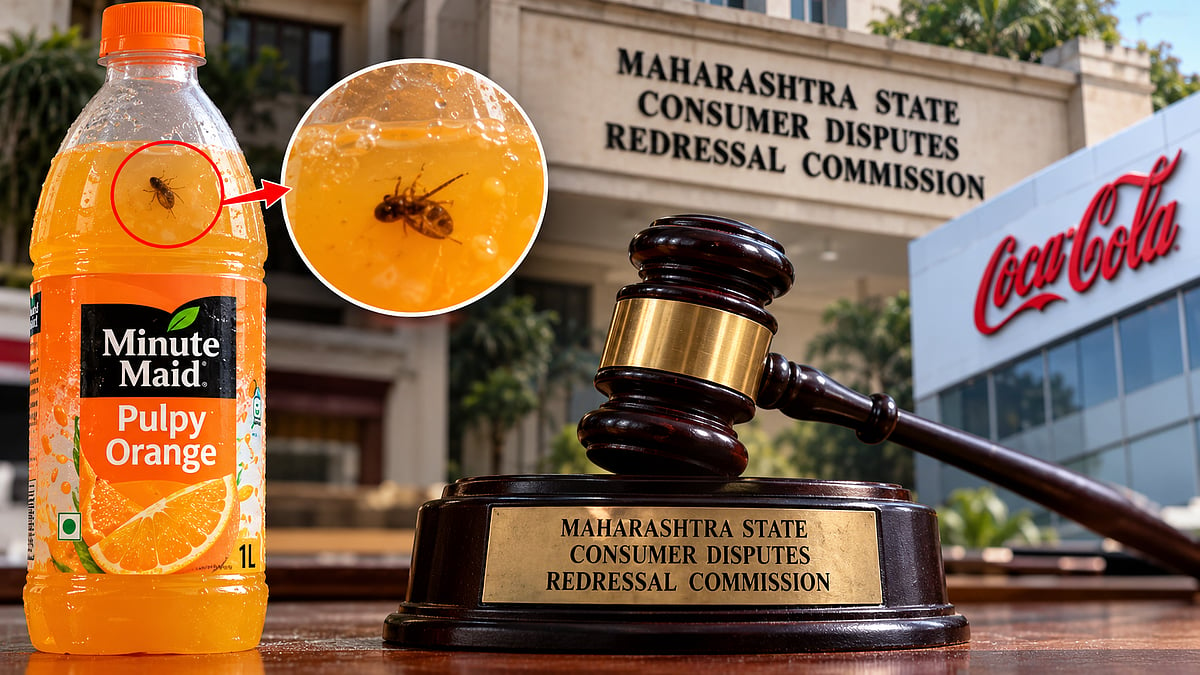
Maharashtra's State Consumer Commission has upheld ₹1 lakh compensation for advocate Nikita Ajwani, who alleged finding a dead insect in a sealed Minute Maid Pulpy Orange bottle bought in 2011. Dismissing Hindustan Coca-Cola Beverages' appeal, the commission said on September 30 that the foreign object constituted a severe deficiency in service and unfair trade practice.

Dead Insect In Minute Maid Bottle: Maharashtra Consumer Commission Upholds ₹1 Lakh Compensation To Mumbai Lawyer | AI
Mumbai: The Maharashtra State Consumer Disputes Redressal Commission has upheld an order directing Hindustan Coca-Cola Beverages Pvt Ltd and other parties to pay compensation to a South Mumbai lawyer after she allegedly found a dead insect floating inside a sealed one-litre bottle of Minute Maid Pulpy Orange.
₹1 Lakh Compensation Upheld
The State Commission, in its order delivered on September 30, 2026, dismissed an appeal filed by the company and confirmed the order passed by the District Consumer Disputes Redressal Commission, South Mumbai in August 2018, directing the parties to pay ₹1 lakh as compensation to advocate Nikita Ajwani. The District Commission had also awarded ₹25,000 towards litigation costs.
Ajwani had purchased the beverage from Sahakari Bhandar's Colaba outlet in October 2011. She approached the consumer forum in January 2012 after alleging that the company failed to satisfactorily respond to her complaints despite three notices. The District Commission had held Coca-Cola, Hindustan Coca-Cola Beverages Pvt Ltd and Sahakari Bhandar jointly liable.
Commission Cites Consumer Protection
The State Commission, while dismissing the company's appeal, observed that the Consumer Protection Act is a beneficial legislation intended to protect consumers from such hazards. It held that the presence of a dead insect in a sealed beverage constituted a serious deficiency in service and an unfair trade practice.
“The Consumer Protection Act is a piece of beneficial legislation designed to protect consumers from precisely this type of hazard. The Appellant is a large-scale manufacturer producing consumable beverages. The standard of care required in bottling plants is absolute. The presence of a dead insect in a sealed beverage is a gross violation of food safety standards and constitutes a severe deficiency in service and an unfair trade practice,” the State Commission observed.
Company Challenges Laboratory Findings
The company had challenged the findings on several grounds. It argued that the bottle was sent for laboratory testing nearly six months after its manufacture and after its four-month shelf life had expired. It also questioned the report of ITA Lab, pointing out that it mentioned a different batch number and was based on visual inspection rather than scientific testing.
The company further contended that ITA Lab was not a legally recognised laboratory under the Consumer Protection Act and argued that the District Commission had failed to properly consider its objections to the report.
Commission Rejects Company’s Objections
The State Commission, however, rejected these objections. It held that the consumer was justified in preserving the sealed bottle rather than handing it over to the manufacturer, as the bottle constituted the primary physical evidence in the dispute.
The commission observed that handing over the evidence to the party accused of the manufacturing defect before initiating legal proceedings could have jeopardised the consumer's case. It therefore found no fault with Ajwani's decision to preserve the sealed bottle for production before the judicial or quasi-judicial authority.
Batch Number Error Explained
On the discrepancy in the batch number mentioned in the laboratory report, the commission held that the laboratory had clarified that it was a typographical error. Since the bottle had been forwarded to the laboratory under the direct supervision and seal of the District Commission, the chain of custody remained intact. The commission further rejected the argument that the laboratory examination was conducted after the expiry of the product's shelf life.
“The expiry of a product’s shelf life leads to natural degradation, fermentation, or spoilage of the juice; it does not spontaneously generate a dead insect inside a sealed bottle,” the commission observed, holding that the presence of a macroscopic foreign biological entity in a sealed beverage constituted a manufacturing and packaging defect.
ALSO READ
It further held that where a visible foreign object is found in a sealed consumable product, chemical analysis of the liquid was secondary to establishing the integrity of the seal and the presence of the foreign object.The commission also rejected the company's attempt to challenge the complaint on technical grounds relating to the laboratory report.
“The District Commission rightly appreciated the evidence. The Appellant's attempts to defeat a legitimate consumer grievance through technicalities and procedural hair-splitting regarding lab accreditation and typographical errors are unacceptable,” the State Commission said.
The State Commission accordingly dismissed Coca-Cola's appeal and confirmed the District Commission's August 30, 2018 order. It made no order as to costs.
To get details on exclusive and budget-friendly property deals in Mumbai & surrounding regions, do visit: https://budgetproperties.in/
RECENT STORIES
-
-
-
-
-