BEST Wet-Lease Buses Under Scanner After 249 Accidents, Experts Demand Safety Reforms And Accountability
The issue assumes greater significance because contractor-operated buses now dominate BEST's fleet. Of the undertaking's 2,801 buses, 2,553 are operated by private contractors, while only 249 are owned and operated by BEST. Wet-lease buses operate on 349 of Mumbai's 400 routes and undertake more than 25,700 trips every day, making them the backbone of the city's bus transport network.

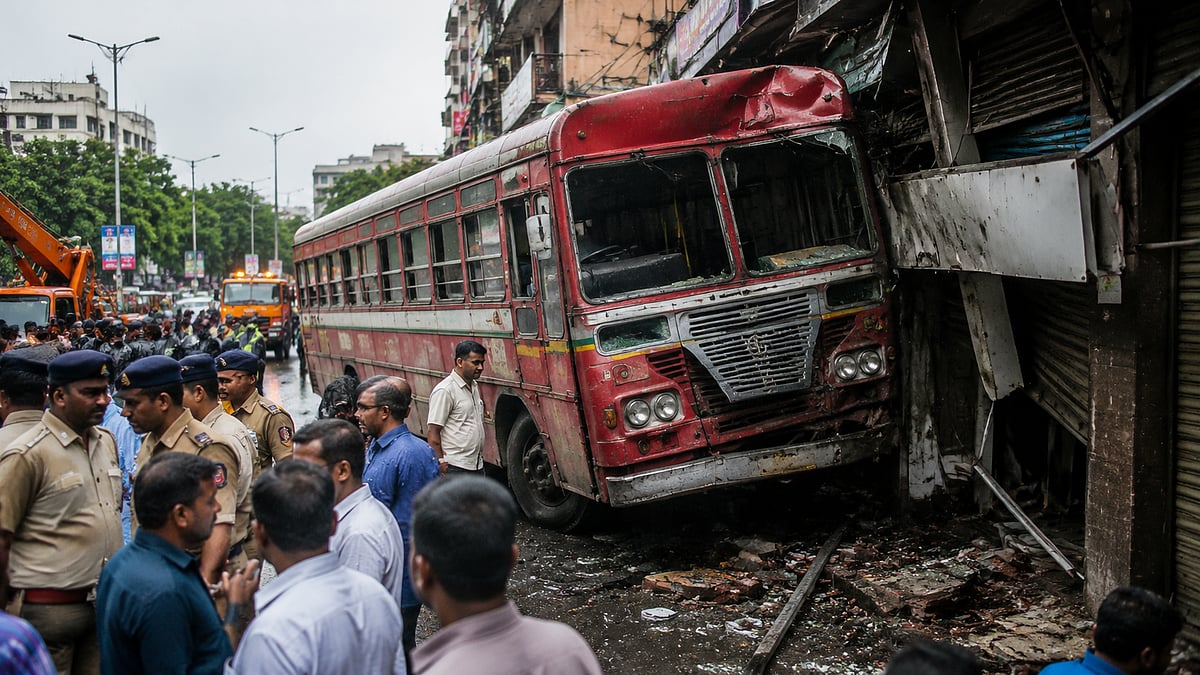
BEST Wet-Lease Buses Under Scanner After 249 Accidents, Experts Demand Safety Reforms And Accountability. | AI
Mumbai: BEST's growing dependence on contractor-operated wet-lease buses is increasingly being seen as damaging the undertaking's image, as repeated accidents, alleged maintenance lapses and claims of ignored safety warnings raise serious questions over the operating model. Official data shows that 249 accidents involving wet-lease buses between January and May 2026 claimed 10 lives and injured 46 people. With fresh crashes in June and July—including the recent Andheri West accident in which a Route 242 bus rammed into 14 vehicles. Transport experts, commuter groups and BEST committee members have demanded accountability, stricter monitoring of private operators and a larger fleet of self-owned buses to restore public confidence.
Official records show that May recorded the highest number of accidents (99), followed by March (96) and April (92). January and February reported three fatalities each, while May recorded two deaths. The concerns have deepened after a series of recent accidents. On June 4, a wet-lease bus hit an Ola driver in Malad. Four days later, an electric wet-lease bus crashed near Dadar after colliding with a stationary crane and a taxi, killing a motorcyclist and injuring several others. On June 24, another contractor-operated bus collided with a taxi while entering Colaba depot. On July 8, a bus in Bhandup seriously injured a pedestrian after reversing and then moving forward uncontrollably. Two days later, a Route 242 bus in Andheri West lost control and crashed into 14 vehicles, once again putting the spotlight on the safety of wet-lease operations.
May Records Highest Number Of Wet-Lease Bus Accidents
The issue assumes greater significance because contractor-operated buses now dominate BEST's fleet. Of the undertaking's 2,801 buses, 2,553 are operated by private contractors, while only 249 are owned and operated by BEST. Wet-lease buses operate on 349 of Mumbai's 400 routes and undertake more than 25,700 trips every day, making them the backbone of the city's bus transport network. Experts say that with such overwhelming dependence on private operators, even minor lapses in maintenance, vehicle fitness or driver supervision can directly affect commuter safety and public confidence.
BEST Committee member Ramakant Gupta said the increasing dependence on contractor-operated buses was affecting both commuter confidence and BEST's reputation. "We have consistently demanded that BEST increase its fleet of self-owned buses," he said.
Private Operators Control Majority Of BEST Fleet
Transport expert MD Afzal said passenger safety should never be compromised for cost savings. He said BEST must exercise strict oversight of private operators while gradually strengthening its own fleet to improve accountability, reliability and public confidence.
Transport expert Rupak Dhakate urged the Brihanmumbai Municipal Corporation (BMC) to provide adequate funding to BEST for purchasing more self-owned buses instead of relying heavily on contractor-operated buses. He also called for stringent vehicle inspections, timely maintenance, reasonable working hours for drivers, adequate rest and strict action against drivers found using mobile phones while driving. "Passenger safety must always remain the top priority because every human life is precious," he said.
Calls For Safety Audit Of Contractor-Operated Electric Buses
Meanwhile, Aapli BEST Aaplyasathi president Rupesh Shelatkar demanded an independent technical audit of contractor-operated electric buses. He said three major accidents involving contractor-operated Olectra buses and concerns over sudden acceleration could not be ignored. "Instead of making drivers scapegoats, BEST must conduct an independent safety audit and prioritise self-owned buses operated by trained in-house staff before more innocent lives are put at risk," he said.
Fresh questions have also been raised over whether repeated warnings were ignored. BEST Committee member Dr. Nitin Nandgaokar claimed that he had written to the BEST administration on April 2 warning about serious technical defects in contractor-operated buses and the threat they posed to passenger safety. According to him, the letter specifically highlighted defects in braking systems, steering mechanisms and other critical components. He alleged that despite the engineering department identifying these defects, several buses continued to operate without the necessary repairs. Following the Dadar accident, he sent another letter to the BEST Committee chairman on July 10, demanding that the action taken on his earlier complaint be made public.
Demand For Inquiry Into Accidents And Safety Lapses
Nandgaokar has also sought a high-level independent inquiry into the Dadar accident, administrative as well as criminal action against officials, departments and contractors found responsible for negligence, and a special safety audit of all wet-lease buses to prevent similar incidents in future.
ALSO READ
Additional concerns have emerged from the Kurla depot. BEST Committee member Ajay Singh said that during a recent inspection, committee members found that several electric buses had been facing air pressure leakage issues for several months despite repeated complaints. Employees alleged that the operating company had failed to carry out timely repairs, resulting in frequent breakdowns and buses returning to the depot before completing their scheduled trips.
A BEST bus driver told The Free Press Journal that an air pressure leak can severely affect the functioning of a bus. According to the driver, such leaks can reduce braking efficiency, lead to brake failure, affect the air suspension system and even cause automatic doors to malfunction, significantly increasing the risk of accidents.
With wet-lease buses now carrying the bulk of Mumbai's daily commuters, experts believe the recent accidents have exposed the urgent need for stronger oversight, transparent accountability and greater investment in BEST's self-owned fleet. They warn that unless maintenance standards, technical inspections and driver welfare improve, the wet-lease model will continue to damage BEST's image and erode public trust in one of Mumbai's most important public transport services.
To get details on exclusive and budget-friendly property deals in Mumbai & surrounding regions, do visit: https://budgetproperties.in/
RECENT STORIES
-
-
-
-
-