A visit to dispel myths and promote brotherhood
At the over 200-year-old masjid, devotees have the option of washing up either at a tap or at the natural reservoir over which the mosque was built and which continues to house fish and turtles.

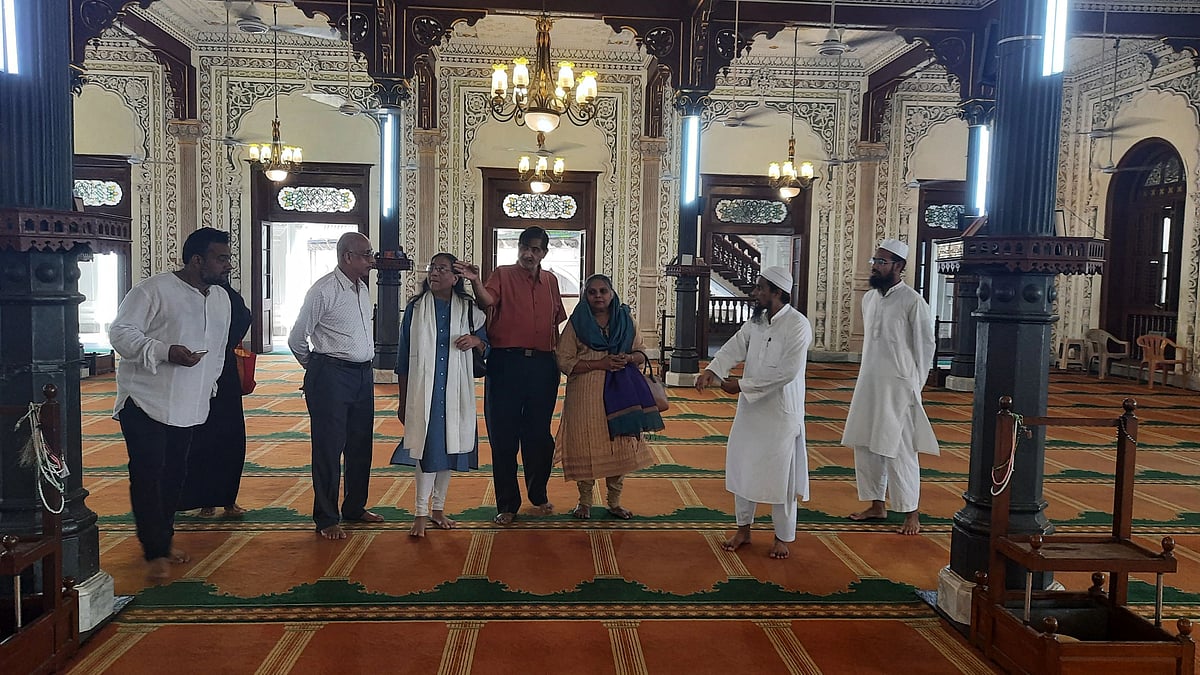
Photo: File
As Harshad Kapadia stood before mufti and librarian Abdul Matin to understand the various steps to be followed while performing namaaz, he asked if seeking forgiveness was part of the prayer.
The 66-year-old finally satisfied his desire to visit the Juma Masjid near Crawford Market which he grew up looking at while going to school but never could visit until Sunday, thanks to ‘Visit and Explore a Masjid/Mosque’, one of many events planned under the ‘Prophet for All’ campaign. The visit was also open to women.
“Seeking forgiveness is as much part of namaaz,” Mr Matin said as he demonstrated the steps, including prostration, and the duration that differs according to rakaats (units). “In the Quran, it finds mention several times."
The visit, attended by six people, started with first-things-first when a person enters a mosque. It went on to explain the different types of namaaz and their timings, how to perform them, the two prayer rooms, the structure with ornate designs, and the library it houses.
“It is important to clean the self before going for prayers,” said Shoaib Khateeb, chairman of the trust that looks after the Juma Masjid. “The idea is that we stand clean before the god we pray to."
Those explaining said that while cleaning of the fists three times, the feet till the ankles, the hands up to the elbows, the face, and the back of the neck were mandatory, some people also gargle and inhale just a little water into the nostrils so there is no bad breath.
“Most things are scientific,” Mr Matin said. “When you clean the back of your neck, there is better blood circulation, just as when you touch your head to the ground while praying.”
At the over 200-year-old masjid, devotees have the option of washing up either at a tap or at the natural reservoir over which the mosque was built and which continues to house fish and turtles.
The reservoir was cleaned during the Covid-19 pandemic, a task that took several months. “Two months went simply in shifting the fishes into the giant fish tanks,” Mr Khateeb said.
Inside the prayer room, the direction of prayer, place of sermon, prayer mat of the maulana leading the prayer and the Jumma (Friday) prayer were explained. The Jumma prayer happens only in big mosques where the faithful are supposed to stand shoulder to shoulder on lines marked through intricate designs on the carpet. “The shoulders have to touch,” Maulana Tausif Bangi explained. “It is a sign of brotherhood.”
The mosque, which can accommodate 5,000 people at a time, has a lower and upper prayer hall with the latter supported by bare minimum pillars and a 500kg chandelier hanging in the middle.
“It was some engineering at that time,” the maulana continued. “We have no roof in certain sections of the ground-floor prayer hall so that the voice could travel to the upper hall. There was no modern technology back then.”
“If you notice, the chandelier will rotate when the hall is full,” said Udayan Shah, a visitor passionate about chandeliers. “That is because the vibrations pass from the wooden flooring.”
After the prayer rooms, the visitors were shown the library that has over 18,000 books in Arabic, Urdu and Persian and is looking to acquire some in English too. Of the 2,000 manuscripts in the library, the oldest is 600 years old while Qurans ranged from coffee-table-size ones to those that could fit in a tiny box. Most Qurans written by hand were preserved with butter paper between pages so that the ink does not spoil. Some had translations in Persian next to the Arabic text. One of the first Qurans with commentary done in Mumbai is also part of the collection.
Visitors said it was important that such visits are held to dispel misgivings and get people together. They said such visits should be conducted more often and places of worship of different faiths should follow the lead.
“This is the first time I have visited a mosque,” said Sudha Shah, a homemaker and resident of Pedder Road. “I always wanted to see and understand the lifestyle of Muslims. My school friend told me about it. The architecture is out of the world while their prayer system is similar to ours. They too bow their head before god and clean up before as we do.”
Mr Kapadia added, “There are a lot of misgivings in the world outside. It is good that this is not about conversion.”
Emphasizing the importance of visiting, Himesh said, “After all we have to stay together. It is important that such visits are held. It will promote brotherhood.”
RECENT STORIES
-
-
-
-
-