Who Is Goddess Chandraghanta Worshiped On The Third Day Of Shardiya Navratri?

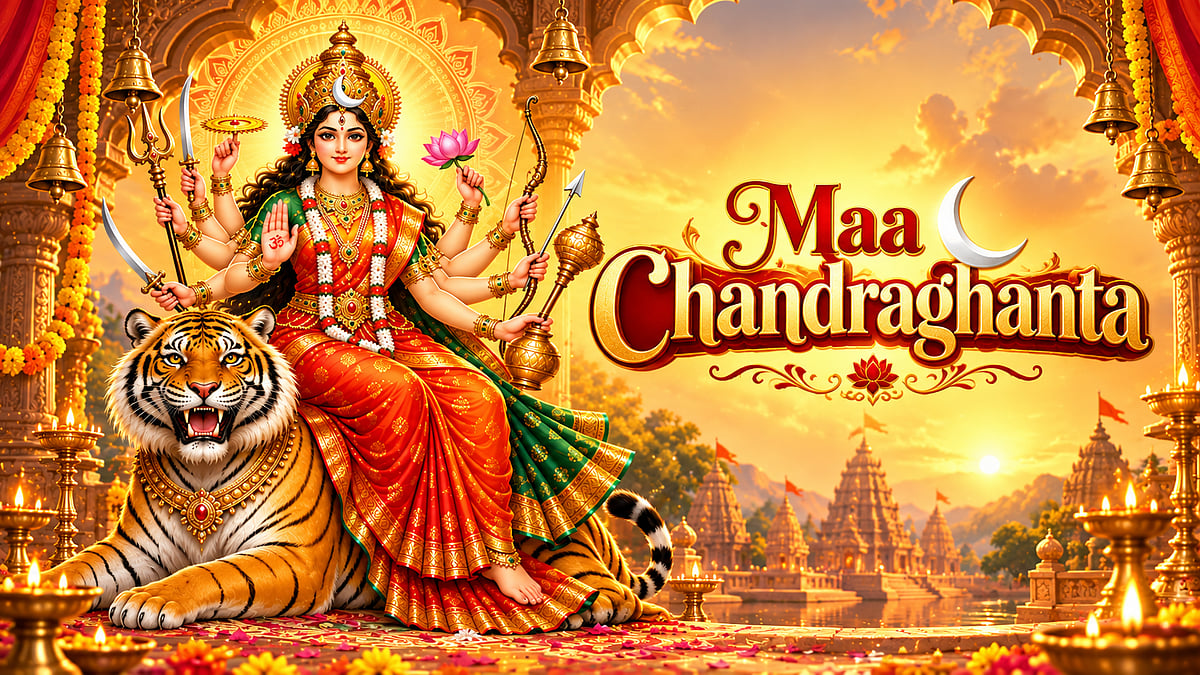
Who Is Goddess Chandraghanta Worshiped On The Third Day Of Shardiya Navratri? | FPJ
Shardiya Navratri is an auspicious festival which falls in the Ashwin month and it is dedicated to nine forms of Goddess Durga, collectively known as Navdurga. Each day holds religious significance and is associated with a particular form of the goddess. On the third day of Shardiya Navratri, devotees worship Goddess Chandraghanta, who symbolises courage, strength, peace and protection.
This year, the Shardiya Navratri began from Sunday, October 11, 2026, the first day is dedicated to first form of Goddess Durga, that is Shailputri. On October 12, devotees celebrated the second day of Shardiya Navratri which is dedicated to Brahmacharini and today, Day three of Shardiya Navratri honours the third form of Goddess Durga which is Chandraghanta.
Goddess Chandraghanta is the third form of Navdurga and is believed to protect her devotees from negative energies while blessing them with bravery and spiritual strength. Devotees offer prayers to the goddess and seek her blessings for peace, prosperity and protection from obstacles.
Why Is Goddess Chandraghanta Called By This Name?
The name Chandraghanta is derived from two Sanskrit words: Chandra, meaning moon, and Ghanta, meaning bell. The goddess is depicted with a crescent-shaped moon resembling a bell on her forehead, which gives her this distinctive name.
According to Hindu beliefs, Goddess Chandraghanta represents the balance between serenity and warrior-like strength. While she is compassionate towards her devotees, she is also portrayed as a fierce warrior who fights evil and protects the righteous.
What Does Goddess Chandraghanta Look Like?
Goddess Chandraghanta is generally depicted riding a tiger or lion, symbolising courage and fearlessness. She is traditionally portrayed with ten hands, carrying various weapons and objects, including a trident, sword, bow and arrow, lotus and a bell. Some of her hands are shown in protective and blessing gestures.
Her appearance reflects her readiness to fight negative forces while remaining benevolent towards those who worship her with devotion.
Legends of Chandraghanta
The form of Chandraghanta is worshipped on the third day, representing the married aspect of Goddess Parvati. Her name is derived from the half-moon on her forehead. According to Hindu mythology, after performing thousands of years of penance to win Lord Shiva, which named her Brahmacharini, Goddess Parvati wins Lord Shiva. But, at their wedding, Lord Shiva arrived with a wild array of ghosts, goblins and aghoris.
Seeing his appearance, Parvati's mother Menavati and other guests fainted, and then she requested Shiva to appear in a charming form, which led him to be named Chandreshwar. Meanwhile, she also transformed, and her appearance with a crescent-shaped bell over her forehead named her Chandraghanta.
RECENT STORIES
-
-
-
-
-