What Is Kinesiology Tape, And How Does It Help With Pain And Recovery?
Discover the benefits of the stretchy therapeutic K-tape for muscle support, pain relief, and better movement

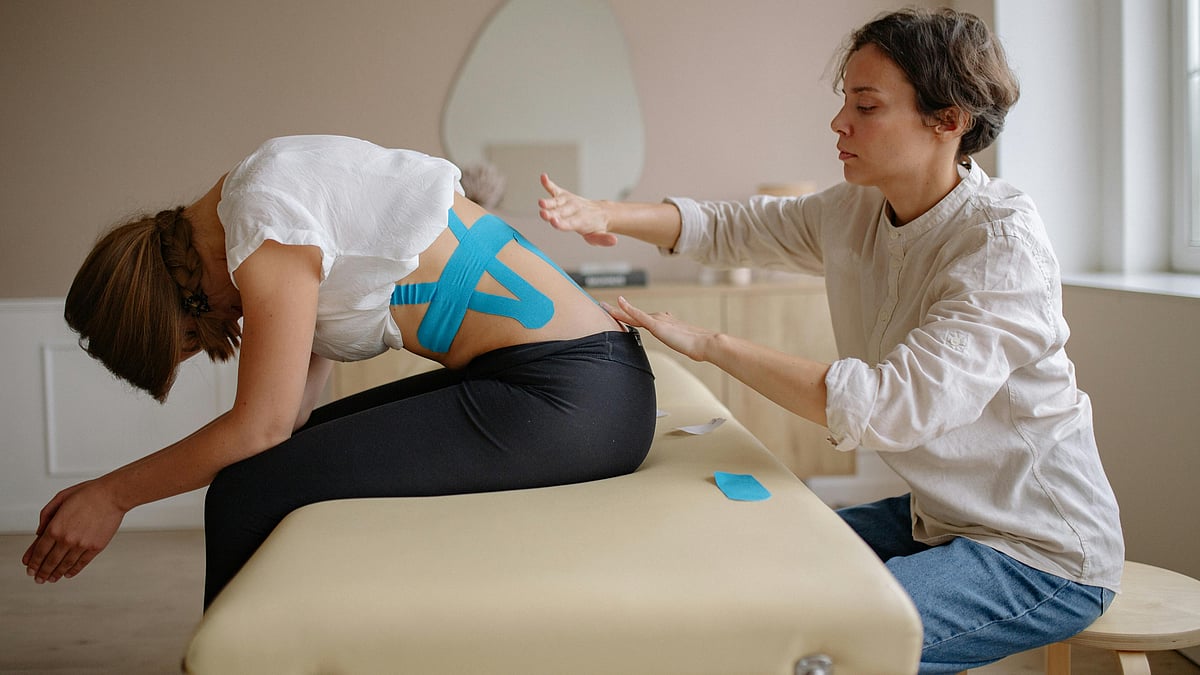
Pics: Pexels
If you are into heavy-duty physical training, acrobatics or some intense sporting activity, this tape could act as a pain reliever. Got the hint? Well, we got you covered then. If you are nursing injuries and bruises, this could be a great antidote. We are talking about nothing else but kinesiology or K-tape. But what is it after all?
Healing Tape
“K-tape is an elastic therapeutic tape designed to support muscles and joints without limiting movement. Unlike traditional sports tape that restricts motion, kinesiology tape stretches with the body and mimics the elasticity of human skin. It was developed back in the 1970s. It is a bouncy, flexible cotton strip with an acrylic adhesive that expands up to 140% of its original length. Impressively, the tape is meant to stay on for several days despite showering and working out,” informs yoga teacher and wellness coach Giri Yadav. For the uninitiated, kinesiology refers to the study of the mechanics of body movements.
For the unversed, K-tape has many utilities to keep in mind. It is commonly used for managing muscle strain, joint discomfort and minor swelling. The tape gently lifts the skin, which may help reduce pressure on the pain receptors and improve local circulation.
Many athletes and fitness practitioners use it for knee pain, shoulder strain, lower back discomfort and posture correction. However, it should be viewed as a supportive tool, not as a replacement for proper rehabilitation and exercise,” reminds Yadav.
Muscle, Pain, Mobility
K-tape is said to prop up muscles, reduce pain and swelling, and enhance mobility. Fitness expert Akshay Verma comments that K-tape is “best understood as a neuromuscular assistive tool rather than a structural brace.”
“Its primary value lies in how it interacts with the skin and the underlying sensory receptors. When applied correctly, it can provide proprioceptive feedback, encourage better movement patterns and help lower perceived uneasiness. It is not a substitute for building strength or clinical intervention but in the right context, the tape can complement recovery by aiding in muscle function without restricting mobility. The key to success is apt assessment and application,” shares Verma, who’s the co-founder of FITPASS (India’s largest fitness membership and wellness programme, offering solutions and access to 8,100 plus premium gyms and fitness centres nationwide).
“In musculoskeletal issues, especially in cases of mild strains or overuse conditions, proper feedbacks could help guide safer mobility while the core tissue heals. However, its impact hinges significantly on technique and individual responses,” opines Verma.
Skin Lifting
K-tape creates a microscopic lifting of the skin. What is this basically? K-tape has a springy property. When it is applied with stretch and the body returns to a neutral position, it forms subtle convolutions or ripples in the skin.
“This is often described as ‘microscopic lifting’. The theory is that this slight decompression enlarges the interstitial space (any small, narrow gap located between closely spaced structures, cells or components) between the skin and the underlying tissue. While the skin raising is minimal and not visibly dramatic, it may help lessen mechanical pressure on sensitive structures beneath the skin,” explains Verma.
Aids in Lymph Leakage
Good news is that a K-tape could smoothen lymphatic drainage. But how does it aid the process? Biology suggests that the lymphatic system helps clear excess fluid, waste products and inflammatory by-products from tissues. When injury or soreness occurs, fluid can accumulate in an area.
“By gently lifting the skin and potentially improving superficial circulation, K-tape may facilitate natural lymphatic flow. This can contribute to a decrease in mild swelling when used alongside proper motion and recovery protocols. It is important to note that the kinesiology tape backs the body’s own drainage mechanisms rather than actively seeping out anything on its own,” states Verma.
Light and Agile
A rigid sports tape induces immobility. It restricts joint movement to prevent further hurt and wound as well as stabilise structures during high-intensity sport. K-tape, in contrast, is elastic and allows full range of motion. It works with mobility rather than limiting it. This makes kinesiology more suitable for dynamic activity, restoration phases and longer-wear duration or long-term use.
As Stretchy as Skin
K-tape can reportedly be stretched to copy the skin’s elasticity, thus allowing a complete range of motion. Fitness exponent Sumit Dubey elucidates: “Almost like a living tissue, kinesio tape elongates until it reaches a considerable portion of its starting size. Owing to this trait, motion continues unblocked during activity. In fact, full joint mobility remains possible due to minimal restraint. On the contrary, firm, unbending tapes impede movement to shield injuries.”
K-tape’s pliability makes it common in rehab centers and at long-distance events. Even workout routines are built on freedom of motion. “Those training with the K-tape, stay steady without stiffness getting in their way. This is simply because the tape moves with the body uninterruptedly due to its plasticity. It doesn’t squeeze the skin too tight and retains body balance that matters a lot,” infers Dubey.
Research reveals that a high-quality K-tape is engineered to extend roughly 120-140% of its resting length, closely mirroring the elasticity of human skin. This allows it to move smoothly with the body and not against it. Individuals can continue training, rehabilitation or daily movement without the tape acting as a brace.
Wellness Gift
K-tape can address a smorgasbord of health issues and physical injuries to deliver immense relief. It can help with muscle pain, sprains, small muscle pulls, knee pain, backache, shoulder pain, neck pain, ankle injuries, tennis elbow and heel pain. Many athletes use it for sports injuries and recuperation.
One may reap benefits from kinesiology tape to a great degree when dealing with repeated stress problems or slight muscle pulls. “Relief may come for people grappling with tennis elbow, kneecap alignment trouble, sore heels, irritated Achilles tendons, shoulder strain, achy lower backs, even minor twists in the ankle. Posture-related soreness tends to subside too, particularly for those glued to office chairs all day,” reports Dubey.
Expert Advice
One wonders if it is better to have a fitness trainer or a physical therapist to apply the tape correctly for best results. What could go wrong otherwise? Can wrong application have any side effects?
“It is better if a licensed physical therapist or a trained professional applies the tape, especially if you have an injury. If applied faultily, it may not work properly. It can cause skin eruption, discomfort or even aggravate that stinging feeling if the tape gets too tight. So precision is important,” opines fitness coach and dance instructor Adele Angela Johnson, who runs the online platform Fit Sassy Mommy.
Material Power
Material composition plays a pivotal role in seamless performance. Tapes made of rayon-spandex blends regulate elasticity and rebound reliably. This means, the tapes stretch predictably and maintain tension over a prolonged, multi-day wear. Breathability and water-resistance are equally important, particularly in humid climates or high-sweat conditions, as the tape must be kept intact through showers and rigorous gym sessions without compromising on the skin comfort.
K-tapes with a medical-grade, hypoallergenic adhesive permit athletes and professionals to sustain movement continuity without frequent reapplication.
Waterproof
K-tape is also useful because of its water-resistant characteristic. “You can shower or sweat while wearing it. It usually lasts three to five days. You should change it if it starts peeling off or trigger rashes or any kind of irritation,” says Johnson.
Water resistance is common in top-grade K-tapes, built to tackle perspiration, quick rinses or brief dips in water. “Durability is contingent on how much you move, the ongoing weather or your skin’s nature. When humidity climbs, stickiness tends to fade faster than usual. It starts peeling off once the edges of the tape lift the skin too far, tension drops or redness appears. A brief pause lets the skin settle before reapplying the tape for continued care. When prepped well, the surface holds better and feels plain or crease-free,” apprises Dubey.
At an Advantage
Many professional spheres or a clutch of physical activities can benefit from using a K-tape. Athletes, runners, gym-goers, dancers, football and cricket players can gain from it having an edge in their performance field. Even people with desk jobs who suffer back or neck pain can use it. It is helpful for anyone who needs extra muscle or joint support.
A sticky strip of tape is seen wherever athletes push limits.
Runners stick it around knees to stay stable on long miles, while those swimming or slicing through water wrap their shoulders with the tape hoping for relief.
Cricket players lean on it when their lower backs ache after hours of bending sideways.
Footballers rely on it to keep ankles locked sans stiffness slowing them down.
Lifters carrying heavy loads sometimes wear it during repeat efforts where muscles start lagging behind willpower.
Dance artists use it mid-rehearsals when joints whisper warnings too loud to ignore.
Yoga followers find help holding postures longer when tension pulls at spine curves.
Office workers hunched over screens notice less pull across the neck after applying strips early in shifts.
“As more people move daily not just to create records or hit milestones but to execute routine tasks with ease, this elastic aid appears to come in handy. Over time, it shifted gears from the sidelines to regular life fixes. Movement matters now beyond winning medals. How bodies handle repeated motion defines the K-tape’s role today,” concludes Dubey.
RECENT STORIES
-
-
-
-
-