Stuck in Traffic? These Colour-Coded Corridors Decide Who Gets To Move — And Who Waits
From green ambulance corridors to pink gender-safe routes, India’s colour-coded mobility system is reshaping how cities prioritise movement amid rising congestion

Lungi Ngidi was up for an unlikely feat of speed in Delhi recently, just not as a result of any heroics with the ball at the Arun Jaitley Stadium, where he was playing an IPL match. The South African cricketer navigated a 9-kilometre stretch in the national capital during rush hours in all of 11 minutes. Quite remarkable for a route where threading through a torrent of humanity on wheels, even on the best of days, can leave one poorer by 30–45 minutes and truckloads of sanity.
Except that Ngidi — hit hard on the head while attempting a catch just minutes earlier — was in an ambulance on his way to BLK-Max Hospital, and it was the Delhi Police holding back bumper-to-bumper traffic that ensured he received timely medical help. Although it was an exploit the Delhi Capitals pacer, despite being no stranger to speed, would hardly want to remember, it marked yet another success of a “green corridor” — a concept that has come to demonstrate a level of empathy quite rare in our indifferent cities.
Mosaic in grey
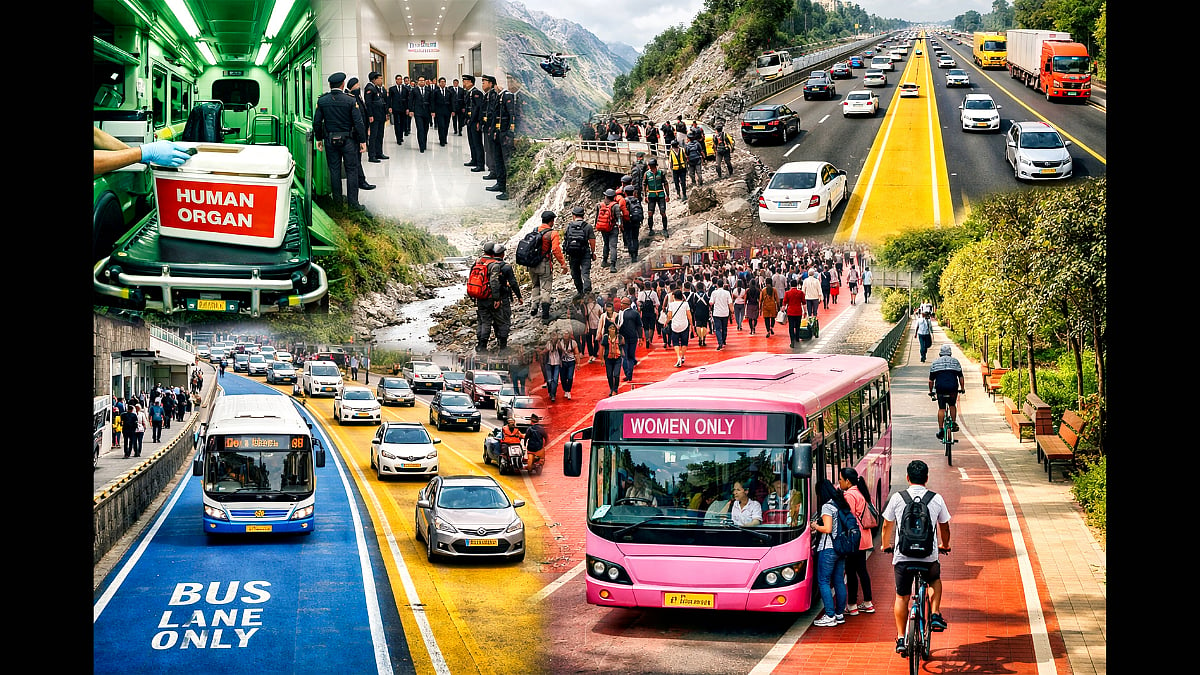
Thanks to green corridors — where traffic police temporarily turn busy roads into signal-free expressways for ambulances — harvested organs travel faster than commuters, quite ironically on the very roads that claim hundreds of lives every day without a ripple. Notably, Mumbai’s preplanned, highly coordinated green corridors are said to have improved the success rates of organ transplants by reducing travel time from various hospitals to the airport to under 20 minutes.
Gridlocks are the greatest levellers of our time, but green corridors aren’t the only ones breaching this rawest form of democracy. The grey of our transit arteries, it turns out, now comes with colour codes — white, red, yellow, black, even pink — teaching breathless cities valuable lessons in calculated priorities and deciding when something is worth moving for, or rather, stopping for.
White corridors are a lot like their green counterparts but with route sanitisation, controlled access points and police escorts thrown in for swifter and safer VVIP movement, including during medical emergencies. Many Indian cities are experimenting with integrated control rooms to formalise ambulance corridors, often created on the fly by police or commuters themselves for emergency vehicles. States like Uttarakhand bear witness to disaster and evacuation corridors — routes cleared to deliver aid and move people to safety during crises such as floods, earthquakes and landslides.
Shades of movement
Not all corridors are about emergencies though. Red corridors in Delhi-NCR, for example, restrict freight movement to non-peak hours on roads heavily used by commuters. Likewise, yellow corridors on high-speed routes like the Mumbai-Pune Expressway allow commercial vehicles to run only during specific time slots, affording passenger vehicles greater speeds and safety. Although relatively rare, black corridors are created to ensure the safe passage of hazardous or oversized cargo such as industrial machinery, chemicals and defence equipment, under the watch of pilot vehicles and police escorts.
Blue corridors, as seen in sections of Bengaluru’s Outer Ring Road, offer dedicated lanes for public buses to ply smoothly during peak hours. Ahmedabad’s Bus Rapid Transit system, one of India’s few successes in segregating lanes for high-frequency buses, has dedicated stations and priority signals to ensure metro-like efficiency on everyday roads. Pink corridors, being piloted in cities like Delhi to look at mobility through the lens of gender, are about enhancing safety and accessibility for women in transit, including by way of reserved buses and routes.
In a bid to make human-powered movement safer and more attractive through physically separated paths, cities like Pune and Bengaluru are developing dedicated cycling and pedestrian corridors along rivers and major roads, hoping this will also ultimately reduce congestion and pollution.
There are ecological corridors too — stretches of natural habitat connecting fragmented forests, like the ones between Kanha and Pench national parks that allow tigers to move and breed, or those linking Bandipur National Park, Mudumalai National Park and Wayanad Wildlife Sanctuary into one of Asia’s largest contiguous elephant habitats. With crisscrossing highways, though, wildlife underpasses are now emerging as a compromise.
The concept of corridors is also extending to the world on rails with the likes of metro and freight corridors attempting to streamline passenger traffic within and between cities.
Mind the gap
An ecosystem of corridors works well only when routes for organs, goods, people, aid or wildlife cooperate. Complications arise when they intersect and compete, testing and exposing the limits of a city’s traffic management capacity, infrastructure and trade-offs between everyday mobility, commerce and priority movement.
Although effective, corridors can end up moving the core problem instead of solving it. “The real solution to traffic and transport inefficiencies lies in managing rapidly increasing urban congestion,” says B. I. Singal, former Director General of the Institute of Urban Transport. “Congestion is caused by several factors, primarily the ineffective management of different types of traffic and the unstructured use of shared infrastructure.”
That makes corridors little more than a band-aid. Yet, they are becoming dynamic systems that create hierarchies of movement. Managing corridors when they start competing for the same space may well become our next big challenge if we don’t stop defining success as merely helping one type of movement prevail over the others for a while. The fleeting satisfaction of pushing chaos aside, even if momentarily, by assigning a name and a colour to a lane can only take us so far.
Corridors at a glance
Green: Ambulances carrying harvested organs and critical patients
White: VVIP movement
Red: Closed to heavy vehicles during peak hours
Yellow: Freight movement only during specific hours
Black: Hazardous and oversized cargo
Blue: Buses and public transport
Pink: Women-only buses
BRT/Metro/Expressway: Swifter urban and intercity transit
Cycle/Pedestrian: Non-motorised movement
Wildlife: Safe animal movement
Disaster: Relief and evacuation during crises
RECENT STORIES
-
-
-
-
-