Solar Ring On Moon? Japan's Endless Power Energy From Space Could Transform Global Energy; Here's What To Know
Lunar Solar Power, or the Lunar Ring, is a massive infrastructure project that would surround the Moon with solar cells along its equatorial belt. The idea was first proposed by Shimizu Corporation, in which a solar ring made of solar panels would encircle the Moon's surface with an aim to produce endless electricity for the blue planet, Earth.

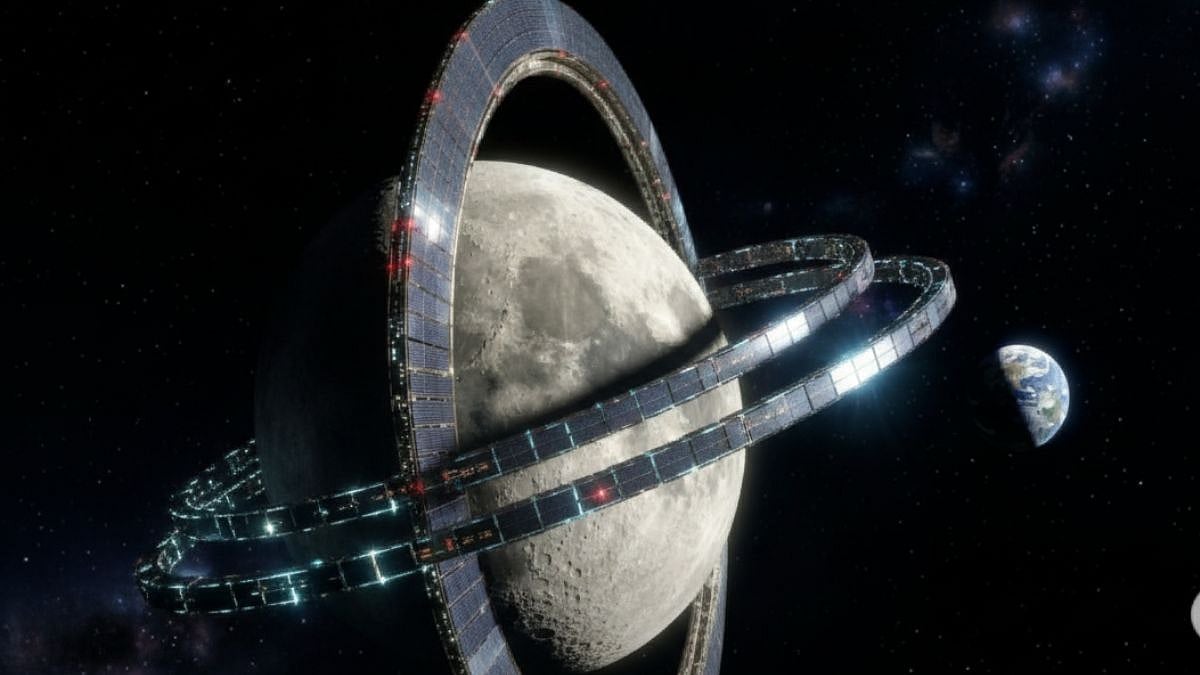
Solar Ring On Moon | AI
You might have heard about the idea of constructing bricks on Mars, which was proposed by Elon Musk. Can you imagine a world with an endless source of energy? Today, the grid power that the world works on comes from natural resources, either renewable or non-renewable energy, mostly non-renewable energy. This is an energy source which could end by overuse, so to balance it and keep the environment clean and healthy, we also use renewable energy.
But what if there could be a source of infinite energy? You might have heard about the idea of constructing bricks on Mars, which was proposed by Elon Musk. Doesn't it seem to be true, right? But Japan has already thought about it. The idea was considered by engineers from Japan in a project called the "Lunar Solar Ring." Let's deep dive into the idea of the Lunar Solar Ring and how it could create a revolution.
Lunar Solar Ring: What is Japan's project about?
Lunar Solar Power, or the Lunar Ring, is a massive infrastructure project that would surround the Moon with solar cells along its equatorial belt. The idea was first proposed by Shimizu Corporation, in which a solar ring made of solar panels would encircle the Moon's surface with an aim to produce endless electricity for the blue planet, Earth. The seemingly impossible idea was first proposed in 2011 after the Fukushima nuclear disaster, which promoted safer and cleaner energy solutions.
The Shimizu Corporation stated on its official concept page that it "will harness solar energy by placing solar panels in a belt around the Moon's equator." The concept-based project stretches roughly around 11,000 kilometres in length and several hundred kilometres in width. It could become one of the largest human-made structures ever imagined.
How will the Lunar Ring work?
Japan is exploring an ambitious idea that sounds like science fiction: a solar power system built around the Moon that could provide nearly endless energy to Earth. Unlike solar panels on Earth, the Moon has no atmosphere or weather disruptions, allowing solar panels to capture sunlight almost continuously, which would provide 24-hour power.
The energy generated would be converted into microwaves or laser beams and transmitted wirelessly back to receiving stations on Earth, where it would be converted back into electricity and added to the global power grid. This could provide a constant, renewable source of electricity, potentially solving issues like power shortages and reliance on fossil fuels.
How it could revolutionise global energy?
One of the biggest advantages of a lunar solar ring is its efficiency. On Earth, solar panels are limited by day-night cycles and weather conditions. On the Moon, however, sunlight is far more consistent, making energy generation more reliable. This could help meet growing global energy demands while reducing carbon emissions. It will also reduce dependence on fossil fuels.
ALSO READ
What could be the challenges in the Lunar Ring Project?
First and foremost, the challenges in the project are the massive construction of infrastructure in space. Building and maintaining infrastructure on the Moon would require significant investment, advanced robotics, and breakthroughs in space transportation. There are also concerns about the safety and efficiency of transmitting energy across such vast distances. Creators of the Lunar Ring called it a long-term project, and initial plans have suggested a timeframe of 2035.
RECENT STORIES
-
-
-
-
-