‘Our Younger Generation Yearns For Accountability’: Singer Bhrigu Sahni On His New Hindi Album 'Azaadi'
The singer kicks off his forthcoming album with ‘Azaadi’, a protest song that speaks of collective strength, unity and hope

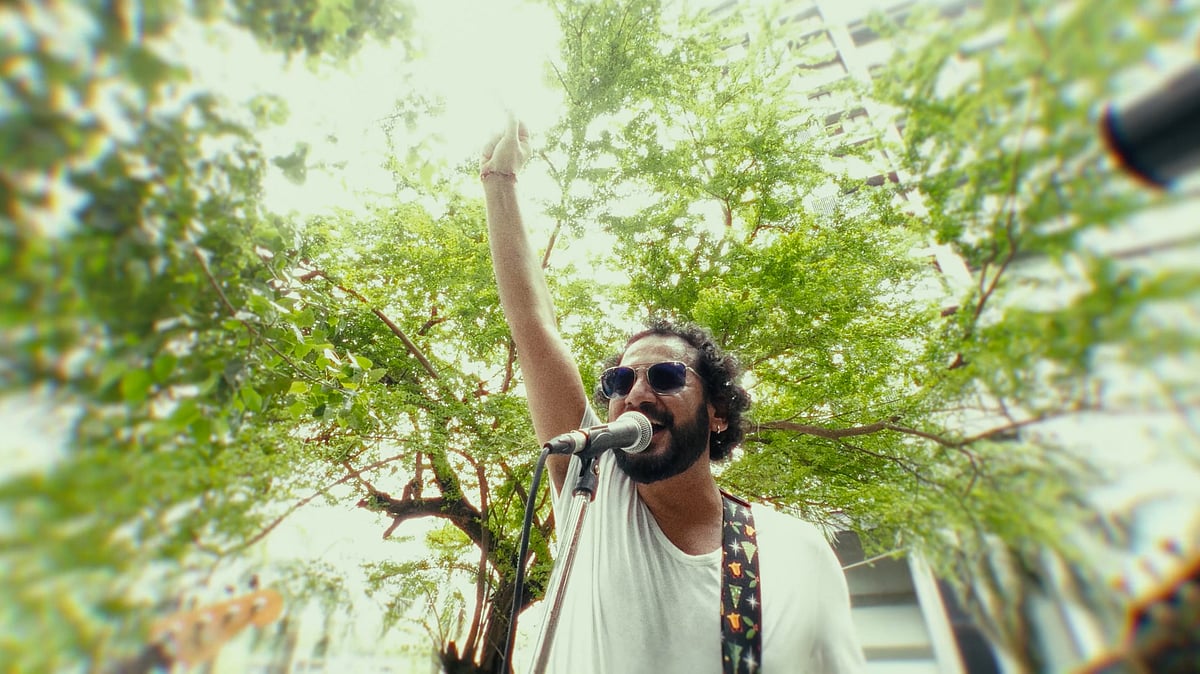
After spending a decade studying music and performing in the US, Bhrigu Sahni returned to India. He had released the English EPs What Is Now and Awakening, besides a few singles, but felt the need to write and sing in Hindi.
Some inspiration came from his own roots, Bhrigu is the grandson of Bhisham Sahni, the late writer, playwright and actor most famous for his novel Tamas. He started reading his grandfather’s works, and even explored Hindi comics like Chacha Chaudhury and Urdu poets Momin Khan Momin, Mohammed Iqbal and Firaq Gorakhpuri.
The preparations helped. On October 2, Bhrigu released Azaadi, the first single from his forthcoming album. Featuring his band Bhrigu and the Jaanemans, it is a protest song which offers a sense of hope in the current political context. He says, “The multiple protests over the last few months have shown that our younger generation yearns for accountability. Each line in the song relates to the protests. There is one that says, ‘Oonche hai pahaad, par hum chhote, phir bhi hum chale sabke liye’. Basically, it means that while individually we are very small in the political context, the collective strength of the people is high and we walk together for everyone.”
Bhrigu and the Jaanemans consists of artistes he knew or was introduced to in Pune, where he stayed while working on the album, before shifting recently to Mumbai. While Bhrigu is on vocals and guitar, multi-instrumentalist Jayesh Malani plays keyboards, piano, guitar and saxophone. Drummer Varun Venkit and bassist Shreyas Kadkol firm up the rhythm section, and vocalist Meher Paralikar presents a Hindustani sargam stretch on Azaadi. The song’s video contains live shots of the band’s performance, interwoven with footage from the actual protests.
Interestingly, Azaadi was written much before the protests. Even as he was working on his Hindi writing abilities, Bhrigu was reading a book called The Creative Act: A Way Of Being by renowned music producer Rick Rubin. He says, “Rubin says you must try to collect seeds, or collect ideas, when you are empty inside. In my case, I had finished work on my previous record Awakening. But instead of taking a break, I just continued writing songs, this time in Hindi. The songs just came to me, and I was so involved with the process.”
In that newfound burst of creative inspiration, Bhrigu wrote six songs. One of them was Azaadi. He recalls, “At that time, I was talking of another kind of freedom, which was more spiritual in nature and something that would give me calm and peace. Even reggae singer Bob Marley talked of emancipating oneself from mental slavery. So that was the thought behind the song. But when the protests happened in July, my bandmate Jayesh Malani felt the words went perfectly with the current situation. I hadn’t even thought about it that way, but I listened to it with this in mind. And line-to-line, it’s so apt.”
The entire album will be released by mid-2027, but the single Chalo Mere Saath will be released in November. He says, “The song is an ode to creating music, and the joy that follows. The best thing is we recorded the entire album live, instead of using the general practice of recording in parts. We are also doing some shows, including one in Bonobo, Bandra, on November 11.”
ALSO READ
As a musician, Bhrigu has had multiple influences across genres. His favourites include American guitarist Michael Hedges, reggae star Bob Marley, singer-songwriter Leonard Cohen, the bands Pink Floyd, Crosby Stills Nash & Young and The Who, Sufi maestro Nusrat Fateh Ali Khan, vocalist Kumar Gandharva, sarod legend Ali Akbar Khan and sitar exponent Nikhil Banerjee.
On a personal level, a huge inspiration was his grandfather Bhisham Sahni, younger brother of legendary actor Balraj Sahni. He recalls, “Bhisham-ji would come from Delhi to Pune, and talk about how refugees settled down in Delhi after Partition, and his days with IPTA (Indian People’s Theatre Association). I try and learn from his values, and his thoughts on unity and secularism. I never met Balraj-ji but he was like a guiding figure. He had an amazing story. He was in Santiniketan, BBC, IPTA and even wanted to write in Punjabi. I used to watch his films and it was a matter of pride.”
Bhrigu’s father Varun Sahni is a leading astrophysicist. “He also has a strong literary streak and passion for theatre. It’s from people like these that I learn things. It gives me the desire to do more, and focus totally on what I do,” says the musician. It probably explains why he decided to study Hindi so deeply before writing songs in the language.
RECENT STORIES
-
-
-
-
-