Nisha’s Mumbai: Nisha JamVwal on Truthful Memoirs, Royal Tales, And Eid Evenings
From intimate memoirs to royal legacies, spiritual musings to Eid celebrations—Mumbai unfolds in stories and spirit

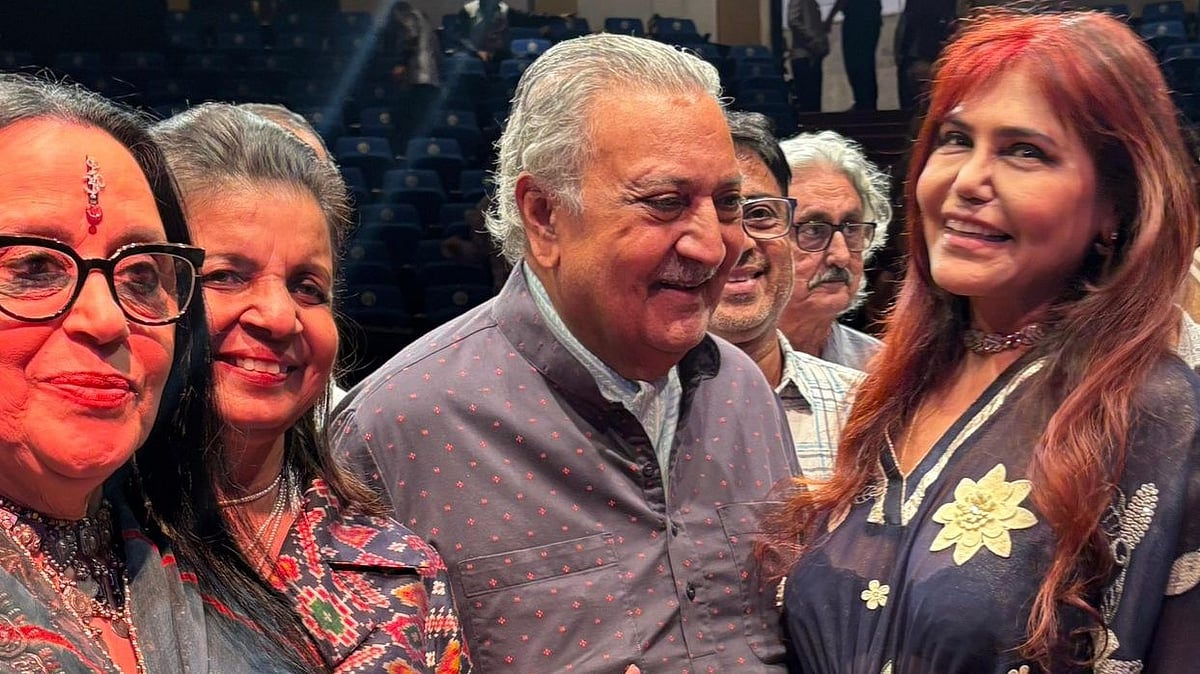
Some weeks in Mumbai come with a mood board and this week was all about Books including chef maestro Rahul Akerkar’s Biting Off More Than I Can Chew a deeply personal and cathartic journey he’s written which to my dismay I missed, what with Mumbais hurry and flurry!
Suvir Saran — Truth, finally plated
Suvir Saran has always been hard to box in. Chef, artist, author, educator and he even calls himself a ‘farmer’. And now with his memoir “Tell My Mother I Like Boys” by Penguin he’s firmly stepped into deeply personal territory that Mumbai’s folk are leaning into with curiosity.
For those who track the city’s culinary evolution, Suvir’s imprint is unmistakable. From shaping menus at places like Bastian and Neuma to now leading culinary planning at ‘Awas’ in Alibaug , he’s been quietly defining what modern Indian dining can look and feel like—global and yet rooted.
But at my evening at a marquee set up by Art of India at the Prince Of Wales Gallery food took a backseat. It was more about his personal memoir set in the unmatched atmosphere that only art and paintings can create.
In conversation with Ana De, Suvir stripped things to his real journey revealing his vulnerable growth into who we see him as today! No grandstanding, no performance just about his fears, vulnerabilities, longing—and the slow, often painful work of self-acceptance. His journey across Delhi and New York isn’t told as a linear success story but a messy fragmented real and endearing journey of a very creative soul.
He spoke about growing up in a space where silence was often louder than words. About navigating queerness within the layered expectations of family and culture. About building a public life that looked complete, even as parts of him remained unspoken. And that’s what makes the book land.
It’s not a dramatic “coming-out” narrative. It’s quieter than that. More nuanced in a coming-home to self kindova way and to truth. To the parts we spend years editing out.
The gallery setting of us surrounded by bold Indian art made the conversation felt intimate, almost confessional. You could sense the audience leaning in, not out of voyeurism, but recognition.
Bombay or Mumbai is a city that thrives on surface, and for me evenings like this are necessary to feel the reality of life as it is!
“Baapji” — Royalty to human
If Suvir’s evening was introspective, “Baapji” at the NCPA was expansive.
I found that it isn’t your standard royal biography. The book, by Aman Nath and Yogi Ved, captures Maharaja Gaj Singh II of Jodhpur in an expansive pictorial way that feels grand and disarmingly personal. The format is a large, visually rich volume with over 200 photographs, many drawn from private archives that haven’t been widely seen before.
The panel, moderated by Avid Learning’s Asad Lalljee, had energy and Humor, and being privy to many stories because of my marrying into royalty I enjoyed to not stiff, not reverential but humorous witty chat. The right amount of irreverence to keep it engaging for the length of time it extended into.
What stayed with me was the story of Baapji’s return from Oxford. A young man stepping off a special royal saloon attached to the train from Delhi to Jodhpur - his city that hadn’t just been waiting—it had been watching. Thousands lining the streets, not for spectacle, but for connection and continuity. The twelve hours it took him to make it from the station to his palace - on a journey that would normally take thirty minutes- made him stay back forever.
At 19, he inherited not just a title, but responsibility at a time when India was redefining its identity post-Independence. The book captures that transition—the shift from princely privilege to public accountability- evocatively.
But it’s the smaller details that give it texture like personal anecdotes. Long-standing relationships. Glimpses into Mehrangarh Fort not just as architecture, but as a lived space. The restoration work, the cultural stewardship, the balancing act between legacy and modernity.
It’s easy to romanticise royalty. This book doesn’t quite allow that. It humanises it.
Baapji himself, present on stage, carried that ease without theatrics. Just a certain quiet authority that made it all identifiable.
Symbols, signs, and the search for meaning
Baldev Krishan’s “Secrets of the Universe” took the conversation into an entirely different space—one that attempts to decode the visual language of Hinduism. Not as religion alone, but as symbolism, philosophy, and pattern.
Held at the Nehru Science Centre in Worli on Ram Navami, the timing was deliberate. Auspicious, certainly—but also reflective of the book’s intent to bridge tradition with interpretation.
The book itself is visual which makes it more attractive—rich with iconography, diagrams, and layered explanations of symbols we often take for granted. The lotus, the conch, the chakra, Lord Ganpati’s stomach which he feels represents the earth and his trunk the direction of it’s journey around the sun! —Familiar forms with a mix of scriptural references and contemporary interpretations I may not agree with but are worth delving into.
The audience was an interesting mix. Scholars, spiritual seekers, scientists, educationists, culturally curious. And yes, a fair amount of Mumbai’s ever-present “occasion crowd”—immaculately turned out at nine in the morning, which in itself deserves a mention.
Actor Madhoo Shah brought her characteristic grace, A.P. Jayaram added a scientific lens to the conversation, and Dr. S.S. Kantha added academic weight.
Eid, the Mumbai way
And just when the week risked becoming too cerebral, was Aakif Habib’s annual Eid dinner at Ebrahim Manzil.
No panel discussions. No moderation. No intellectual heavy lifting. Just people.
Aakif’s evenings are looked forward to by our design community for their warmth and not trying too hard- elegant without being staged. The guest list was eclectic—expats, designers, old friends, architects. The kind of mix that works well in our city.
What i enjoyed was rhe food set about on the lawns- proper Mughlai. Rich, familiar and varied, buffet-style and relaxed. Plates being filled, refilled, and conversations flowing in between.
And Ofcourse, the photos. Half the evening is spent documenting the other half.
But beyond the obvious, what stands out every year is the ease. People from every community showing up with affection. Laughing, eating, catching up. No subtext. No agenda.
In a time where narratives around division seem louder than ever, evenings like this quietly push back. No speeches required.
I’ve always said this—Mumbai’s greatest joys are its skyline its speed but also the ability to hold difference and celebrate it all!
I call Aakif my brother. And that, really, is the city in a sentence.
Some weeks entertain and others inform. And then there are weeks like this—where the city pauses to reflect just a little, because memoirs make me think back about my own life before heading back into Mumbais delicious chaos.
(Write to Nisha JamVwal at Indiaphenix@gmail.com)
RECENT STORIES
-
-
-
-
-