Ever Wondered How Your Brain Works? Here’s A Simple Guide
A closer look at the brain’s key regions and how they work together to manage everything from emotions to balance

Ever walked into a room and completely forgotten why you went there? Or suddenly remembered the lyrics of a song you haven’t heard in years? Perhaps you’ve instinctively pulled your hand away from a hot cup of tea before you even realised it was burning.
Behind all these everyday moments, the forgetful, the funny and the fast, is the most sophisticated control centre you carry around all the time: your brain.
Roughly the size of two clenched fists and weighing about 1.2 to 1.4 kilograms, the human brain may not look particularly dramatic, but it is easily one of the most complex organs known to science. Packed with billions of neurons constantly firing electrical signals, it quietly manages everything from breathing and blinking to memories, emotions, movement and decision-making.
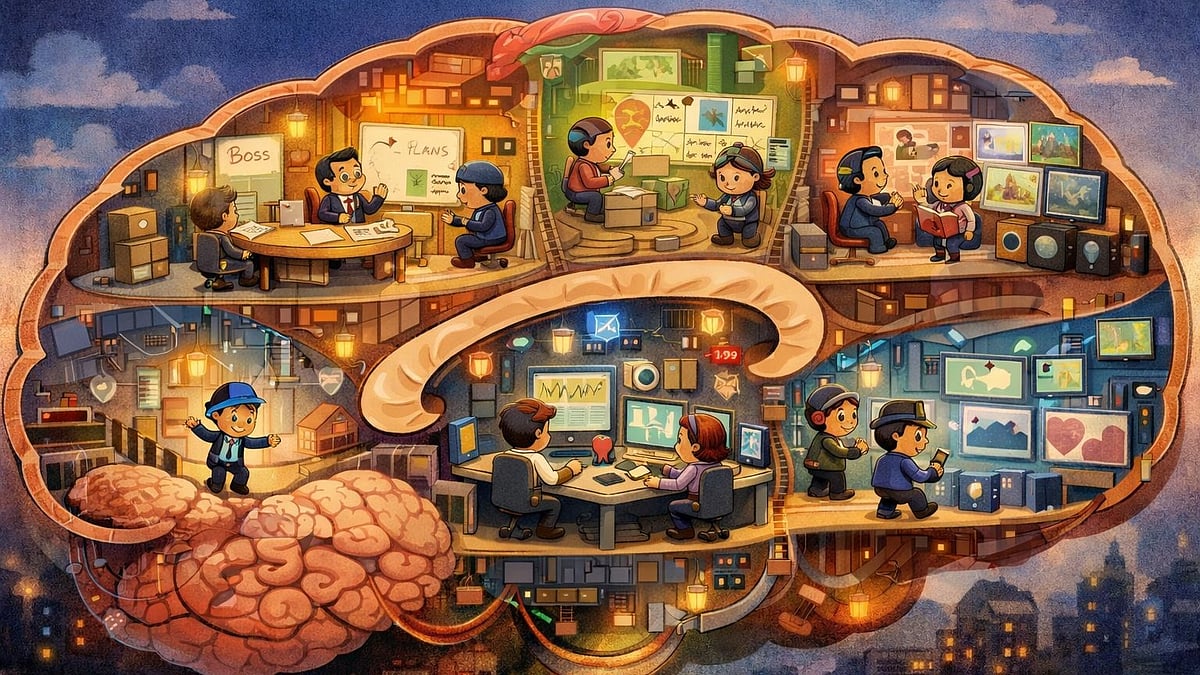
Think of it less like a single organ and more like a highly efficient command centre, where different departments handle specific tasks, some making decisions, others storing memories, while a few silently ensure the body keeps running smoothly.
“The brain functions as the body's main control centre, operating with remarkable power despite its small size. Weighing about 1.4 kg, this organ regulates everything from breathing and blinking to emotions, memory, and decision-making. The brain consists of different regions, each performing unique roles to keep the body functioning efficiently,” explains Dr Sujit Paul, Group CEO Zota Healthcare Ltd. and health expert.
To understand how this remarkable organ works, it helps to imagine the brain as a well-run organisation, complete with decision-makers, interpreters, archivists and quiet managers ensuring everything runs exactly as it should.
Brain’s Headquarters
The cerebrum is the largest and most visible part of the brain. If the brain were a company, this would be the main office where all the major decisions happen.
“The cerebrum is the largest part of the brain and acts as the central hub for thinking and cognition. It enables you to learn new things, store memories, make decisions, and control voluntary movements,” says Dr Paul.
This region handles many of the activities we associate with being human — learning new skills, remembering important moments, solving problems and even daydreaming.
According to neuroscience research, the cerebrum is divided into two hemispheres, which communicate through a bundle of nerve fibres called the corpus callosum, allowing the brain to coordinate information and body movements seamlessly.
Within this region are four specialised sections known as lobes, each handling different tasks.
Inner CEO
At the front of the brain sits the frontal lobe, often described as the brain’s decision-making executive. This is the part that helps you plan, organise and control impulses.
“It helps you plan your day, control impulses, focus on work, and make choices. It’s also responsible for personality, so yes, it plays a role in what makes you you,” explains Dr Bhaskar Shukla, Consultant Neurologist at PSRI Hospital, Delhi.
Whether you’re planning a presentation, resisting the urge to check your phone during work, or coming up with a creative solution to a problem, your frontal lobe is actively involved.
Medical research also shows that this region plays a critical role in reasoning, behaviour and voluntary movement, making it one of the brain’s most important control centres.
Sensation Interpreter
Ever wondered how your brain instantly knows whether something is hot, cold, soft or rough? That’s the parietal lobe doing its job.
“Ever wondered how your brain knows that tea is hot or ice cream is cold? This region processes touch, pressure, temperature, and spatial awareness,” says Dr Shukla.
The parietal lobe acts like the brain’s sensory translator. It receives signals from the body and helps interpret them, allowing you to understand physical sensations.
It also helps you navigate space, which is why you can walk through a crowded room, reach for a glass on the table, or climb stairs without constantly watching your feet.
Where Sounds Become Memories
Located near the ears, the temporal lobe is responsible for processing sound, language and memory.
“This area helps you understand language, recognise sounds, and store memories. When a song from childhood suddenly takes you down memory lane, your temporal lobe is to thank,” Dr Shukla explains.
Researchers note that this region contains the hippocampus, a structure essential for forming and storing memories. That’s why a familiar smell, a melody or even a voice can instantly transport you back to a moment from years ago.
Brain’s movie screen
At the very back of the brain lies the occipital lobe, the region responsible for processing everything we see.
“Located at the back of the brain, it processes everything you see — colours, shapes, faces, and movement,” Dr Shukla notes.
When your eyes capture visual information, the occipital lobe interprets it and helps the brain understand what it’s looking at, whether it’s recognising a friend’s face or spotting a car approaching on the road.
Without this region, the eyes could still detect light, but the brain wouldn’t be able to make sense of the images.
Balance ninja
Just beneath the cerebrum sits the cerebellum, a smaller but incredibly important region that controls coordination and balance.
“The cerebellum is responsible for coordination and balance. It helps you move smoothly during everyday activities such as walking, dancing, or typing on your phone,” says Dr Paul.
This is the part of the brain that allows you to ride a bicycle, maintain balance while climbing stairs, or dance without consciously thinking about every movement.
Quiet life manager
Finally, there is the brainstem, the brain’s silent multitasker. It connects the brain to the spinal cord and manages essential life functions that keep the body alive.
“This part quietly controls breathing, heartbeat, swallowing, and sleep — all critical functions we rarely think about but absolutely depend on,” explains Dr Shukla.
The brainstem works around the clock, ensuring that the body continues to function even when we are asleep or unaware.
In perfect sync
Neurologists often compare the brain to a finely tuned orchestra. Each region performs its own specialised role, but the real brilliance lies in how they work together.
“Together, these brain regions work like a well-coordinated orchestra, ensuring that thoughts, movements, and emotions flow smoothly throughout the day,” says Dr Paul.
From remembering a friend’s name to maintaining balance on uneven ground or reacting instantly to danger, the brain performs countless calculations every moment.
RECENT STORIES
-
-
-
-
-