Supreme Court Suggests Linking Unpaid Traffic Challans To Electricity Bills, Vehicle Service Restrictions To Recover Outstanding Fines
The Supreme Court has suggested linking unpaid traffic challans to electricity bills and restricting vehicle-related services to recover outstanding fines. Other measures discussed include blacklisting vehicles, withholding fitness and pollution certificates, blocking licence renewals, random checks and possible vehicle impounding.

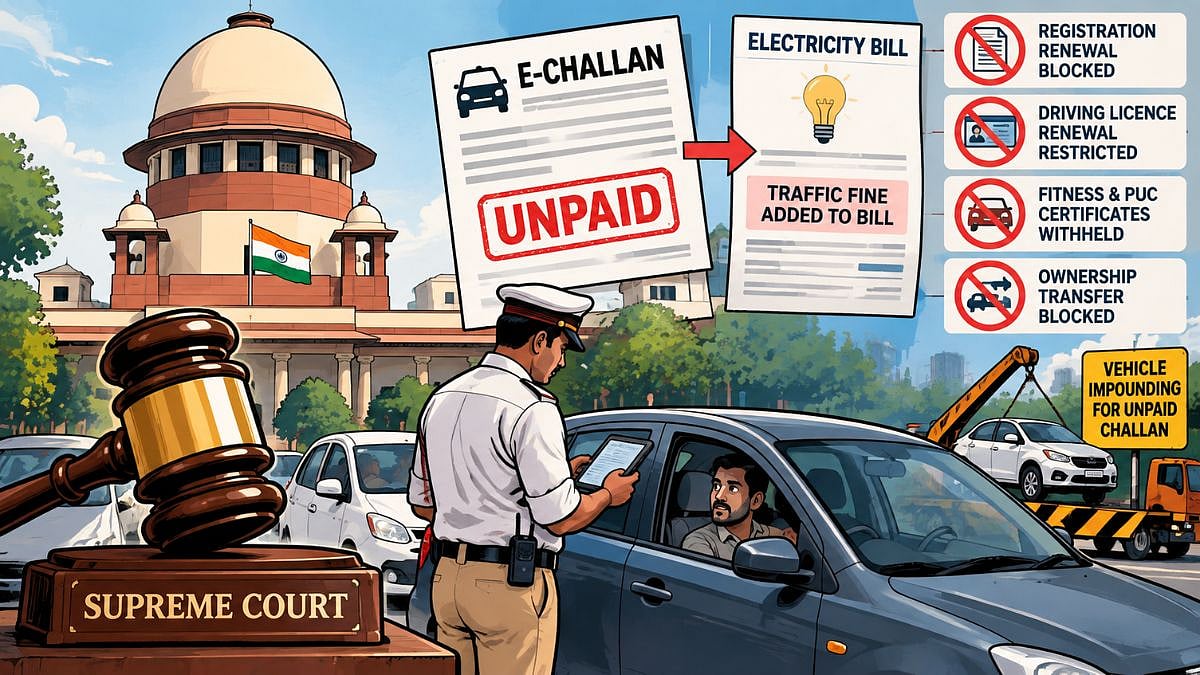
The Supreme Court has proposed stronger enforcement measures to recover outstanding traffic fines from vehicle owners | AI Generated Representational Image
New Delhi, September 28, 2026: The Supreme Court has suggested a range of measures to recover unpaid traffic challans, including linking outstanding fines to electricity bills, restricting vehicle-related services and conducting random checks of vehicles.
The suggestions came as the Court considered ways to ensure that e-challans do not remain unpaid. The Bench of Justice JB Pardiwala and Justice KV Viswanathan said authorities must focus not only on issuing challans but also on recovering the fines, Bar & Bench reports.
From Challans To Electricity Bills
The Court suggested that States and Union Territories could consider adding unpaid traffic fines to electricity dues. The idea, as discussed by the Court, is that defaulters would have an additional reason to clear their traffic fines.
‘If people are not paying traffic challans, add it to their electricity dues bill. They’ll have to pay electricity bills else power line will be disconnected. Work it out. In this country, you have to find a way out,’ the Court said.
Justice Pardiwala observed that simply issuing large numbers of e-challans would not solve the problem if the fines were not recovered.
‘It is not just sufficient to keep issuing e-challans. Police may issue thousands and lakhs of such e-challans. Question is recovery of fines as sought to be imposed by way of the e-challans,’ he said.
Vehicle Services May Face Restrictions
The Court was informed that States and Union Territories have to recover around Rs 45,000 crore towards e-challans, of which approximately Rs 25,000 crore has been recovered.
Against this backdrop, the Court discussed several measures that could be used to recover the remaining fines. These include preventing the renewal of registration certificates, issuing duplicate certificates and making changes to ownership details until outstanding challans are cleared.
The Court also suggested blacklisting vehicles with unpaid challans on the Parivahan portal and blocking ownership transfers. It discussed withholding fitness and Pollution Under Control certificates for such vehicles, as well as preventing the renewal of driving licences and taking steps to suspend licences already in force.
The suggestions point to a broader approach in which unpaid traffic fines could affect several vehicle-related services, rather than being treated only as outstanding penalties.
Justice Pardiwala stressed that the measures must work in practice and take into account the realities faced by authorities on the ground.
‘The authorities need to work at the ground level having regard to ground realities,’ he said.
Random Checks And Possible Vehicle Impounding
The Court also suggested random checks of vehicles to identify those against which e-challans remain unpaid.
‘Let there be random checking of vehicles and if found that e-challan has not been honoured necessary steps to be taken to impound the vehicle itself,’ the Court said.
The suggestions were made while hearing an application seeking directions for the implementation of electronic enforcement mechanisms under Section 136A of the Motor Vehicles Act, 1988, read with Rule 167A of the Central Motor Vehicles Rules, 1989.
The application forms part of a long-running public interest litigation petition on road safety filed in 2012 by Coimbatore-based orthopaedic surgeon S Rajaseekaran. The petition seeks coordinated measures to reduce road accidents and improve infrastructure and post-accident care.
Court Questions Implementation Of Its Directions
Over the years, the Supreme Court has issued several directions in the case concerning road safety and enforcement of the Motor Vehicles Act.
In August 2025, the Court said it would consider issuing directions for creating portals to facilitate payment of compensation to road accident victims.
In October 2025, the Court ordered all States and Union Territories to frame rules to ensure pedestrian safety and regulate the movement of non-motorised vehicles such as cycles and hand carts in public spaces.
More recently, in May 2026, the Court directed States and Union Territories to strictly implement Rule 125H of the Central Motor Vehicles Rules, 1989. The rule requires public service vehicles to be equipped with vehicle location tracking devices and emergency or panic buttons.
The Court also directed that no public service vehicle should be granted a fitness certificate or transport permit unless the required devices were installed. It further directed States to retrofit the devices in existing public service vehicles and integrate their installation and functionality with the Vahan database.
‘Directions Cannot Remain On Paper’
During the broader proceedings, the Court questioned whether its directions issued over nearly 14 years had translated into results on the ground.
‘We want to know from the learned amicus (Senior Advocate Gaurav Agarwal) as to what is the position at the ground level. We will keep issuing directions for an indefinite period of time, but if all these directions are going to remain on paper and are not going to be implemented by the authorities, then one fine day we may have to take some stern action which may not be liked by the authorities,’ the Court said.
The Court accordingly asked amicus curiae Senior Advocate Gaurav Agarwal to prepare a chart setting out the directions issued, the time given for implementation, their current status and the amicus’ remarks.
Also Watch:
ALSO READ
The proceedings underline the Court’s concern that enforcement measures must translate into action on the ground. In the case of unpaid traffic challans, the proposed measures would move enforcement beyond the issuance of fines towards restricting services and taking direct action against vehicles with outstanding penalties.
To get details on exclusive and budget-friendly property deals in Mumbai & surrounding regions, do visit: https://budgetproperties.in/
RECENT STORIES
-
-
-
-
-